THE SHORT ANSWER
FBA means Amazon stores, ships, and handles returns for your orders for a per-unit fee. FBM means you fulfill orders yourself. FBA usually wins on small, fast-selling items and gets the Prime badge automatically. FBM can win on heavy, slow-moving, or custom products, and can earn Prime through Seller Fulfilled Prime. Amazon lets you combine both.
Amazon's own FBA vs FBM guide notes that many sellers use both methods on a per-product basis. The costly part is never revisiting that split. In 2026, FBA fees depend on your price band as well as size and weight, a 3.5% surcharge sits on top, and holiday peak rates apply right now. FBM gets a new returns rule of its own on December 18.
This guide runs real 2026 costs on two products, including peak season, explains what each method does to Prime and the Buy Box, and shows when FBM wins and how a hybrid setup works. It's written for brands deciding SKU by SKU, not for first-time sellers.
What is Amazon FBM?
Amazon FBM, Fulfilled by Merchant, means selling on Amazon without FBA: you list products in the Amazon store but store, pack, and ship orders yourself or through your own 3PL. You pay Amazon's referral fee on each sale but no FBA fulfillment or storage fees. In exchange, you own delivery speed, tracking, customer service, and returns, and those metrics count toward your account health.
Amazon offers tools to keep FBM costs down. It says pre-negotiated rates through Amazon Buy Shipping average over 31% below retail ground rates for UPS, FedEx, and USPS ( Amazon). FBM offers don't show the Prime badge unless you qualify for Seller Fulfilled Prime: you prequalify on package volume, late shipment rate, valid tracking rate, and cancellation rate, then pass a 30-day trial.
What does FBA cost in 2026?
FBA in 2026 is a stack of fees: a referral fee by category, a fulfillment fee set by size tier, shipping weight, and price band, a 3.5% fuel and logistics surcharge on that fulfillment fee, and monthly storage. Holiday peak rates apply from October 15, 2026 to January 14, 2027.
| Fee | 2026 rate (US) |
|---|---|
| Referral fee | By category: 15% in Home and Kitchen; 8% or 15% in Beauty, Health, and Personal Care depending on price ( Amazon) |
| Fulfillment fee, non-peak | Large standard, 12 to 16 oz: $3.78 under $10, $4.60 from $10 to $50. Large standard, 2.75 to 3 lb: $6.93 over $50 |
| Fulfillment fee, holiday peak | Higher; for example, $5.04 rises to $5.34 for a 1 to 1.25 lb item in the $10 to $50 band |
| Fuel and logistics surcharge | 3.5% of the fulfillment fee |
| Monthly storage, standard size | $0.78 per cubic foot (January to September), $2.40 (October to December) |
| Storage utilization surcharge | $0.44 to $1.88 per cubic foot when you hold more than 22 weeks of supply |
| Aged inventory surcharge | Starts at 181 days in a fulfillment center |
| Low-inventory-level fee | Per unit when days of supply fall below 28; for large standard up to 3 lb, $0.36 to $0.97 |
| Inbound placement fee | $0 with Amazon-optimized splits; $0.24 to $0.50 per unit for large standard 12 oz to 1.5 lb with minimal splits |
| Prep and labeling | Your cost: Amazon ended its prep and labeling services for US FBA shipments on January 1, 2026 |
Rates from our Amazon seller fees guide; confirm current figures in Seller Central.
The price band matters. The same 14 oz item costs $3.78 to fulfill at $9.99 and $4.60 at $10.99. Our Amazon seller fees guide covers every fee in detail.
FBA vs FBM costs: worked examples
Neither method is cheaper across the board. FBA usually wins on small items that sell quickly, even in peak season. FBM can win on heavier items that sit in storage for months, especially with discounted shipping rates. The examples below include the costs that usually get left out on both sides: prep and inbound freight for FBA, and storage for FBM.
Example 1: a 14 oz serum priced at $24.99, selling daily
| Cost per unit | FBA non-peak | FBA peak | FBM |
|---|---|---|---|
| Referral fee (15%) | $3.75 | $3.75 | $3.75 |
| Fulfillment or shipping label | $4.60 | $4.89 | $5.25 label |
| 3.5% surcharge | $0.16 | $0.17 | None |
| Storage (0.05 cu ft, one month) | $0.04 | $0.12 | $0.02 |
| Prep and labeling | $0.30 | $0.30 | None |
| Inbound freight to Amazon | $0.25 | $0.25 | None |
| Packaging and labor | Included in fulfillment | Included in fulfillment | $1.40 |
| Total per unit | $9.10 | $9.48 | $10.42 |
Illustrative example. FBA fulfillment and storage are 2026 rate card figures; the $4.89 peak rate comes from third-party tables. Prep, inbound freight, and all FBM costs are illustrative. Amazon-optimized inbound split assumed ($0 placement).
FBA wins Example 1 by $1.32 a unit at non-peak rates and still wins by $0.94 during peak season.
Example 2: a 2.9 lb kitchen tool priced at $59.99, selling slowly
This SKU carries more than 22 weeks of supply, and each unit sits about five months before it sells, just under the 181-day aged inventory line.
| Cost per unit | FBA | FBM |
|---|---|---|
| Referral fee (15%) | $9.00 | $9.00 |
| Fulfillment or shipping label | $6.93 | $7.00 discounted label |
| 3.5% surcharge | $0.24 | None |
| Storage (0.6 cu ft, five months) | $2.34 at $0.78 | $1.35 at $0.45 in your warehouse |
| Storage utilization surcharge (over 22 weeks of supply) | $1.32 at $0.44 | None |
| Prep and labeling | $0.30 | None |
| Inbound freight to Amazon | $0.80 | None |
| Packaging and labor | Included in fulfillment | $2.05 |
| Total per unit | $20.93 | $19.40 |
Illustrative example. FBA fees use 2026 non-peak rates and the low end of the utilization surcharge; FBM costs are illustrative.
FBM wins Example 2 by $1.53. The gap widens if units cross 181 days or sit through peak storage months, and it narrows if your own storage costs more than about $0.96 per cubic foot a month. Run your own SKUs through Amazon's Revenue Calculator before moving anything.
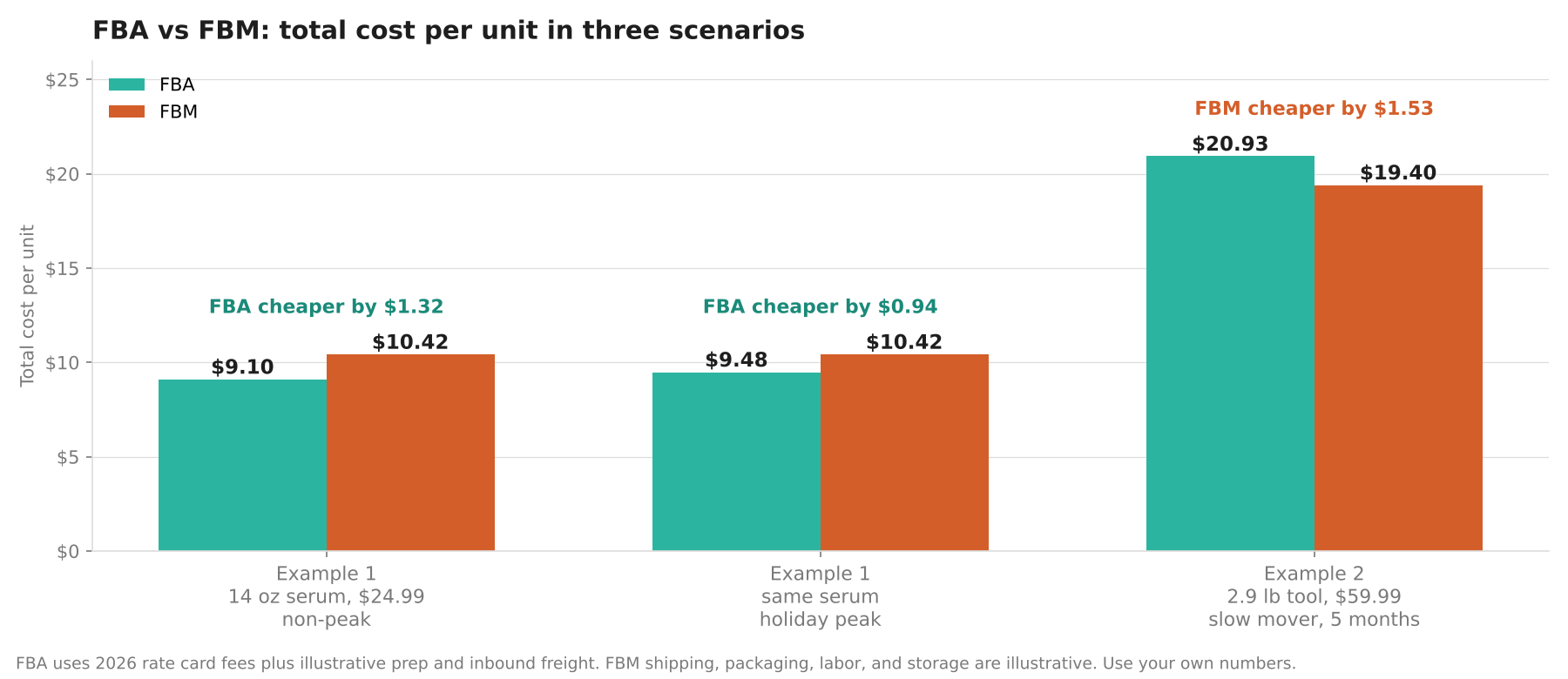 Figure 1: FBA wins on the fast-selling serum, even at peak; FBM wins on the slow-moving tool.
Does FBM hurt your Buy Box chances?
Not by itself, though Amazon's messaging points both ways. Amazon's Featured Offer guide says fulfilling orders yourself can be just as effective as FBA, while its FBA vs FBM guide calls FBA one way to improve your chances. What both reward is fast, reliable delivery, so FBM loses the Buy Box when its delivery is slower or less certain than a competing offer.
Prime is where FBA has a practical edge. FBA offers carry the Prime badge automatically, and Amazon's Seller Fulfilled Prime page says the badge helps increase your likelihood of becoming the Featured Offer. Yet Amazon's July 2026 notice, as reported by ChannelX, says Prime and non-Prime offers are equally likely to be featured when everything else is equal. The badge matters mostly because of the delivery promise behind it ( Featured Offer guide).
When FBM wins
FBM tends to win when FBA fees or rules work against the product. These are the common cases.
- Slow movers. Storage builds every month, the utilization surcharge applies above 22 weeks of supply, and the aged inventory surcharge starts at 181 days.
- Heavy or oversized items. If your carrier or Buy Shipping rates beat FBA's weight-based fees, FBM can come out ahead, as in Example 2.
- Custom or made-to-order products. These need handling FBA can't offer.
- Inventory you already ship from one warehouse. If you serve your website and wholesale from your own stock, FBM can reuse that setup. Amazon's Multi-Channel Fulfillment lets FBA stock serve other channels too, so compare both.
- Peak season pressure. Storage at $2.40 per cubic foot and higher peak fulfillment fees can tip marginal SKUs to FBM from October to January.
FBM has its own 2026 change coming. From December 18, 2026, most US returns on seller-fulfilled orders need a prepaid return label, with heavy and bulky items exempt. You have seven calendar days to issue a label through Manage Seller-Fulfilled Returns or refund without asking for the item back, and Amazon assigns the label cost by return reason, so it isn't always yours ( CMO seller news).
Seller Fulfilled Prime adds Prime without FBA fees, but not without cost. Enrolled sellers commit to fast, free delivery and free returns for domestic Prime customers, and Amazon reviews performance weekly and can disable Prime offers if requirements slip ( Amazon).
Can you use FBA and FBM together?
Yes. Amazon says you can use either method or combine both to meet your business needs. A hybrid setup lets each product use the method that fits its cost and speed profile.
| Product type | Best fit | Why |
|---|---|---|
| Small, fast-selling items | FBA | Lower total cost and the Prime badge |
| Heavy or slow-moving items | FBM | Avoids months of storage and utilization charges |
| Top sellers with stockout risk | FBA, with an FBM backup offer | Keeps the listing buyable if FBA stock runs out |
| Custom or made-to-order items | FBM | Needs your own handling |
| Items where Prime matters but FBA is costly | FBM with Seller Fulfilled Prime | Prime badge, with SFP's delivery and returns commitments |
The backup offer matters most during peak season and inbound delays. When FBA stock runs out, the FBA offer can't win the Featured Offer and Sponsored Products can't serve it, and Amazon doesn't say how the gap affects ranking. An FBM backup keeps the listing buyable and its sales history unbroken. Keep FBA stock lean with care, though: the low-inventory-level fee applies below 28 days of supply. Our inventory forecasting guide covers the planning side.
Across 16 years and more than 100 brands, the costly mistake isn't choosing FBA or FBM. It's choosing once for the whole catalog and never checking again. Fees change every year, and a SKU that belonged in FBA in March can lose money there by November. Review fulfillment method per SKU at least twice a year, and again before peak season.
Is your fulfillment setup costing you margin?
If you haven't checked FBA vs FBM SKU by SKU since the 2026 fee changes, start with an audit. CMO's Amazon account management covers fulfillment strategy, inventory, and account health.
Amazon FBA vs FBM: Questions Sellers Ask
Q Is FBA or FBM more profitable?
It depends on the product. FBA is usually cheaper for small, light items that sell quickly, even in peak season. FBM can be more profitable for heavy, slow-moving, or custom products. Compare total cost per unit, including prep, inbound freight, and storage on both sides.
Q What is Amazon FBM?
FBM, Fulfilled by Merchant, means selling on Amazon without FBA: you store and ship orders yourself. You pay referral fees but no FBA fulfillment or storage fees, and you own delivery speed, tracking, customer service, and returns.
Q Can you use FBA and FBM together?
Yes. Amazon says you can combine both methods. Many brands use FBA for fast sellers, FBM for heavy or slow items, and an FBM backup offer on top sellers to stay buyable if FBA inventory runs out.
Q Does FBM hurt Buy Box chances?
Not by itself. Amazon says merchant fulfillment can be just as effective as FBA, though it also calls FBA one way to improve your odds. Delivery speed and reliability decide it. Seller Fulfilled Prime adds the Prime badge to FBM offers.