
Amazon Creative That Sells
Before Your Customers
Read a Word
Your product deserves more than basic visuals, and without compelling creative, shoppers may overlook its value, miss key benefits, and choose competing brands. We combine strategic design with engaging A+ Content to tell your product story, highlight key features, build buyer confidence, and create a premium shopping experience that turns attention into conversions.
What we run
One shopper, three moments, one argument
A shopper moving from an ad to a store page to a listing should meet the same brand and the same sales argument at every step, and when those elements are designed separately, the coherence that builds purchase confidence disappears. The image stack earns the click and sets scale and context, A+ content continues the argument the bullets started and answers the objections that lose the sale, and the Brand Store captures the shopper who wants to see the rest of the range. We build all three from the same brief.
Creative Services
Premium product photography, lifestyle imagery, infographics, and video built for ecommerce conversion rather than the brand book.
- Main image and full secondary stack
- Lifestyle photography and infographics
- Product and Sponsored Brands video
- Mobile and thumbnail review
A+ Content
Enhanced brand content built around buyer psychology rather than brand aesthetics, with every module structured to answer a question that loses sales.
- Objection research from reviews and Q&A
- Module strategy and sequencing
- Conversion copywriting and design
- Premium A+ where it earns its place
Storefront Design
Custom, mobile-optimized Amazon Brand Stores with strategy, copy, and design built for your catalog and indexed by Google for external traffic.
- Catalog architecture and navigation
- Page strategy and content hierarchy
- Sponsored Brands landing pages
- Post-launch optimization rounds
Work produced for leading consumer brands, including:






The problem
Traffic without conversion is money out the door
Most brands underestimate how much of the sale their creative is responsible for, and how much a weak version quietly costs them every day.
Built for the brand book, not the buyer
Retail and DTC photography often fails on Amazon. Dark backgrounds vanish at thumbnail size, and generic lifestyle shots give shoppers nothing to hold onto. Brand aesthetics and thumbnail legibility are different problems.
A+ content that repeats the bullets
Nobody unconvinced by your bullets gets convinced by the same information in a nicer layout. The questions costing you sales are already in your reviews and competitors' Q&A.
A store that was never built to convert
Most Amazon storefronts are brand showcases, not shopping experiences. Polished pages, flat conversion. A shopper who lands there already wants your brand, so the store's only job is helping them buy.
The 2026 layer
Your A+ content has a second reader now
Amazon Rufus reads A+ content alongside your title, bullets, and Q&A when answering conversational shopper questions, and generic lifestyle copy gives it nothing to work with, so it recommends the competitor whose content actually answered something. We write A+ copy that works for buyers and for the AI, built into the copy strategy from the first brief rather than bolted on later.
Illustrative example of how structured A+ copy surfaces in AI recommendations.
The detail
What each service covers
Open only what you need. Every engagement starts with buyer research rather than a mood board.
Amazon Creative Services
Photography, lifestyle, infographics, and video
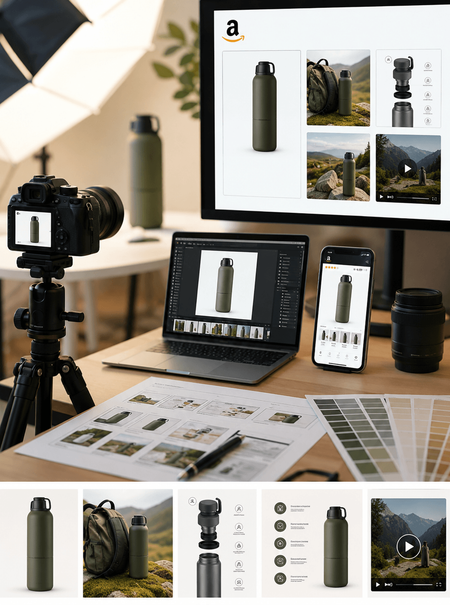
Amazon is a visual platform where the zoom function gets used and the image stack gets reviewed in order. The main image is the first gate between a click and a scroll-past, so we produce creative for that environment specifically, with click-through as the brief rather than the brand style guide.
Every asset is also checked where it will actually be seen. An infographic that reads beautifully at full resolution on a desktop monitor is useless if the text is illegible on the phone where most of your traffic arrives.
- Main image production to Amazon technical specifications
- Full secondary stack planning and production
- Lifestyle photography briefed against a defined buyer profile
- Infographics readable at thumbnail size on mobile
- Product video for the carousel and Sponsored Brands
- Mobile display review and Amazon compliance check
Amazon A+ Content
Modules built around the objections that lose the sale
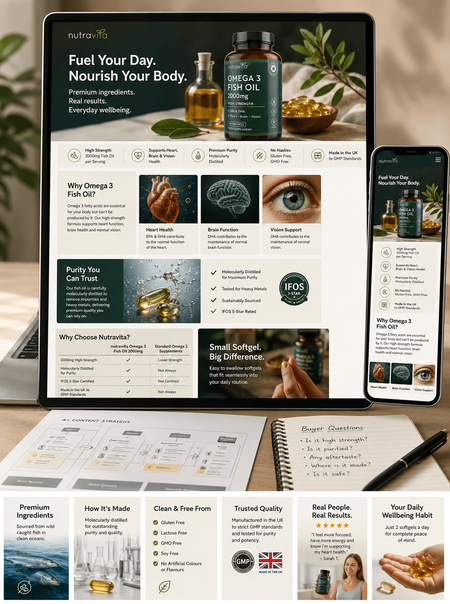
A+ Content replaces the standard product description with a rich, image-led layout available to brand-registered sellers. It has been shown to improve conversion rates by 3 to 10 percent on average, and Premium A+ implemented properly can go further. Those numbers only materialize when the modules are doing real work.
We start with category and competitor research, then mine reviews and Q&A for the questions buyers keep raising before purchase. Module sequencing follows buyer intent rather than a template, because a supplement brand and a beauty brand are not answering the same questions in the same order.
- Category and competitor A+ research before anything is designed
- Buyer question and objection analysis from reviews and Q&A
- Module strategy and sequencing by buyer intent
- Conversion-focused copywriting for every module
- Comparison charts and brand story modules
- Premium A+ assessment, recommended only where it adds conversion value
- Rufus readiness check on all copy, included as standard
Amazon Storefront Design
The one place on Amazon with no competitor ads
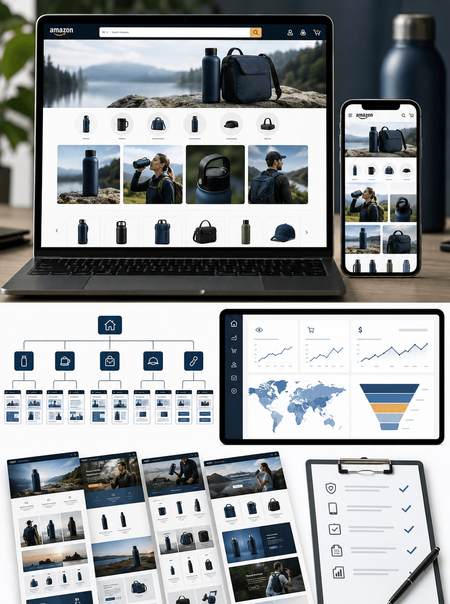
An Amazon Brand Store is the only place on Amazon where your brand has complete control over the experience. No competitor ads, no distraction, just your products and a shopper who chose to come to you specifically. Most brands treat the store as a design exercise. We build it as a conversion asset.
Structure comes before design. We map your catalog to the way buyers think about it rather than the way your internal team organizes it, aiming for a structure where any shopper reaches the right product within two clicks of the homepage. Campaign-specific landing pages are standard, because a Sponsored Brands click that lands on a generic homepage is a cost rather than an opportunity.
- Catalog architecture and navigation planning
- Page structure, content hierarchy, and homepage design
- Sub-pages for categories and featured collections
- Sponsored Brands landing page setup, tested and measured separately
- Conversion-focused copywriting across all pages
- Mobile experience review, where most store traffic arrives
- Amazon style guide compliance and submission management
- Store performance metric review and post-launch optimization rounds
Real accounts
What rebuilt creative has produced
Two engagements, with the numbers as they were reported.
A consumer health brand with strong PPC traffic
The main ASIN pulled strong PPC traffic but converted at 9.8%, well below the 18.5% category average, and had not been updated in 18 months.
The audit found three issues: a title missing the primary conversion keyword, feature-led bullets with no benefit framing, and no A+ content at all. CMO rewrote the full listing stack, built A+ content with a comparison module, and restructured the Q&A to answer the three most common pre-purchase questions.
A home and lifestyle brand, 35 ASINs across four categories
Live for two years with a homepage and four category pages, built at launch by the packaging agency and never touched since. Store-attributed sales were 3.1% of total Amazon revenue, and every Sponsored Brands campaign pushed traffic to the homepage regardless of what the ad featured.
Rebuilt the store from the navigation up. Four category pages became seven, organized around how buyers described their needs in reviews and Q&A. Built campaign-specific landing pages for the three active Sponsored Brands campaigns, and put the three highest-converting ASINs above the fold on the homepage.
Named client results
Conversion gains driven by A+ content
Every ad click lands on a listing. These are brands where rebuilding the content changed the return on everything upstream of it.
How we work
Research first, design last
Brands that have had creative built before and seen no result almost always had the process run in reverse, with design decided first and copy fitted to the visuals afterward.
Top reviews, Q&A, and competitor negative reviews mined for the objections that actually lose sales.
Sequence chosen by buyer intent rather than template, because categories do not answer the same questions in the same order.
Photography brief, A+ brief, and store brief developed together so all three carry the same argument.
Reviewed at thumbnail and phone size, which is where most Amazon browsing and most store traffic actually happens.
Structured, factual copy Amazon's AI can draw on with confidence, included in every A+ engagement as standard.
Store metrics and listing conversion tracked against the launch benchmark, with optimization rounds where pages underperform.
Why brands choose CMO
Category context changes what converts
Having worked across 100+ brands from health and beauty to home goods and supplements, our writers know what converts in a specific category rather than what follows generic best practice, because category context changes how buyers read copy, which trust signals matter, and which objections must be handled before the sale.
Most copywriters optimize for search and most designers optimize for conversion. We do both at once, because a listing that ranks without converting is just as broken as one that converts for the rare visitor who finds it.
"In three months they have professionally designed my product listing images and storefront, and I have already started generating revenue. The staff at CMO is friendly, efficient, and professional."
Rochelle Weitzner The Pause GroupWorks with
Creative decides what your traffic is worth
Creative and A+ content is one of four service categories here. Clicks that land on a high-converting listing cost exactly the same as clicks that land on a weak one, and the difference shows up in your return.
Who builds this
Strategy before design, every time
CMO is a real agency with 60 full-time in-house teammates and no subcontracting. Every creative engagement starts with a buyer psychology brief rather than a brand guidelines document, and the brand aesthetic fits inside that framework rather than the other way around.
CMO is an Amazon Service Provider Network certified agency, a verified status rather than a self-reported claim, which means accountability to Amazon's own standards.
Chief Marketplace Officer is not affiliated with or endorsed by Amazon.

William Fikhman
FAQ
Amazon creative, A+ content, and storefront questions
A+ Content replaces the standard product description with a rich, image-led layout available to brand-registered sellers. It enables custom visuals, comparison charts, and brand storytelling, and has been shown to improve conversion rates by 3 to 10 percent on average. It is also read by Amazon Rufus when surfacing product recommendations, which makes it a conversion and visibility asset at the same time.
Yes. A+ Content is only available to sellers enrolled in Amazon Brand Registry, and Amazon Brand Stores require enrollment as well. CMO can advise on Brand Registry enrollment if that step is still needed.
Amazon photography is optimized for thumbnail click-through in search results, zoom on the detail page, and the image stack sequence that builds the purchase argument. Standard product photography is typically optimized for brand aesthetics or retail display. The two sets of priorities are not always aligned, so CMO produces photography with Amazon's performance requirements as the brief rather than as an afterthought.
A+ Content is not directly indexed by Amazon for keyword search. However, it improves conversion rate, and Amazon's algorithm rewards better-converting listings with higher organic ranking over time. It also gives Amazon Rufus more information to draw on when recommending products.
Yes. CMO audits existing photography against current image stack performance and identifies which images are underperforming and why. In many cases a partial rebuild, replacing the main image and one or two secondary images, produces meaningful improvement at lower cost than a full reshoot. The audit determines what actually needs to change.
An Amazon Brand Store is a multi-page branded destination within Amazon.com available to brand-registered sellers. It gives brands a dedicated space with no competitor advertising, where they can present their full product catalog, tell their brand story, and create a curated shopping experience. Stores can be linked from Sponsored Brands campaigns and appear in Amazon search results for branded queries.
Sponsored Brands campaigns can send traffic directly to a store page rather than a product listing. When the landing page matches the intent of the ad, conversion rates improve measurably. CMO builds campaign-specific store pages as a standard part of every storefront engagement, which directly improves the return on Sponsored Brands investment.
A complete store build from strategy through to Amazon approval typically takes 3 to 5 weeks, depending on catalog size and the number of pages required. Amazon's own approval process adds 1 to 3 business days. CMO manages the submission and approval process as part of the engagement.
Yes. CMO audits existing stores against current performance data, catalog changes, and the advertising campaigns sending traffic to them before recommending structural changes. In most cases a full rebuild produces better results than adding pages to an existing structure that was not designed for conversion from the start. The audit determines which approach makes sense.
Amazon provides store analytics covering page views, sales, revenue per visitor, and traffic sources broken down by page. CMO reviews these metrics regularly and uses them to identify which pages are underperforming and what changes are likely to improve them. Store performance is tracked against the benchmark established at launch rather than against generic averages.
Yes. Rufus reads A+ Content alongside titles, bullets, and Q&A to match conversational shopper queries. Content that answers specific buyer questions rather than describing the product in general terms is more likely to be surfaced in Rufus recommendations, which makes this an increasingly important and often underused part of Amazon SEO.
Yes. If existing A+ content is underperforming, CMO audits it against your category's top converters and rebuilds what is not working. You do not need to start from scratch, and most brands with existing A+ find that targeted module rebuilds produce faster results than a full replacement.
