
Amazon's pay-per-click formats — Sponsored Products, Sponsored Brands, Sponsored Display — compete for the buyer who is already searching. Amazon DSP reaches the buyer before they search: on Amazon properties, on third-party sites, on streaming video, and across Amazon's owned ecosystem using the most precise first-party purchase intent data in digital advertising. CMO manages Amazon DSP as a strategic growth layer for brands at the scale and margin level where programmatic makes a measurable difference.
Why Amazon DSP Is Different From Every Other Programmatic Platform
Amazon DSP is not Google Display or Meta Ads with an Amazon logo on it. The targeting capability, the attribution model, and the audience data are different in ways that matter significantly for consumer brands.
Amazon's First-Party Purchase Data
Amazon DSP uses Amazon's own first-party purchase, browse, and search behavior data to build and target audiences. No other programmatic platform has access to this data. A brand running DSP on Amazon can target shoppers who have searched for a specific category keyword in the last 30 days, who have purchased from a competitor ASIN in the last 60 days, or who have viewed a specific product page and not converted. This level of purchase-intent precision is not available on any other platform.
Reach Across the Full Amazon Ecosystem
DSP placements appear on Amazon.com, IMDb, Freevee, Twitch, Fire TV, the Amazon Publisher Network, and a large inventory of third-party publisher sites. A brand running DSP is not limited to the Amazon search results page. It can reach its buyer at the top of a news article, during a streaming show, on a connected TV screen, and at the moment they return to Amazon to browse — all using the same audience segments and attribution.
Retargeting That Actually Works
Sponsored Display offers basic retargeting. DSP offers sophisticated audience retargeting with frequency capping, sequential messaging, and cross-device reach. A shopper who viewed your product detail page, added to cart and did not purchase, or purchased once 90 days ago can each be reached with a different message at a different bid level. That precision is what separates DSP retargeting from the blunt instrument of standard display.
How CMO Manages Amazon DSP
DSP management at CMO is a strategic engagement. The audience strategy, creative brief, and measurement framework are defined before a single campaign goes live — because DSP spend without a clear thesis for why it will work is expensive and difficult to evaluate.
Audience Strategy and Segmentation
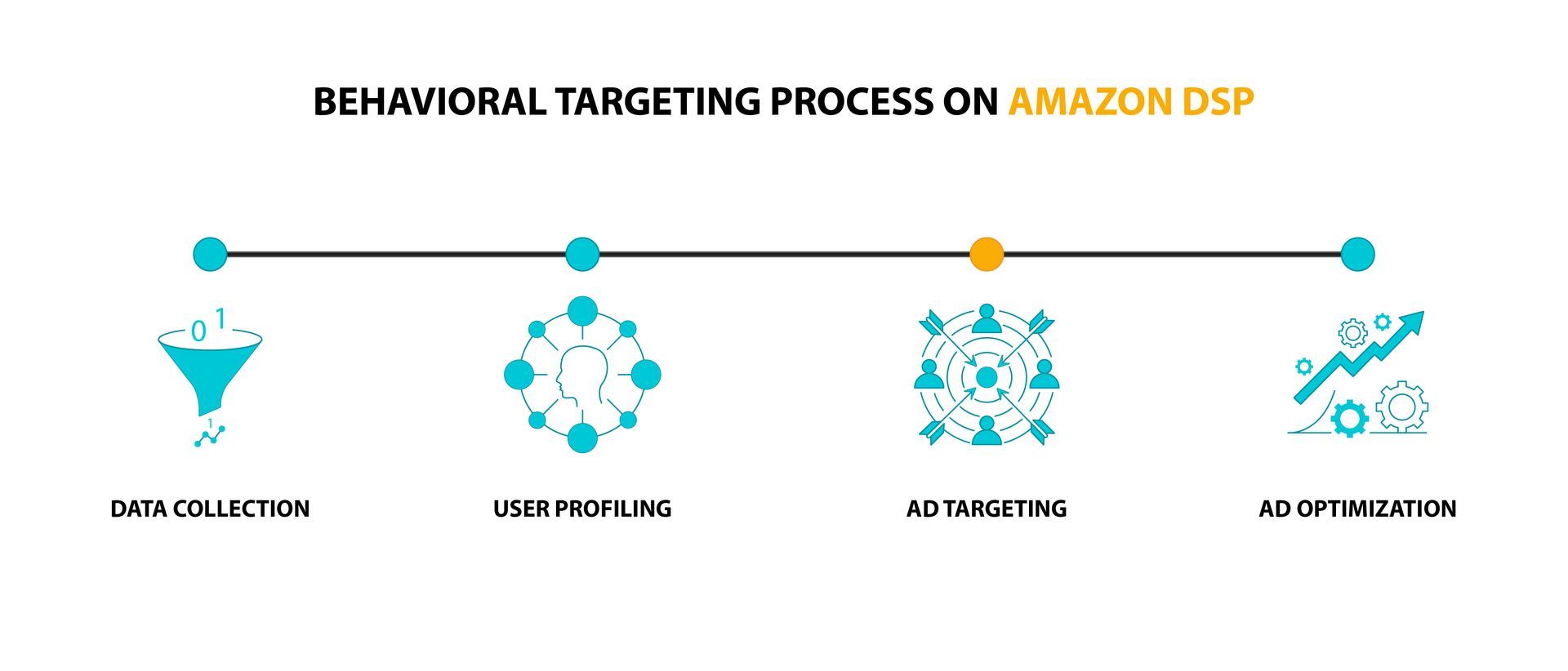
CMO builds DSP audience segments based on your specific brand objectives. Retargeting audiences — product viewers, cart abandoners, past purchasers — are structured by recency and intent level and bid against separately. Conquest audiences targeting competitor purchasers and category browsers are built against the competitive landscape CMO identifies through category analysis. Prospecting audiences for upper-funnel awareness are defined against Amazon's lifestyle and in-market segments that match your buyer profile.
Creative Strategy and Execution
DSP display ads require creative that works at multiple sizes across multiple placements. CMO writes and designs DSP ad units with the specific audience segment and funnel stage in mind. Retargeting creative for a cart abandoner communicates differently than prospecting creative reaching a category browser for the first time. Ad creative is refreshed on a defined cycle to manage frequency fatigue. Video creative for OTT and streaming placements is produced where the product and budget support it.
Campaign Structure and Trafficking
CMO structures DSP campaigns by audience type, funnel stage, and creative variant so that performance can be read clearly and optimized accurately. Campaigns that combine audience types produce data that is difficult to act on. CMO's architecture keeps the segments clean and the attribution readable.
Measurement and Attribution
DSP performance is measured against TACoS — total ad spend as a percentage of total Amazon revenue including organic — not standalone ROAS from DSP clicks alone. DSP drives awareness and retargeting that contributes to organic and PPC conversion without always receiving last-click credit. CMO sets up the measurement framework at engagement start so performance is evaluated correctly, not against the wrong benchmark.
Coordination With PPC Strategy
CMO manages DSP in direct coordination with Amazon PPC management and Amazon SEO. Upper-funnel DSP awareness feeds mid-funnel Sponsored Brands consideration and lower-funnel Sponsored Products conversion. The three layers are managed as one strategy with shared audience data informing bid decisions across all formats.
DSP-Driven Results
We use Amazon DSP to reach shoppers at every stage of the funnel — from awareness to retargeting — using first-party Amazon data unavailable through Sponsored Ads alone. We deliver consistent, impressive, and measurable results through audience-led DSP campaigns that grow brand reach and improve total account efficiency.
What Amazon DSP Management Includes
Every CMO DSP engagement covers strategy, audience build, creative, trafficking, and ongoing optimization.
What CMO DSP Management Has Delivered
A personal care brand spending $45,000 per month on Amazon PPC
The Situation: This brand had a mature PPC operation with ACoS at 22% and strong Sponsored Products and Sponsored Brands performance. Organic traffic share was 34%. The brand's category had three well-funded competitors running aggressive Sponsored Products campaigns that were making it increasingly expensive to hold position on high-volume keywords. New-to-brand customer acquisition through PPC alone was declining as a percentage of total ad-attributed sales, suggesting the brand was recirculating existing customers rather than growing its buyer base.
What CMO Did: CMO introduced a DSP layer structured across three audience segments. A retargeting campaign targeted product page viewers who had not purchased within 14 days, with display creative addressing the two primary purchase objections identified from review analysis. A conquest campaign targeted purchasers of the brand's two closest competitors using Amazon's purchase-based audience data. A prospecting campaign reached shoppers identified as in-market for the category using Amazon lifestyle segments, with sequential messaging designed to introduce the brand over three ad exposures before a conversion ask. OTT pre-roll video was added to the prospecting segment for Fire TV and Freevee placements in the fourth week.
The Result: New-to-brand sales increased by 44% over the 90 days following DSP activation. TACoS for the combined PPC and DSP spend improved from 14% to 11% as the upper-funnel DSP activity lifted organic sessions by 18%. Retargeting campaigns produced a 3.8x return on ad spend against product page visitors who had not converted from PPC. Category share of voice on high-volume keywords held position despite increased competitor PPC spend, in part because the awareness layer was reducing price sensitivity among shoppers who had already been exposed to the brand through DSP.
Why Brands Choose CMO for Amazon DSP
DSP managed as strategy, not spend
CMO does not run DSP campaigns without a defined audience thesis, a creative brief aligned to funnel stage, and a measurement framework that evaluates performance correctly. DSP spend without those foundations produces results that are difficult to read and easy to misinterpret. CMO's approach ensures every dollar has a defined job and a clear way to measure whether it is doing that job.
Integrated with PPC and organic strategy
DSP in isolation is an awareness tool. DSP managed alongside Amazon advertising and Amazon SEO is a growth system. The audience data, the creative messaging, and the attribution are all built to work with the brand's full Amazon strategy rather than as a standalone channel with its own objectives that may or may not align with the rest of the operation.
Right-sized for your brand
CMO assesses DSP fit honestly during onboarding. Not every brand at every stage needs DSP. The minimum effective investment, the margin structure required to justify programmatic spend, and the competitive context all factor into whether CMO recommends DSP for a given brand. If the math does not work, CMO says so.
Frequently Asked Questions
DSP Is Where Brands Build the Audience That Makes Everything Else Work Better
Lower-funnel PPC converts the buyers already looking for you. DSP builds the awareness that makes more buyers start looking. CMO manages Amazon DSP as a strategic layer that compounds the return on everything else your Amazon operation is doing.
