
Amazon PPC Management That Maximizes Profit, Not Just Clicks
Every ad dollar should drive profitable growth. We build and optimize Amazon PPC across Sponsored Products, Sponsored Brands, Sponsored Display, and DSP, aligned with SEO, listing optimization, and conversion work, and measured on total business performance: TACoS, ACoS, profitability, and organic growth.
What we run
The full Amazon advertising stack, managed as one system
Most brands run Sponsored Products and call it a strategy, which covers the buyer already searching for you and does nothing for the one who has not heard of you yet. Each layer does a different job: DSP builds awareness that drives searches, Sponsored Brands and Display catch buyers mid-consideration, Sponsored Products closes them, and underneath it all SEO and listing optimization decide whether the traffic you paid for converts.
PPC Management
Campaign architecture, keyword strategy, daily bids, and negative keyword management.
Learn moreAdvertising Services
The full stack: Sponsored Products, Brands, Display, and DSP managed together.
Learn moreDSP Advertising
Programmatic display and video using Amazon's first-party purchase data.
Learn moreSEO Services
Keyword indexation, ranking signals, conversion rate, and Rufus readiness.
Learn moreListing Optimization
Title, bullets, A+ copy, backend terms, and images that convert the click.
Learn moreWork produced for leading consumer brands, including:






The problem
Why most Amazon PPC campaigns underperform
Bad results are rarely random. Across the hundreds of accounts we have audited, the same problems show up again and again, and they compound quietly until the numbers become impossible to ignore.
Wasted spend
Campaigns running broad match on irrelevant terms, budgets exhausted by mid-morning, and no negative keyword strategy. The spend is high but the return is unclear, and money leaves the account every day without a clear line back to revenue.
The ACoS trap
Chasing a low ACoS at the expense of growth, or accepting a high ACoS without understanding whether it is justified by category, margin, or launch stage. Most brands do not have the benchmarks to know which situation they are in, and both versions of this mistake cost real money.
Set-and-forget management
An agency or freelancer launched campaigns six months ago and has not touched the structure since. Amazon's algorithm changes constantly, so a campaign that performed well at setup is losing ground quietly. By the time the data shows the damage, months of spend are gone.
How we measure
ACoS tells you part of the story. TACoS tells you the rest.
We report both, because one of them can look healthy while the business underneath it is not growing.
ACoS
ACoS measures ad spend against ad-attributed revenue only. It tells you how efficiently a campaign converts the traffic it buys and nothing about what is happening organically. As a general guide, 15 to 30% is healthy for established products, though the right number depends on your margins, category, and growth stage.
TACoS
TACoS measures ad spend against total store revenue, organic included. This is the number that tells you whether advertising is building organic rank or just propping up sales that should be arriving on their own. A high ACoS can still be healthy when TACoS is strong and trending down.
The detail
What each service covers
Open only what you need. Every account is managed by Amazon veterans who have run PPC for brands doing $1M to $20M and above on the platform.
Amazon PPC Management
Campaign architecture, keywords, bids, and negatives
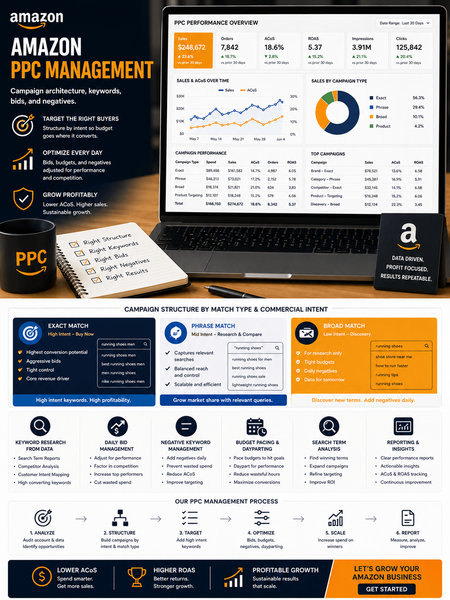
We build campaign structures that map to commercial intent, not just search volume. High-intent terms go into exact match campaigns where bids can be aggressive without waste. Mid-funnel terms go into phrase match where they capture the right queries while staying manageable. Broad match is restricted to research campaigns with tight budgets and daily negative keyword reviews.
- Campaign structure by match type and commercial intent
- Keyword research from search term reports and competitors
- Daily bid adjustments on performance and competitive pressure
- Negative keyword management across all campaign types
- Budget pacing and dayparting
- Search term analysis for expansion and refinement
Amazon Advertising Services
Sponsored Products, Brands, Display, and DSP together
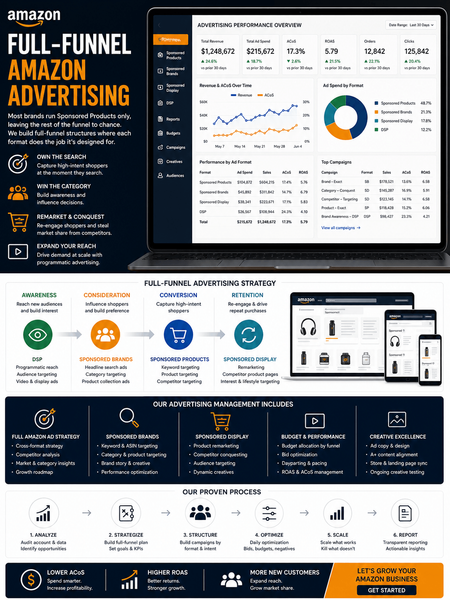
Most brands run Sponsored Products only, leaving the rest of the funnel to chance. We build full-funnel structures where each format does the job it is designed for: Sponsored Brands for category ownership and conquest, Sponsored Display for retargeting and competitor product pages, and DSP for programmatic reach.
- Full Amazon advertising strategy across all formats
- Sponsored Brands headline and category targeting
- Sponsored Display remarketing and conquest campaigns
- Cross-campaign budget allocation and performance analysis
- Creative coordination across ad formats
Amazon DSP Advertising
Programmatic reach using first-party purchase data
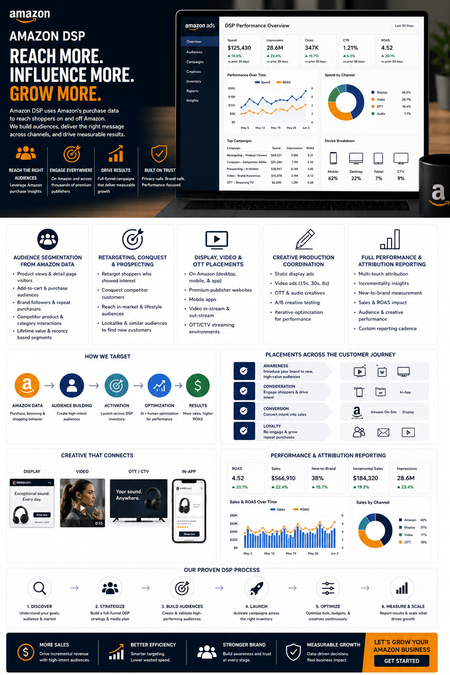
DSP uses Amazon's purchase data to reach shoppers on and off Amazon. We build audiences from your product views, purchases, and competitor interactions, then layer in contextual and behavioral targeting across display, video, and OTT.
- Audience segmentation from Amazon purchase data
- Retargeting, conquest, and prospecting campaigns
- Display, video, and OTT placements
- Creative production coordination
- Full performance and attribution reporting
Amazon SEO Services
Indexation, ranking signals, conversion, and Rufus
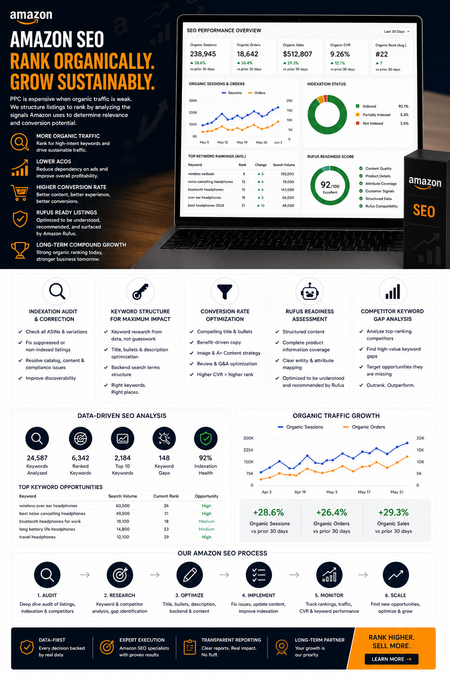
PPC is expensive when organic traffic is weak. We structure listings to rank by analyzing indexation status, keyword density, backend terms, and the signals Amazon uses to determine relevance and conversion potential. Rufus readiness is included as standard.
- Indexation audit and correction
- Keyword structure for title, bullets, backend
- Conversion rate optimization for organic rank
- Rufus readiness assessment
- Competitor keyword gap analysis
Amazon Listing Optimization
The page every ad click lands on
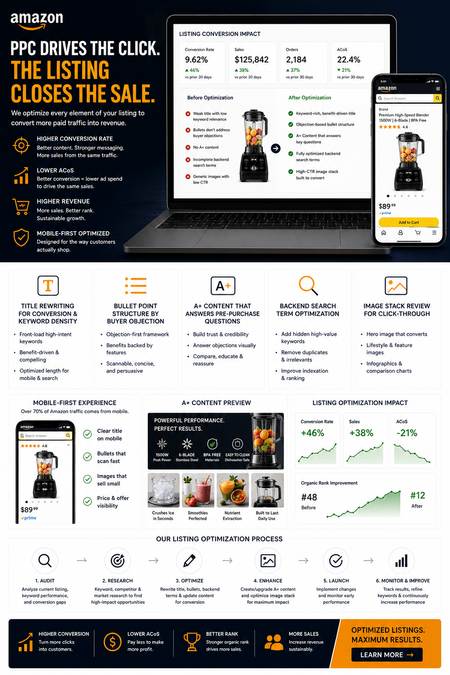
PPC drives the click. The listing closes the sale. We rewrite titles, bullets, A+ content, and backend terms to convert paid traffic at higher rates. Every listing is optimized for mobile and thumbnail display, where most of your traffic actually arrives.
- Title rewriting for conversion and keyword density
- Bullet point structure by buyer objection
- A+ content that answers pre-purchase questions
- Backend search term optimization
- Image stack review for click-through
Real accounts
What the work has produced
Four engagements across PPC, advertising, DSP, and SEO, with the numbers as they were reported.
Consumer beauty brand, $38,000 per month in ad spend
ACoS at 42%. Campaigns had run on broad match for over a year with no negative keyword management and no Sponsored Brands presence. The account structure had not been touched since setup.
Rebuilt campaign architecture across Sponsored Products and Sponsored Brands, added category and competitor targeting, and implemented a negative keyword strategy that cut irrelevant spend by 28% in the first 30 days while segmenting campaigns by match type and intent.
Supplement brand, 18 ASINs, $28,000 per month
Sponsored Products only, no Sponsored Brands or Display. ACoS at 44% and climbing for four months. Competitors were showing up in Sponsored Brands placements on this brand's own listing pages.
Restructured the full campaign architecture with tiered targeting across high, medium, and low commercial intent. Launched Sponsored Brands against category and competitor terms, activated Sponsored Display for retargeting and conquest, and removed 340 irrelevant search terms eating 19% of spend.
Personal care brand, $45,000 per month on PPC
A mature PPC operation with ACoS at 22% and organic traffic share of 34%. Three well-funded competitors were making it expensive to hold positions on high-volume keywords, and new-to-brand acquisition was falling as a share of ad-attributed sales.
Added a DSP layer across three audience segments: retargeting product page viewers who had not purchased within 14 days, conquesting purchasers of the two closest competitors, and prospecting in-market shoppers with sequential messaging. OTT pre-roll for Fire TV and Freevee went live in week four.
Home goods brand with 20 ASINs
The primary ASIN was ranked on page three for its main category keyword with no measurable organic traffic share and conversion at 6.8%. An indexation check found the listing was not indexed for 11 of its 18 target keywords, including its second-highest volume term.
Rebuilt the keyword structure starting with an indexation audit, cleared backend terms of title duplicates, restructured the title around the primary conversion keyword, rewrote bullets against the three most common pre-purchase questions, and rebuilt A+ content with Rufus readiness as a core requirement.
Listing and A+ results
Every ad click lands on a listing. These are the brands where rebuilding it changed the return on everything upstream.
Included as standard
What every advertising engagement covers
These are part of the managed service rather than individual campaign tasks billed separately.
Full advertising audit
Existing campaigns, spend allocation, keyword structure, and historical performance reviewed before anything changes.
Daily bid management
Adjusted on performance data, time of day, and competitive pressure, with human judgment on the calls automation gets wrong.
Negative keyword management
Ongoing identification and exclusion, which frequently recovers 10 to 20% of wasted spend in the first 30 days.
Search term report analysis
Keyword expansion drawn from what shoppers actually typed, including long-tail and question-based queries.
Budget pacing and dayparting
Spend allocated across campaign types and times of day so budgets are not exhausted before the buying hours.
Plain-English reporting
Weekly and monthly reports explaining what changed, why it changed, and what is being done about it. If a change did not work, the report says so.
Why brands choose CMO
Senior expertise, and a model that keeps us accountable
Your account is run by Amazon veterans who have managed PPC for brands doing $1M to $20M and above, not an account manager six months in following a template. And because ads perform better when the listing converts, we manage PPC alongside listing optimization, A+ content, and storefront rather than treating the top of the funnel as the whole job. Engagements run month to month, so if we are not moving your numbers you are not locked in.
"We began our collaboration with CMO nearly a year ago and it has been a game-changer for our business. Our store's traffic has significantly increased, and sales continue to grow steadily."
Elena Davidson Christina USAWorks with
Advertising performs better when the rest of the account is working
PPC and advertising is one of four service categories here. An advertising strategy running alongside a weak listing or a poorly structured account is working at a significant disadvantage.
Who runs this
Operators, not account coordinators
We have 60 full-time people in house and we do not subcontract, so the person who sells you the engagement is someone you will keep working with. Everyone leading an account here has already run Seller Central and Vendor Central through a suspension, a counterfeit problem, a category migration, and at least one Q4, which is where most of the useful judgment comes from.
Chief Marketplace Officer is not affiliated with or endorsed by Amazon.

William Fikhman
FAQ
Amazon PPC management and advertising questions
ACoS (Advertising Cost of Sale) measures ad spend against ad-attributed revenue only. TACoS (Total Advertising Cost of Sale) measures ad spend against total revenue including organic sales. TACoS tells you whether advertising is building organic rank or just subsidizing sales that should be arriving organically.
As a general guide, 15-30% is healthy for established products with good margins. However, the right ACoS depends on your margins, category, and growth stage. A product with 60% margins can tolerate a higher ACoS than one with 20% margins. We benchmark against your category and set targets based on your profitability goals.
Amazon PPC traditionally refers to Sponsored Products, Sponsored Brands, and Sponsored Display. Amazon advertising is the broader category that includes Amazon DSP, OTT, and programmatic display. We manage all of them together as one system.
Amazon DSP (Demand Side Platform) is programmatic advertising that uses Amazon's first-party purchase data to reach shoppers on and off Amazon. You typically need it when you are ready to scale new-to-brand acquisition, reach shoppers who have not yet searched for your product, or compete in categories where brand recognition matters.
DSP campaigns typically require a minimum of $10,000 to $15,000 per month to generate meaningful results, though smaller budgets can work for retargeting. We advise on budget allocation based on your goals and category.
Most accounts see ACoS improvements within 30-45 days from better bid management and negative keyword work. Structural changes like rebuilding campaign architectures and launching new formats typically show results at 60-90 days.
Yes, indirectly. Amazon's algorithm favors listings with higher conversion rates and sales velocity. Well-managed PPC that generates sales at a reasonable ACoS improves your organic rank over time. This is why we track TACoS and organic traffic share as key metrics.
For most brands, a budget equal to 10-15% of gross revenue is a reasonable starting point for PPC, with DSP requiring additional budget. The right number depends on category competitiveness, margins, and growth goals. We start with a free audit that recommends a budget based on your specific situation.
Indexation fixes can show results within 2-4 weeks. Significant ranking improvements typically take 45-90 days, as Amazon needs time to re-evaluate your listing's performance signals. The timeline also depends on category competitiveness and how much change is needed.
In-house management works when you have dedicated expertise and can avoid frequent turnover. We often see agencies and internal teams struggle with the depth of ongoing optimization required. CMO provides senior expertise without the overhead of building and maintaining an in-house PPC function.
We take over existing accounts regularly. We start with a full audit to understand the current structure, then rebuild campaigns gradually to avoid disruption. You do not need to start fresh unless the existing structure is fundamentally broken.
Yes. Rufus reads your listing copy, including A+ Content, to match conversational shopper queries. Structured copy that answers specific buyer questions is more likely to be surfaced in Rufus recommendations. We treat Rufus readiness as a standard component of every listing and SEO engagement.
Your advertising budget should be building something
Ad spend that is not connected to an organic strategy, a conversion-optimized listing, and a full-funnel structure is producing less than it should. Let us audit the account and show you where the waste is.
Book a free consultation