THE SHORT ANSWER
1P means selling wholesale to Amazon through Vendor Central, an invitation-only program where Amazon buys your stock and sets the retail price. 3P means selling directly to customers through Seller Central, where you set the price and carry the inventory and fees. Many established brands decide product by product, and keep a Seller Central account ready either way.
Selling on Amazon as a third party costs $39.99 a month on the Professional plan, plus selling fees ( Amazon). Selling to Amazon as a vendor has no plan fee, but its costs come out of your invoices instead: allowances, chargebacks, and the price Amazon decides to sell at. That trade, visible costs against hidden ones and control against convenience, is the real 1P vs 3P decision.
Much of what ranks for this question was written before Amazon's latest rounds of vendor cuts, when 1P still looked like the safe default. This guide is for brand owners deciding in 2026: how each model works, a side-by-side comparison, how margins differ, what has changed for vendors, the hybrid model, and a decision matrix.
What is Amazon Vendor Central (1P)?
Amazon Vendor Central is the platform for first-party (1P) suppliers. Amazon sends you purchase orders, buys your inventory at wholesale, and resells it as "Ships from and sold by Amazon." It's an invite-only program, and the commercial terms, including payment timing and allowances, are set in your vendor agreement.
Amazon controls the retail price and can change it at any time. It enforces operational rules through chargebacks for late shipments, incorrect labeling, PO confirmation delays, ASN errors, and routing violations, and chargebacks that aren't disputed within Amazon's window become permanent deductions ( CMO Vendor Central). Amazon can also stop ordering products it can't sell profitably, a risk vendors know as CRaP, short for "Can't Realize a Profit."
Your performance data is spread across Operational Performance (compliance and chargebacks), Retail Analytics (sales, inventory, and Net PPM, Amazon's margin on your products), and Payments (what was actually deducted). Our Vendor Central reports guide explains each one, including CRaP risk.
What is Amazon Seller Central (3P)?
Amazon Seller Central is the platform for third-party (3P) sellers. Anyone who meets Amazon's requirements can register and sell directly to Amazon's customers at a price they set. On the Professional plan you pay $39.99 a month plus referral fees, which vary by category and apply to each sale, and Fulfillment by Amazon (FBA) adds fulfillment and storage fees.
You hold the inventory and the pricing decision. You also compete for the Buy Box with any other seller on your listing, including unauthorized resellers. Brand Registry protects listings in both models; our Brand Registry team can help with enrollment.
1P vs 3P: side-by-side comparison
The core difference is who owns the inventory and the price. In 1P, Amazon does, and you earn a wholesale margin. In 3P, you do, and you earn the retail margin minus Amazon's fees.
| 1P: Vendor Central | 3P: Seller Central | |
|---|---|---|
| Access | Invitation only | Open registration |
| Who sets the retail price | Amazon | You |
| Who owns the inventory | Amazon, after it buys on PO | You, in FBA or your own warehouse |
| What you earn | Wholesale price minus allowances and chargebacks | Retail price minus referral, fulfillment, and storage fees |
| Cash flow | Paid on the PO under your vendor terms, whether or not it sells through | You finance inventory until it sells, then receive regular disbursements |
| Main cost risks | Chargebacks, shortage claims, cost price pressure, CRaP | Fees, storage, stockouts, account health |
| Advertising | Ad spend comes out of a wholesale margin | Ad spend comes out of the retail margin you keep |
| Data | Retail Analytics, Operational Performance, Payments | Business Reports; Brand Analytics with Brand Registry |
| Content control | Amazon controls the detail page; Brand Registry and escalation help hold content | Brand Registry plus your own listing management |
| Buy Box | Amazon's retail offer competes on the same criteria | Your offer competes with other sellers |
Sponsored Products is open to professional sellers, vendors, book vendors, KDP authors, and agencies, but a product must be eligible for the Featured Offer to be advertised ( Amazon Ads). Amazon has said, in 2020, that it holds its own retail offers to the same Featured Offer standard as sellers ( About Amazon).
How do 1P margins compare with 3P?
In 1P, you earn the wholesale price minus allowances, co-op, and chargebacks, and Amazon keeps the retail margin. In 3P, you keep the retail price minus Amazon's fees, but you also fund fulfillment, storage, and more of the advertising. Which leaves you more depends on your wholesale terms, your category's fees, and how much operational work you can absorb.
| 1P | 3P | |
|---|---|---|
| Starting point | $20.00 wholesale price | $40.00 retail price |
| Amazon's deductions | $2.00 allowances and co-op, $0.20 chargebacks | $6.00 referral fee, $7.00 FBA fee, $0.50 storage |
| What reaches you, before cost of goods | $17.80 | $26.50 |
| Still to pay | Cost of goods, freight to Amazon, ads you choose to run | Cost of goods, inbound freight, returns, ads, and the staff to run the account |
Illustrative inputs, not benchmarks. Use your vendor terms and Amazon's Revenue Calculator for real fees.
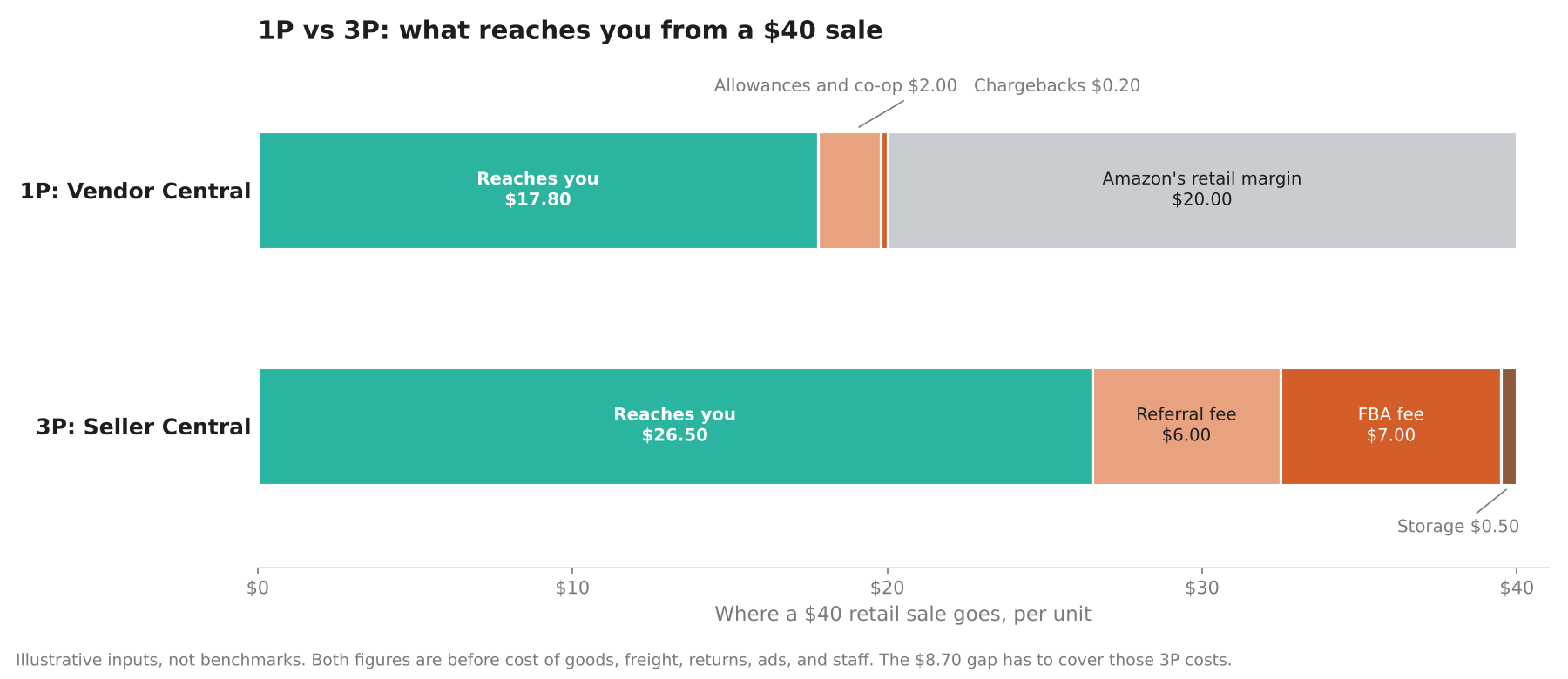 Figure 1: The $8.70 per-unit gap in 3P has to cover freight, returns, ads, and staff.
The 3P figure is $8.70 a unit higher, and that gap has to pay for inbound freight, returns, advertising, and the people running the account. The 1P figure is lower but more predictable, until chargebacks and cost price pressure start to erode it. Check real fees with Amazon's Revenue Calculator.
What changed for vendors
Amazon has cut vendor relationships in waves, and the pattern keeps repeating. In late 2024 it sent termination notices to mostly smaller vendors, often with two to three months' notice. One advisor told Retail Brew that the affected range ran from under $1 million to $5 million in annual Vendor Central sales, in the US and overseas.
It wasn't the first time. In March 2019 Amazon abruptly stopped purchase orders to tens of thousands of vendors before partly walking it back ( Digiday). And it hasn't stopped: one agency reports terminations continuing in waves since late 2024, including notices with an August 2, 2026 end date that point vendors to Seller Central ( Goat Consulting). Amazon hasn't published a revenue cutoff, so treat the specific thresholds you'll see online as unconfirmed.
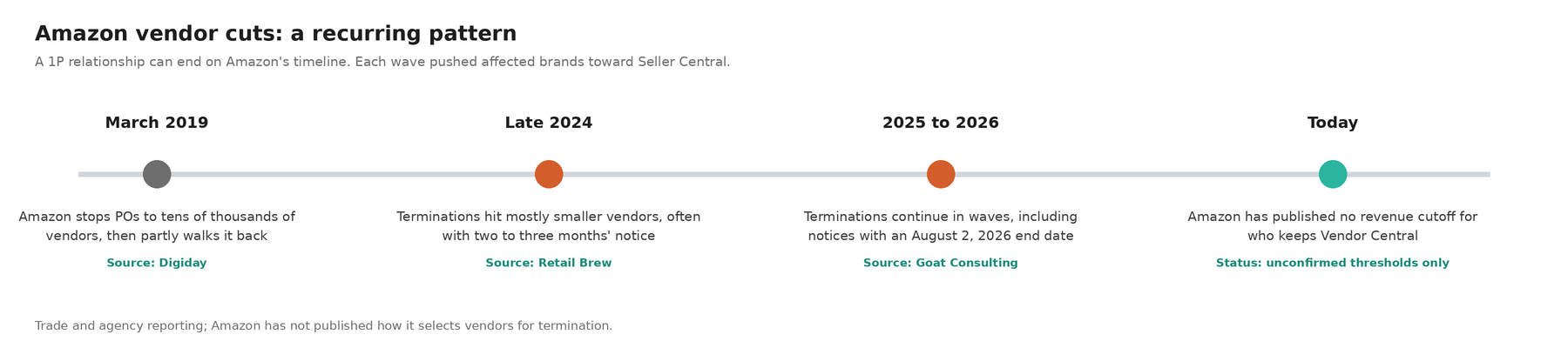 Figure 2: Vendor cuts have come in waves since 2019.
The same advisor's advice holds for every 1P brand: consider a hybrid model, or open a Seller Central account, "even if it's just a backup," to learn how it works. A brand with no 3P capability has nowhere to move its sales when POs stop.
Can you use Vendor Central and Seller Central together?
Often, but not for the same products. Amazon's Standards for Brands Selling in the Amazon Store policy, as quoted by Pattern in 2019, says that if any of a brand's products are sold by Amazon, the brand may not also sell those products as a seller. Pattern noted it wasn't fully enforced in every category. Check the current wording in Seller Central before you plan a hybrid.
The practical rule: give every product one clear home, and don't have the same ASIN live in both channels. Overlap also creates price conflict, because Amazon's retail offer and your own offer would compete for the same Buy Box.
| Product type | Usual home | Why |
|---|---|---|
| High-volume, stable core products | 1P | Amazon's ordering and fulfillment handle the volume |
| New launches and tests | 3P | You control price, content, and timing |
| Bundles and higher-margin items | 3P | Pricing flexibility protects margin |
| Products where MAP matters | 3P | Amazon sets 1P retail prices, not you |
| Contingency for core products | A Seller Central account ready | Lets you move quickly if POs slow or stop, without the same ASINs live in both |
Should your brand sell 1P or 3P? A decision matrix
Choose based on what you need to control, what you can operate, and how much risk you can carry. Score your brand on each row.
| If this describes you | Lean 1P | Lean 3P |
|---|---|---|
| Price control and MAP matter to your brand | ✓ | |
| You need predictable bulk orders and simpler operations | ✓ | |
| You can manage inventory, fulfillment, and account health | ✓ | |
| You can't finance inventory until it sells | ✓ Paid on the PO | Only with working capital |
| You want faster access to cash from each sale | Depends on your terms | ✓ Regular disbursements |
| You already have a Vendor Central invitation and strong volume | ✓ | |
| Unauthorized resellers undercut you | Brand Registry helps in both | ✓ You control your own offer and price |
| You can't absorb chargebacks or shortage claims | ✓ |
Before deciding, answer five questions:
- Who sets your price today across other retailers?
- What do your wholesale terms leave after allowances and chargebacks?
- Can your team handle POs, ASNs, and compliance, or inventory and fulfillment?
- What happens to your Amazon revenue if POs stop next quarter?
- Which products need price control, and which need volume?
Case study: what poor 1P management costs
A supplement brand selling $2.8M a year through Vendor Central came to CMO with $94,000 in chargeback and shortage claims from the previous 12 months, none disputed. That's about 3.4% of sales, above the 3% level our reports guide treats as a problem. Its fill rate had slipped to 81%, and Amazon's automated catalog had overwritten content on six key ASINs.
CMO audited 18 months of claims, found $61,000 in disputable deductions, and filed disputes before Amazon's windows closed ( CMO Vendor Central management).
|
$47,000
Recovered within 90 days (77% of disputable)
|
81% → 96%
Fill rate within 60 days
|
6 ASINs
Content restored and locked in 30 days
|
Amazon's retail buyer increased PO volume the following quarter.
Across 16 years and more than 100 brands, the brands that do best on Amazon don't pick a side. They decide where each product belongs and keep the ability to move it. 1P is a customer relationship that Amazon can end, and 3P is a business you have to run. Knowing which one you're in, product by product, is the strategy.
Not sure which model fits your catalog?
CMO manages Vendor Central, Seller Central, and the hybrid strategy between them, including which products sit where and how pricing holds across both. See our Amazon Vendor Central management .
Amazon 1P vs 3P: What Brand Owners Ask Before Choosing
Q Should my brand sell 1P or 3P?
Sell 1P if you value predictable bulk orders and simpler operations, and you have an invitation and strong volume. Sell 3P if you need price control, can run inventory and fulfillment, and want to own the offer. Many brands split by product.
Q What is Amazon Vendor Central?
Vendor Central is Amazon's invite-only platform for first-party suppliers. Amazon buys your products at wholesale through purchase orders, sets the retail price, and sells them as Amazon, under terms set in your vendor agreement.
Q Can you use Vendor Central and Seller Central together?
Often, but keep each product in one channel. Amazon's Standards for Brands policy has said a brand may not sell as a seller the same products Amazon sells, so don't plan to run the same ASIN in both. Check the current policy in Seller Central.
Q How do 1P margins compare to 3P?
In 1P you keep the wholesale price minus allowances and chargebacks. In 3P you keep the retail price minus Amazon's fees, but you pay for freight, storage, returns, and more advertising. Both figures come before cost of goods, so run your own numbers.