Amazon Marketing Cloud (AMC) is Amazon's privacy-safe clean room for analyzing your ad data across campaigns and ad types. Since September 2025, every advertiser running sponsored ads can open it from the ads console at no cost. Use it to see paths to purchase, which campaigns win new customers, and how long buyers take to convert.
Amazon's September 2025 announcement opened Amazon Marketing Cloud to every advertiser running Sponsored Products, Sponsored Brands, Sponsored Display, or Sponsored TV. Before that, getting into AMC on Amazon Ads meant a separate registration or working through a partner.
Access is no longer the barrier. Knowing which questions to ask is. This guide covers what AMC is, who can use it, five starter analyses with sample outputs, and how it differs from Amazon Attribution and Brand Analytics. It is written for brands already running sponsored ads at scale, where cross-campaign questions start to cost real money.
What is Amazon Marketing Cloud?
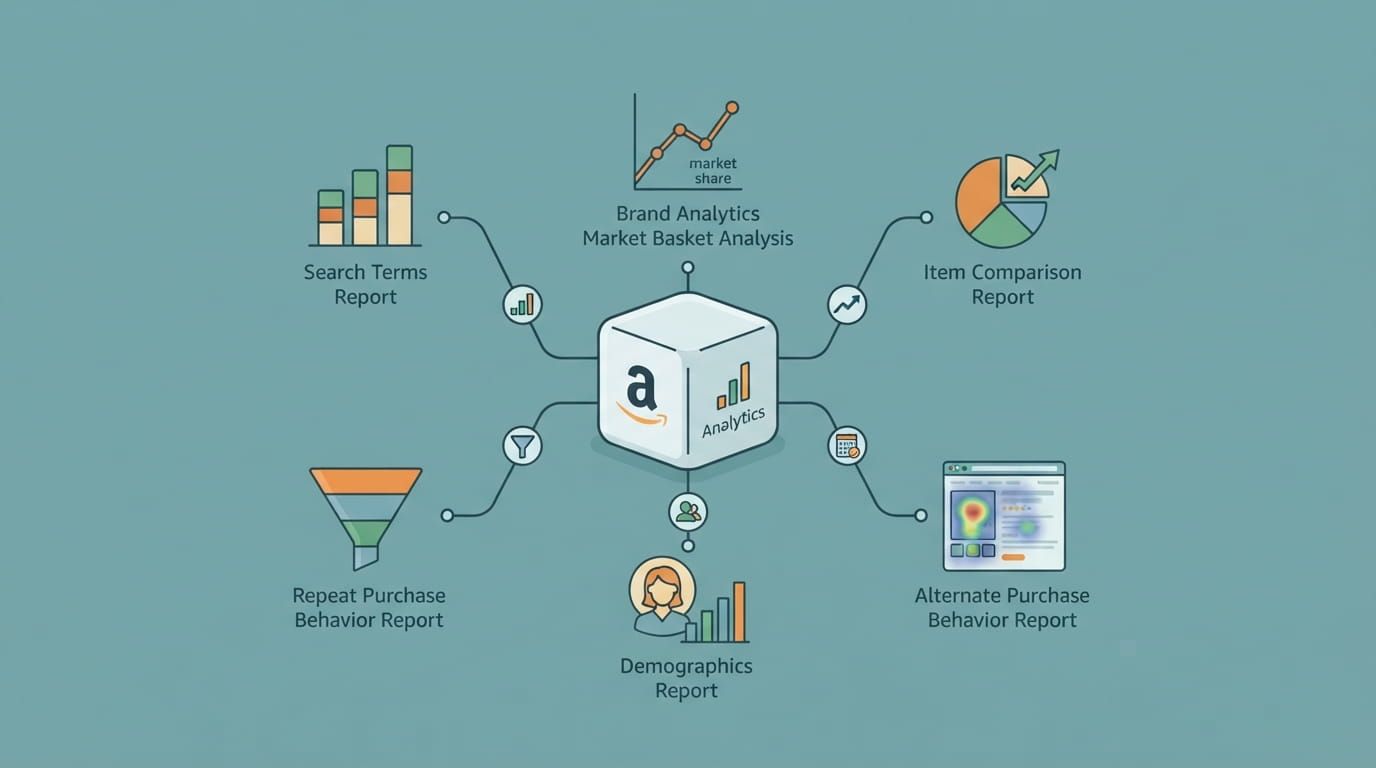
Amazon Marketing Cloud is a secure, cloud-based clean room built on AWS Clean Rooms, where advertisers analyze pseudonymized Amazon Ads signals alongside their own data and build audiences. You only get aggregated, anonymous outputs, and Amazon says the data you upload stays in your instance and can't be accessed by Amazon ( Amazon Ads, Verified November 2026).
Standard console reports show each campaign on its own. AMC joins the same shopper's ad exposures and purchases across ad types, so you can ask how campaigns work together. You can query it three ways: no-code templates on the AMC homepage, low-code templates in the use case library, or a full SQL query editor. A beta AI assistant inside AMC, which Amazon calls Ads Agent, also turns plain-language requests into analyses and audiences. Ad traffic data covers a 25 month lookback.
Who can use AMC on Amazon in 2026?
Any advertiser running Sponsored Products, Sponsored Brands, Sponsored Display, or Sponsored TV can use AMC through self-service, from Measurement & Reporting in the ads console. That has been true since Amazon's announcement on September 18, 2025.
Advertisers who want AMC alongside DVA+ with advanced settings (Amazon's Display, Video, and Audio buying) ask their Ad Tech Account Executive for access. Brands can also work in AMC through partners registered on the Amazon Ads Partner Network ( Amazon Ads FAQ, Verified November 2026).
 Figure 1: Where to open AMC and the three ways to query it.
Is Amazon Marketing Cloud free?
Yes. Amazon states AMC is available at no cost to eligible advertisers through the web interface and API. The exception is optional Paid Features (beta): subscriptions from Amazon Ads and third parties such as Experian and NCS that add data to your instance and carry a separate cost.
What can you measure in AMC? 5 starter analyses
Each analysis below answers a question standard console reports can't. Every table is an illustrative example of what the output looks like, not client data or a benchmark.
For real results, Amazon's own AMC case studies report that UNICEF reached a 366% ROAS using AMC insights, that Tinuiti grew Poppi's new-to-brand orders 16x with AMC, and that AMC Audiences and Amazon Shopping Insights helped SimpliSafe grow ROAS by 109%.
1. Path to conversion across ad types
Question: Do shoppers who see more than one ad type buy at a higher rate?
| Path before purchase | Purchase rate |
|---|---|
| Sponsored Products only | 3.1% |
| Sponsored Products + Sponsored Brands | 5.4% |
| Sponsored Products + Sponsored Brands + Sponsored Display | 7.2% |
Illustrative example, not client data or a benchmark.
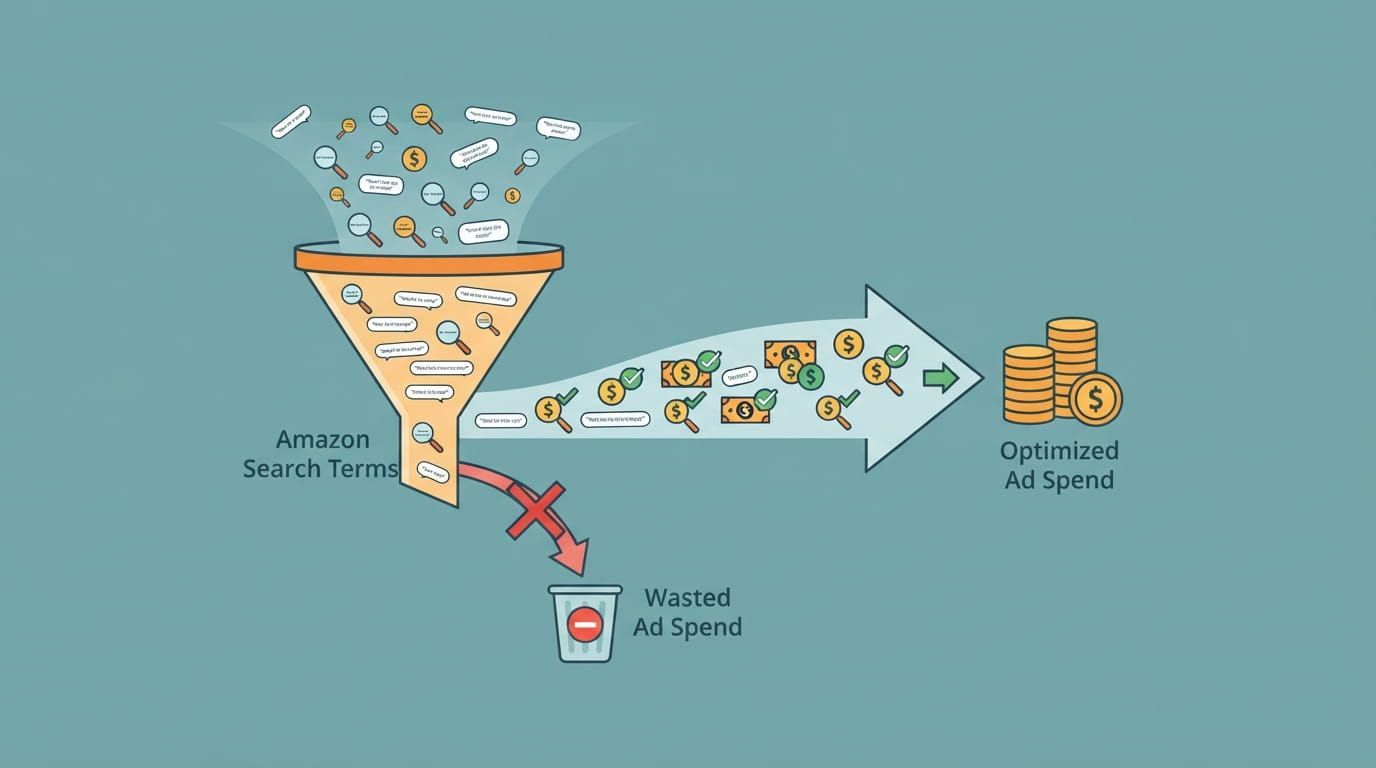
What to do: If combined paths convert far better, check whether Sponsored Brands budget is capping reach before cutting it for a weaker ACoS.
2. New customers by campaign
Question: Which campaigns bring in shoppers who have never bought from your brand?
| Campaign | Purchases from new customers |
|---|---|
| Category generic, Sponsored Products | 71% |
| Competitor targeting, Sponsored Display | 64% |
| Branded search, Sponsored Products | 18% |
Illustrative example, not client data or a benchmark.
What to do: Judge acquisition campaigns on new buyers, not ACoS alone. A higher ACoS can be worth paying for acquisition, as our guide to what a good ACoS is explains.
3. Time to conversion
Question: How long after the ad click do shoppers buy?
| Time from click to purchase | Share of purchases |
|---|---|
| Same day | 52% |
| 1 to 7 days | 33% |
| 8 to 14 days | 15% |
Illustrative example, not client data or a benchmark.
What to do: If a large share lands late in the window, read campaigns over a full window before cutting them, and treat the most recent days of data as incomplete.
For technical readers, this simplified query counts Sponsored Products purchases by time from click to purchase. It is adapted from Amazon's instructional query library; check the table and column names in your own instance before running it.
4. Ad frequency and purchase rate
Question: How many impressions does a shopper need before returns flatten?
| Impressions per shopper | Purchase rate |
|---|---|
| 1 | 1.2% |
| 2 to 3 | 2.9% |
| 4 to 6 | 3.6% |
| 7 or more | 3.7% |
Illustrative example, not client data or a benchmark.
What to do: When the rate stops rising, more frequency is mostly cost. This matters most for Sponsored Display, Sponsored TV, and DSP.
5. An audience you can act on
Question: Who added your product to their cart in the last 30 days but hasn't bought it?
| Output | Value |
|---|---|
| Audience size | 14,200 shoppers |
| Ready to activate in | Sponsored ads and display |
Illustrative example, not client data or a benchmark.
What to do: Amazon says AMC audiences can be activated across sponsored ads, video ads, and display ads. Use this one to re-engage shoppers who were close to buying.
AMC vs Amazon Attribution vs Brand Analytics
These three tools answer different questions, and established brands usually need all of them.
| Amazon Marketing Cloud | Amazon Attribution | Brand Analytics | |
|---|---|---|---|
| What it measures | How your Amazon ads work together across campaigns and ad types | How off-Amazon marketing (search, social, email, influencers) drives Amazon sales | Search, conversion, and customer behavior for your brand |
| Who can use it | Sponsored ads advertisers; DSP advertisers via their account executive | Eligible sellers, vendors, brand owners, and KDP authors using sponsored ads | Brand Registry brands with a Professional plan |
| Cost | No cost; optional Paid Features | Free | No separate fee |
| Best for | Cross-campaign analysis and audiences | Proving off-Amazon traffic sells | Keyword and listing decisions |
Amazon Attribution details come from Amazon's Attribution page(Verified November 2026). Amazon also changed view attribution on January 1, 2026 for Sponsored Brands, Sponsored Display campaigns billed on viewable impressions, and DSP ads in the store; our guide to Amazon advertising attribution explains what that does to your reports. Our Brand Analytics guide covers the search reports.
When AMC is worth your time
AMC pays off when you run more than one ad type and need to know how they work together. A brand running only Sponsored Products on a small budget gets less from it, so start with the no-code templates and move to custom queries once a real budget question needs an answer.
| Your setup | Where to start |
|---|---|
| Sponsored Products only | No-code templates: time to conversion and new customers |
| Sponsored Products, Brands, and Display | Path to conversion and frequency analysis |
| Sponsored ads plus DSP or Sponsored TV | Custom queries and audiences ( DSP minimum spend explained) |
FROM THE CMO DESK
Across 16 years and more than 100 brands, one lesson holds for any new data source: start from the decision, not the dashboard. Write down the budget call you're unsure about, then pick the one analysis that settles it. That's how we'd approach AMC for a brand under our Amazon PPC management or Amazon DSP teams.
What AMC can't do
AMC returns aggregated results only, so it never shows individual shoppers, and small campaigns may not produce enough activity for a useful answer. Its outputs are analyses you design, not a replacement for console reporting, and a badly framed query misleads as easily as it informs. The tool is free; the hours to frame questions and read answers are not.
Get more from your ad data
If you run several ad types and can't say how they work together, start with an audit. CMO's Amazon PPC management includes a full campaign audit for existing accounts.
Amazon Marketing Cloud: Answers Before Your First Query
Is AMC free?
Yes. Amazon states AMC is available at no cost to eligible advertisers through the web interface and API. Optional Paid Features, which add data from Amazon Ads and third parties such as Experian and NCS, are separate subscriptions.
Who can access Amazon Marketing Cloud?
Sponsored ads advertisers open it through self-service from Measurement & Reporting in the ads console. Advertisers using DVA+ with advanced settings request access from their Ad Tech Account Executive, and Amazon Ads partners can run AMC for a brand.
Do I need SQL to use AMC?
Not to start. The AMC homepage offers no-code templates, and Ads Agent, a beta AI assistant inside AMC, accepts plain-language requests. SQL helps once you need custom analyses or audiences beyond the templates.
How is AMC different from Amazon Attribution?
Amazon Attribution measures how off-Amazon marketing, like Google ads or influencer posts, drives sales on Amazon. AMC analyzes how your Amazon ads work together across campaigns and ad types. Brands that send outside traffic to Amazon often use both.