
Most brands run Sponsored Products and call it an advertising strategy. CMO manages the full Amazon advertising stack — Sponsored Products, Sponsored Brands, Sponsored Display, and Amazon DSP — as an integrated system built around where your buyer is in the purchase journey and what it costs to move them through it.
What a Fragmented Advertising Strategy Costs You
Running one ad type well while ignoring the rest is not a strategy — it is leaving money on the table and competitive ground to the brands that understand how Amazon's advertising ecosystem connects.
Relying on Sponsored Products Alone
Sponsored Products are the most direct path to purchase on Amazon and the right foundation for any advertising strategy. But a brand running only Sponsored Products has no presence at the top of search, no awareness layer above keyword intent, and no way to retarget shoppers who viewed the listing and did not buy. Competitors running Sponsored Brands and Sponsored Display around your listings are capturing the traffic you paid to generate.
No Upper-Funnel Investment
Lower-funnel keyword campaigns convert the buyers who are already searching for your product. They do nothing for the buyers who do not yet know your brand exists or who are still in the consideration phase. Brands that invest only in lower-funnel spend are entirely dependent on organic ranking and direct search demand. As category competition grows, that position becomes harder and more expensive to hold.
Disconnected Paid and Organic Strategy
Amazon advertising and Amazon SEO are not separate channels. PPC campaigns generate sales velocity, which is an organic ranking signal. A brand running PPC without an eye on organic rank is spending money that could be building a compounding asset. CMO manages both together so every dollar of ad spend is doing double work where it can.
How CMO Manages Your Amazon Advertising
The right advertising mix depends on your category, margin, stage of growth, and competitive landscape. CMO builds the strategy around those specifics, not around a standard package.
Sponsored Products
The core of Amazon's advertising system and the starting point for every CMO engagement. CMO builds and manages Sponsored Products campaigns across auto and manual targeting, with a keyword strategy drawn from search term report data, competitor ASIN analysis, and category-specific volume research. Bid management runs daily. Negative keyword strategy runs continuously. Structure is reviewed and refined as performance data accumulates.
Sponsored Brands
Sponsored Brands campaigns capture the top-of-search placement that Sponsored Products cannot reach. CMO uses Sponsored Brands for brand awareness, category ownership, and competitor conquest — placing your brand headline and product selection in front of shoppers at the moment they are actively browsing the category. Video creative within Sponsored Brands is managed where the product and category support it.
Sponsored Display
Sponsored Display extends your advertising presence beyond keyword search to product detail pages, off-Amazon placements, and retargeting audiences. CMO uses Sponsored Display to recapture shoppers who viewed your listing without purchasing, to conquest competitor product pages, and to build reach in categories where upper-funnel awareness matters. The targeting logic for Sponsored Display is managed separately from Sponsored Products because the intent signals and bidding dynamics are different.
Amazon DSP
Amazon's Demand-Side Platform gives brands access to programmatic display and video advertising across Amazon-owned properties and third-party inventory. CMO advises on DSP for brands at the scale and margin level where programmatic makes sense — typically brands spending $30,000 or more per month on Amazon advertising who want an upper-funnel awareness layer and retargeting capability that Sponsored Display alone cannot provide. DSP strategy is built around defined audience segments and measured against TACOS, not standalone ROAS.
Campaign Architecture and Reporting
Every CMO advertising engagement is built on a clear campaign architecture — branded, competitor, category, and defensive targeting organized by intent and managed separately. Reporting covers ACOS, TACOS, impression share, click-through rate, and new-to-brand metrics. The reports explain what changed and why, not just what the numbers are.
Advertising-Driven Results
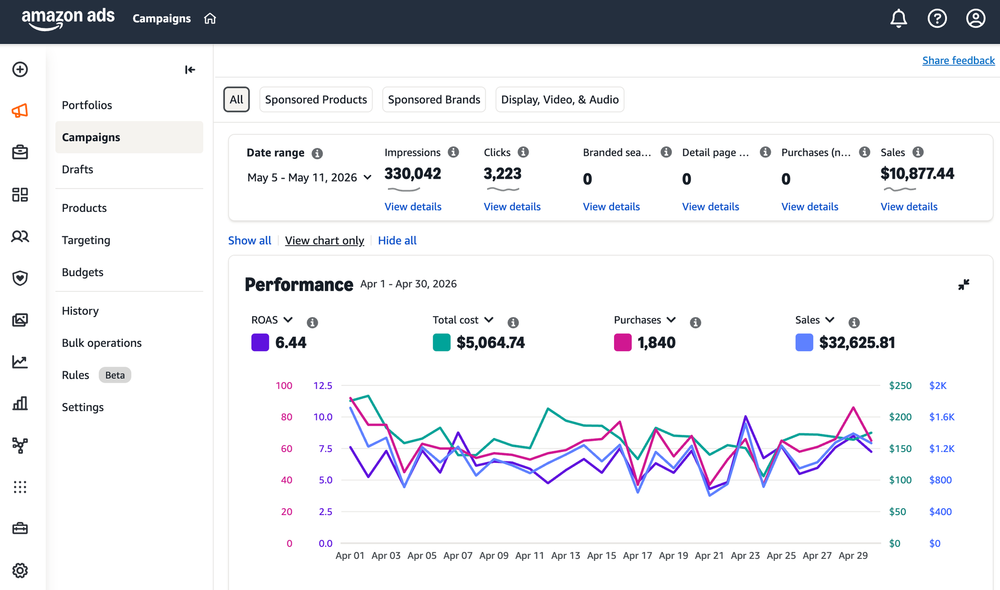
We manage the full Amazon advertising stack: Sponsored Products, Sponsored Brands, Sponsored Display, and DSP—to turn visibility into revenue. We deliver consistent, impressive, and measurable results through integrated advertising strategy across every campaign type.
What Amazon Advertising Services Include
Every CMO advertising engagement covers the full managed service, not individual campaign tasks.
What CMO Advertising Management Has Delivered
A supplement brand with 18 ASINs spending $28,000 per month on Amazon advertising
The Situation: This brand came to CMO running Sponsored Products campaigns only, with no Sponsored Brands or Sponsored Display presence. ACOS was sitting at 44% and had been climbing for four months. The campaign structure had not been reviewed in over a year. Competitor brands were appearing in Sponsored Brands placements on this brand's own listing pages and capturing a meaningful share of the traffic the brand's own PPC was generating.
What CMO Did: CMO restructured the full campaign architecture, separating branded and non-branded campaigns and introducing tiered targeting across high, medium, and low commercial intent keywords. Sponsored Brands campaigns were launched targeting the brand's top category terms and its three closest competitor keywords. Sponsored Display was activated to retarget shoppers who had viewed the primary ASINs without purchasing and to conquest the two highest-traffic competitor listings in the category. A negative keyword audit in the first 30 days removed 340 irrelevant search terms that had been consuming 19% of total ad spend.
The Result: ACOS dropped from 44% to 27% within 60 days. TACOS improved from 18% to 12% over the same period as organic rank lifted on four primary ASINs. Monthly ad-attributed revenue increased by 38% at the lower ACOS. The brand recaptured its own listing pages from competitor Sponsored Brands placements within 45 days of the new campaigns going live.
Why Brands Choose CMO for Amazon Advertising
Full-funnel strategy, not just keyword bidding
CMO manages the complete advertising stack because upper-funnel and lower-funnel spend serve different functions and need to be managed with that in mind. Brands that treat every ad type as a variation of the same keyword campaign consistently underinvest in awareness and overpay for conversion.
Paid and organic managed together
Advertising decisions at CMO are never made in isolation from organic strategy. Every PPC campaign is evaluated for its contribution to sales velocity and organic rank, not just its standalone ROAS. This is the approach that makes advertising spend compound over time rather than disappear when the budget is paused.
Transparent reporting that tells you something
CMO reports on ACOS, TACOS, new-to-brand revenue, impression share, and the specific changes made in the account each week. The goal of reporting is to keep you informed about what is happening and why, not to produce charts that require interpretation. If a campaign change did not work, the report says so.
Amazon SPN Certified
CMO is an Amazon Service Provider Network certified agency. The credential reflects accountability to Amazon's own standards and is a verified status, not a self-reported claim.
Frequently Asked Questions
Your Advertising Budget Should Be Building Something
Ad spend that is not connected to an organic strategy, a conversion-optimized listing, and a full-funnel structure is producing less than it should. CMO manages Amazon advertising as a complete system — from keyword to storefront, from click to conversion, from paid rank to organic.
Book a Free Consultation →