
Amazon Marketplace Operations That Keep Your Business Moving
Marketplace operations sits underneath your ads and creative: case work, catalog integrity, inventory, compliance, chargebacks, and money recovery. Not six separate problems. A suppressed listing stalls inventory, an inventory gap costs organic rank, and once rank slips your ACoS climbs to compensate.
That is why splitting Amazon work across vendors fails. We run it as one loop with one team accountable. Start with a single service, or hand us the whole account.
What we run
Every part of the Amazon marketplace that touches your P&L
Amazon marketplace operations sits underneath your advertising and your creative, and it covers the things that rarely make it onto anyone's roadmap: case work, catalog integrity, inventory, compliance, chargebacks, and money recovery. These are not six separate problems. A suppressed listing stalls your inventory, an inventory gap costs you organic rank, and once rank slips your ACoS climbs to compensate.
That is why splitting Amazon marketplace work between vendors so often fails, and why we would rather run it as one loop with one team accountable for the result. You can start with a single service if that is all you need, or hand us the whole account.
Full Service Management
One team carries ads, listings, creative, and account health together, so nobody can point at another vendor when the number moves.
Learn moreAccount Management
We review account health on a schedule and work the case queue daily, so most problems get caught while they are still small.
Learn moreVendor Central
We dispute chargebacks, confirm purchase orders on time, keep ASNs accurate, and handle 1P negotiation for hybrid brands.
Learn moreAmazon Reimbursement
Amazon owes most sellers money for lost units, damaged inventory, and fee errors. We audit for it and file the claims.
Learn moreWork produced for leading consumer brands, including:






How onboarding runs
From audit to owned account in 14 days
We would rather show you what we found before asking you to commit to anything, so the audit comes first and the plan comes out of what it turns up.
Deep dive
We audit your Amazon marketplace account, catalog, and listings against your closest competitors and send it over within 72 hours, at no cost.
1-page plan
You get one page covering what we would fix first, what it should move, what it costs, and how long it takes.
Pod assigned
A dedicated senior team takes over the account, and onboarding usually runs 7 to 14 days from signature.
Run and compound
From there it is daily case work, weekly reporting, and a quarterly reset, on a month-to-month agreement.
The detail
What each Amazon marketplace service covers
Open only what you need. Every Amazon marketplace engagement is delivered by senior operators, never interns or juniors.
Amazon Full Service Management
One team, one strategy, one revenue number
When a brand buys advertising from one vendor, listings from another, and creative from a third, each one optimizes for the metric it gets judged on, and the account ends up pulling in three directions. We would rather one pod carry all of it. Amazon PPC management, SEO, and listing work all feed the same strategy here, which is what lets the gains stack instead of cancel.
- Account audit and 90-day growth plan with KPI targets
- Dedicated pod and weekly reporting cadence
- Advertising, SEO, catalog, and creative under one owner
- Quarterly strategy reviews that reset priorities
- Direct line to your account team, no ticket portal

Amazon Account Management
Seller Central health, cases, and growth execution
Plenty of account managers are reactive by design. Something breaks, a report flags it a week later, and the work starts after the revenue is already gone. We schedule the health reviews, category checks, and inventory forecasting instead, which means most issues surface while they are still cheap to fix.
- Suppression and case resolution with escalation paths
- Account health, policy compliance, and category monitoring
- Catalog integrity: variations, flat files, node and browse fixes
- Inventory forecasting, stranded and aged unit clearance
- Custom reporting on organic versus paid, ACoS and TACoS

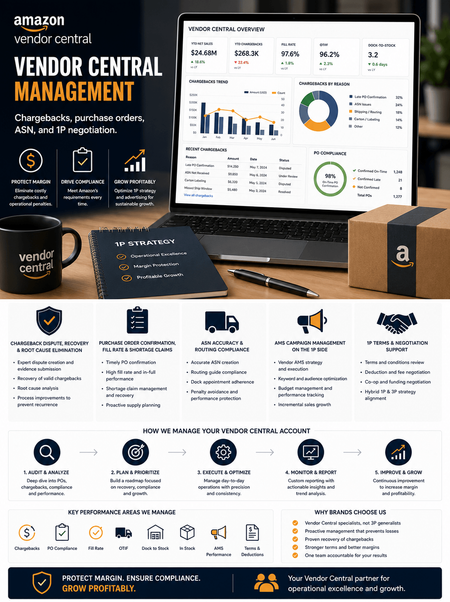
Amazon Vendor Central Management
Chargebacks, purchase orders, ASN, and 1P negotiation
Vendor Central runs on different rules than Seller Central, and the teams that handle it well are rarely the same teams that handle 3P. Most chargebacks trace back to the same handful of small operational slips, repeated: a purchase order confirmed late, an ASN that never arrived or arrived wrong, cartons labelled incorrectly, or a shipment that missed its ship window. Individually they look trivial, and together they take a real bite out of the invoice.
- Chargeback dispute, recovery, and root cause elimination
- Purchase order confirmation, fill rate, and shortage claims
- ASN accuracy and routing compliance
- AMS campaign management on the 1P side
- 1P terms and negotiation support, hybrid 1P and 3P strategy
Amazon Reimbursement
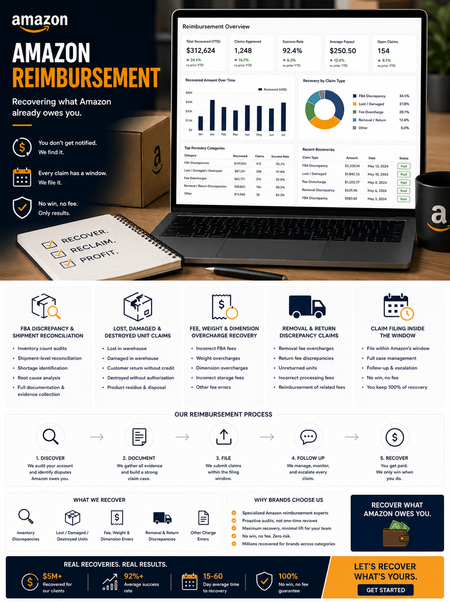
Recovering what Amazon already owes you
Amazon miscounts inventory, damages units, and charges the wrong fees, and it does not tell you when it happens. The discrepancies build up quietly and then expire because every claim type has a filing window. We treat reimbursement as a standing audit rather than something to run once a year when somebody remembers.
- Recurring FBA discrepancy and shipment reconciliation audit
- Lost, damaged, and destroyed unit claims
- Fee, weight, and dimension overcharge recovery
- Removal and return discrepancy claims
- Claim filing inside the window and follow-through. No win, no fee
Additional support
The details nobody else picks up
These are the small jobs that tend to fall through the cracks when an Amazon marketplace account is shared between vendors. All of them are included in every engagement.
The wrong way vs. the CMO way
Most brands run Amazon marketplace operations by accident
Nobody sets out to run their account this way. It happens gradually: a PPC agency here, a listing freelancer there, an Amazon marketplace consultant somewhere, an internal ops manager holding it together. Then one day the seams are everywhere and no one can say why growth stopped.
The old way
- 3+ vendors with conflicting priorities
- No single owner of the revenue number
- Long contracts, no performance accountability
- Juniors do the work, seniors sell it
- Slow turnaround on case files and chargeback disputes
- Reporting that explains the past, not the future
The CMO way
- One integrated pod aligned on marketplace revenue
- A fractional CMO owns the outcome
- Month to month, performance based
- Only senior Amazon operators on your account
- Same-day response on cases and escalations
- Forward-looking growth plan, updated weekly
What changed
A consumer brand with 24 ASINs and no single owner
The situation: The brand ran PPC in house, sent listing work to a freelancer, and used a design agency for A+ content. Every vendor reported against its own metrics and all looked fine in isolation while sales stayed flat for seven months. ACoS sat at 38% in a category averaging 22%, and the top ASIN converted at 8.4% against a category 13.6%.
What CMO did: The audit found three things working against each other. Campaigns were buying impressions in categories the product did not belong in, listing copy never addressed the three objections repeating in reviews, and A+ restated the bullets instead of moving anyone toward a decision. We rebuilt the campaign structure, rewrote the top six listings around what buyers were hesitating over, and rebuilt A+ for the three highest-volume ASINs.
The result: ACoS dropped from 38% to 21% in 60 days, and the primary ASIN went from 8.4% to 13.1% conversion within 45 days of the new listings going live. Over the next 90 days the account grew 44% with no increase in ad spend, ending a seven-month flat stretch.
"We began our collaboration with CMO nearly a year ago and it has been a game-changer for our business. Our store's traffic has significantly increased, and sales continue to grow steadily."
Elena Davidson Christina USAWorks with
Operations keeps the account sellable. These two scale it.
Marketplace operations is one of four service categories here. Brands that run them from a single strategy tend to pull ahead of brands that buy each piece from a different vendor.
Who runs this
Operators, not account coordinators
We have 60 full-time people in house and we do not subcontract, so the person who sells you the engagement is someone you will keep working with. Everyone leading an account here has already run Seller Central and Vendor Central through a suspension, a counterfeit problem, a category migration, and at least one Q4, which is where most of the useful judgment comes from.
Chief Marketplace Officer is not affiliated with or endorsed by Amazon.

William Fikhman
FAQ
Amazon marketplace operations questions
It covers the day-to-day work that keeps a Seller Central or Vendor Central account sellable. In practice that means catalog and variation integrity, FBA and inventory forecasting, filing and escalating cases, resolving suppressions, watching account health, disputing chargebacks, handling purchase orders, and recovering reimbursements.
Account management is the strategic layer, so growth planning, reporting, and deciding what matters this quarter. Marketplace operations is the execution underneath it, which is cases, catalog, inventory, and compliance. We run both from one team, which is why you will find them grouped together here.
Yes, and hybrid 1P and 3P setups are common here. The Vendor Central pod handles chargebacks, purchase order confirmation, ASN accuracy, shortage disputes, and AMS, and they work alongside the Seller Central team on a single strategy rather than two competing ones.
Amazon owes most sellers money for lost inventory, damaged units, fee and dimension overcharges, and removal errors. Every claim type has a filing window attached to it, so the value of a recurring audit is that it catches the discrepancy while you can still claim it. We work reimbursement on a no win, no fee basis.
Nearly all of them come from the same small operational slips repeating. A purchase order confirmed late or not at all, an ASN that is missing or inaccurate, cartons labeled wrong, prep and packaging that misses spec, or a shipment that arrives outside its assigned ship window. Any one of them looks minor on its own, which is exactly why disputing them individually never solves the problem. Finding the process that keeps producing them does.
Cases and suppression escalations get a same-day response from us. Catalog and inventory corrections usually resolve inside a week. Bigger structural work such as a variation rebuild or a category reclassification tends to run 2 to 4 weeks, though that depends on how backed up Amazon's review queue is.
Yes, and we do it regularly. We start with an audit to work out what is already in place, what is working, and what is holding things back. You do not need to tear everything down to work with us, though where the existing setup is capping growth we will say so and rebuild it.
No. The right moment is usually when managing the account in house or across several vendors starts capping what you can grow, and that happens at very different revenue levels for different brands. We work with brands doing $1M on Amazon and with enterprise brands managing $50M or more.
The free audit can be in your inbox within 72 hours. If you decide to move forward, onboarding usually takes 7 to 14 days from signature, and the engagement runs month to month with nothing locking you in.
Your catalog is not managing itself
Let us audit the account and show you what is suppressed, what is stranded, where you are losing the Buy Box, and how much Amazon currently owes you. It is free and it lands in your inbox within 72 hours.
Book a consultation