THE SHORT ANSWER
Amazon display advertising is Amazon's self-serve display format, formerly called Sponsored Display. Amazon now calls it display ads. Brand-registered sellers and vendors can target product pages, categories or audiences, such as shoppers who viewed their products. Billing is per click (CPC) or per 1,000 viewable impressions (vCPM), with no minimum spend.
If you looked for Sponsored Display in your ads account this fall and couldn't find it, it wasn't removed. Amazon renamed it. Its Sponsored Display page now says it directly: "Sponsored Display is now known as display ads." Existing campaigns keep running. New ones start from a different menu.
The mechanics underneath haven't changed much. Measurement has, and plenty of seller guides haven't caught up. This guide covers what display ads do, what they cost, the five jobs they're good at, a sample campaign setup, and where Amazon DSP and DVA+ fit.
What Changed: Sponsored Display Is Now Display Ads
Amazon folded Sponsored Display into its wider display ads offering inside Amazon Ads Agent, the name it gave its unified ads platform on September 29, 2026. Existing Sponsored Display campaigns run uninterrupted. Amazon says new campaigns start under Campaigns, Create Campaign, then Display.
Amazon Ads Agent(formerly the ads console) brings sponsored ads and Amazon DSP workflows into one workspace. Amazon's instructions for a new display campaign are: go to Campaigns, click Create Campaign, and under Display, Video, and Audio, click Display. Existing Sponsored Display campaigns are listed under Display, Video, and Audio campaigns. Menu labels may differ by marketplace while Amazon rolls out the unified workspace.
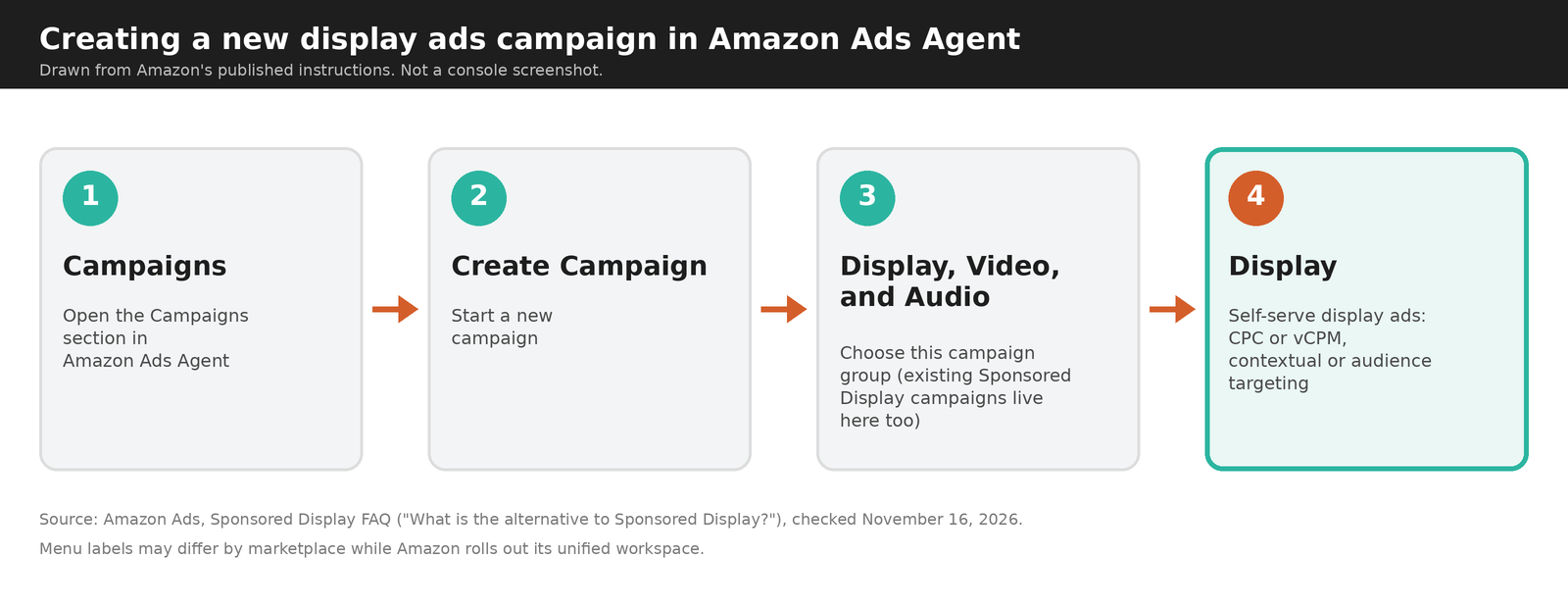 Figure 1: Amazon's published path for a new display ads campaign. Drawn from Amazon's instructions, not a console screenshot.
What stayed the same:
- Eligibility. Display ads are for vendors and professional sellers enrolled in Amazon Brand Registry, according to Amazon's display ads guide. Agencies can run them for eligible accounts.
- Billing. CPC or vCPM, with no minimum spend and no management fee for the self-service option.
- Targeting. Contextual (products and categories) or audiences.
What changed is how view-through sales are credited, covered in the measurement section. It affects how you read vCPM results.
Amazon Display Ads Targeting Options
You choose contextual targeting, which places ads on specific product pages or categories, or audience targeting, which reaches shoppers based on what they viewed, bought or are interested in. Contextual ads serve in the Amazon store. Audience ads can also serve on Twitch and third-party sites and apps.
| Targeting type | What you select | Where ads can appear | Typical job |
|---|---|---|---|
| Contextual: products | Specific ASINs, yours or competitors' | Detail pages, near reviews, under the featured offer, shopping results | Defend your pages, conquest competitors |
| Contextual: categories | Categories, refined by brand, price, star rating, Prime eligibility | Same as above | Reach shoppers browsing a category |
| Views remarketing | Shoppers who viewed your products or similar products but didn't buy | Amazon homepage, detail pages, Twitch, third-party sites and apps | Win back missed sales |
| Purchases remarketing | Shoppers who bought your products or complementary products | Same as above | Repeat purchases, cross-sell |
| Amazon audiences | Prebuilt segments: in-market, interests, lifestyle, life events | Same as above | Prospecting and awareness |
Source: Amazon Ads display ads guide, checked November 16, 2026.
For both remarketing types, you set a lookback window, which is how far back the viewing or buying happened. Amazon's examples are seven and 30 days. Match the window to your buying cycle: shorter for consumables, longer for products shoppers think about for weeks.
Amazon recommends using both tactics together. Contextual ads bring shoppers to the detail page. Views remarketing follows up with the ones who left without buying.
Display Ad Creative: What Amazon Builds and What You Add
Amazon generates the ad from your detail page: main image, title, star rating, Prime badge and price. You can add your logo, a headline, a lifestyle image or video. Ads refresh when your detail page changes and can show deal and coupon badges.
Because the creative pulls from your listing, the listing quality carries into the ad. A weak main image or a low star rating may affect the creative shoppers see. Fix the detail page before you scale spend. CMO's guide to the anatomy of a high-converting Amazon listing explains how images, titles, benefits and offer competitiveness work together.
Amazon also recommends advertising at least 10 related products in a campaign, with similar prices, positive reviews, four or more zoomable images and at least three bullet points. Display ads stop serving when a product can't be bought, and you aren't charged for ads that don't serve.
How Much Do Amazon Display Ads Cost?
There's no minimum spend. You pay per click (CPC) or per 1,000 viewable impressions (vCPM). Amazon suggests starting bids of $1 for CPC and $5 for vCPM, and a daily budget of $40 to $60 for small and mid-sized businesses. Your actual cost depends on your bid and the auction.
These are Amazon's suggested starting points, not market prices. Your real cost depends on category competition, your targets and your bid optimization choice.
| Bid optimization | Billing | What it does |
|---|---|---|
| Optimize for conversions | CPC | Shows ads to shoppers more likely to buy. Amazon recommends it for a first campaign. |
| Optimize for page visits | CPC | Aims for higher click-through rates |
| Optimize for viewable impressions | vCPM | Aims for reach. Expect more views and lower click-through rates. |
CPC or vCPM? Do the math first
To compare the two billing types, convert vCPM into a cost per click:
| vCPM paid | Click-through rate | Effective cost per click |
|---|---|---|
| $5.00 | 0.3% | $1.67 |
| $5.00 | 0.5% | $1.00 |
| $5.00 | 1.0% | $0.50 |
Illustrative example using Amazon's $5 default vCPM bid. Not a benchmark.
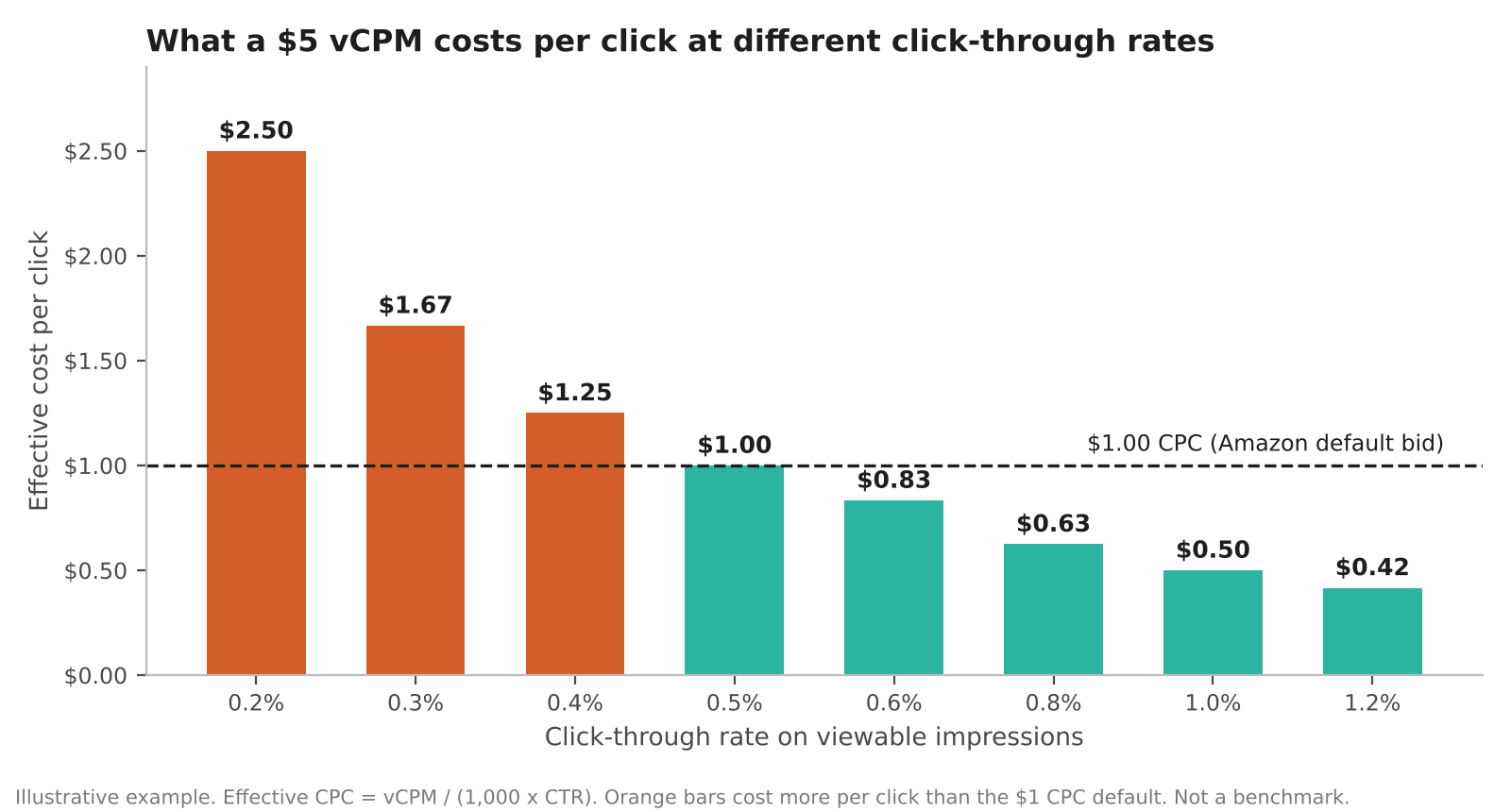 Figure 2: Effective cost per click from a $5 vCPM at different click-through rates. Illustrative.
Use effective CPC as a comparison tool, not the final decision metric. For conversion campaigns, compare cost per order, ROAS and the quality of the traffic. For awareness campaigns, prioritize viewable reach, frequency and new-to-brand customers where available. For context on click prices, see CMO's guide to Amazon CPC.
Five Use Cases for Amazon Display Advertising
Display ads do five jobs well: retargeting shoppers who viewed but didn't buy, supporting visibility on your own detail pages, conquesting competitor pages, bringing past buyers back, and prospecting new audiences. Each job needs its own targeting, billing type and success metric.
| Goal | Targeting | Billing | Judge it by |
|---|---|---|---|
| Retarget viewers | Views remarketing, your products | CPC, optimize for conversions | Purchases, ROAS |
| Defend your listings | Contextual, your own ASINs | CPC | Incremental sales on the defended ASINs |
| Conquest competitors | Contextual, competitor ASINs refined by price and rating | CPC | ACoS against break-even |
| Repeat and cross-sell | Purchases remarketing, your or complementary products | CPC | Repeat orders, sales of the cross-sold product |
| Prospect | Amazon audiences (in-market, interests) | vCPM | Reach, new-to-brand customers |
Retargeting is a common starting point. A shopper who viewed your product and left is a potentially high-intent audience.
Listing defense is the use case sellers often skip. Amazon says product-targeted display ads can appear on detail pages, including under the featured offer. Targeting your own ASINs gives your products an opportunity to appear in those placements, which supports cross-selling and defensive visibility. It doesn't guarantee placement or exclude competing advertisers. Your Buy Box health matters here too, since display ads stop serving when a product can't be bought.
You're also paying for traffic that's already on your page, so measure incremental value rather than assuming every attributed sale is new demand. Compare similar ASIN groups over equivalent periods, one with defense running and one without, and control for promotions, inventory, price and seasonality. A simple before-and-after pause test is directional evidence, not proof of incrementality.
Conquesting works best against competitors you beat on something a shopper can see in the ad: price, rating or Prime badge. Use the price and rating refinements to target only those pages.
Example: Setting Up a Retargeting Campaign
A retargeting campaign targets shoppers who viewed your products but didn't buy, bids for conversions on CPC, and is judged on orders and ROAS after attribution has matured. Here's how the settings fit together, step by step.
| Step | Setting | Why |
|---|---|---|
| 1. Objective | Re-engage shoppers who viewed your products | Defines the audience and the success metric before you spend |
| 2. Products | 10 or more related ASINs with similar prices and solid reviews | Amazon's recommendation; gives the ad more relevant options to serve |
| 3. Audience | Views remarketing on your advertised products | Reaches shoppers who already visited your detail pages |
| 4. Lookback | Match it to your buying cycle, for example 30 days for a considered purchase | Too long dilutes intent; too short shrinks the audience |
| 5. Bid strategy | Optimize for conversions, CPC billing | Amazon's recommended option for a first campaign |
| 6. Budget | Set from your available test budget, not a universal benchmark | Amazon's $40 to $60 a day is a starting suggestion for smaller businesses |
| 7. Review | After at least two weeks, once attribution has matured | Sales can take 7 to 14 days to be attributed |
| 8. Decision | Compare orders, ROAS and cost per order, alongside total sales and TACoS | Shows whether the campaign adds sales or only takes credit for them |
Illustrative setup based on Amazon's display ads guide. Adjust each setting to your catalog and margins.
Display Ads vs Sponsored Products
Sponsored Products targets keywords and products and captures shoppers who are already searching. Display ads don't use keywords. They reach shoppers on product pages, through audiences and off Amazon. Run Sponsored Products first, then add display to reach shoppers that search doesn't.
| Sponsored Products | Display ads (formerly Sponsored Display) | |
|---|---|---|
| Targeting | Keywords and products, manual or automatic | Products, categories and audiences. No keywords. |
| Main placements | Top of, alongside and within shopping results, and product pages | Detail pages, near reviews, under the featured offer, homepage, Twitch, third-party sites and apps |
| Billing | CPC | CPC or vCPM |
| Who can use it | Professional sellers, vendors, book vendors, KDP authors and agencies | Brand Registry sellers, vendors and agencies |
| Creative | Product image or video | Auto-generated, plus optional logo, headline, custom image or video |
| Best at | Capturing search demand | Retargeting, detail-page visibility and reach beyond search |
The two work together. Sponsored Products brings shoppers to the page from search. Display ads bring back some of the ones who left. One Sponsored Products rule matters here: a product must be eligible for the Featured Offer to be advertised, which is another reason to check your Buy Box before raising ad budgets.
Display Ads vs Amazon DSP and DVA+
Self-service display ads focus on product and audience targeting with CPC or vCPM billing. Amazon DSP provides broader programmatic capabilities, and DVA+ offers an automated, cross-format campaign type. These are different buying workflows, not three names for one product.
Amazon describes DVA+ as "a unified campaign type bringing together what was previously created through Amazon DSP, Sponsored Display, and Sponsored TV." It buys across streaming TV, online video and display on CPM, with no minimum spend, and its advanced settings unlock DSP-style targeting, deals and delivery controls. Amazon's managed service is separate and, according to its display ads page, typically requires a minimum spend of $50,000, varying by country.
| Display ads | DVA+ (self-service) | Managed service | |
|---|---|---|---|
| Billing | CPC or vCPM | CPM | Varies by format and placement |
| Minimum spend | None | None | Typically $50,000, varies by country |
| Formats | Image and video display | Streaming TV, online video, display; audio coming soon | Full range |
| Control | You set targets and bids | Automated, with advanced settings for targeting, deals and delivery | Amazon's team runs delivery |
| Best for | Retargeting and detail-page targeting for products sold on Amazon | Multi-format reach, including brands that don't sell on Amazon | Large budgets that want Amazon to manage campaigns |
Sources: Amazon Ads display ads and Display, Video, and Audio pages, checked November 16, 2026. Compare formats, controls, fees and objectives before choosing.
CMO's recommendation: get display ads working profitably on your core ASINs before moving budget into DVA+, unless your goal is reach beyond Amazon from the start. DSP deserves its own guide. For budget planning, see Amazon DSP minimum spend and CMO's Amazon DSP services.
How to Measure Display Ads in 2026
Since January 1, 2026, Amazon credits view-through sales for vCPM display campaigns using a shopping-signal enhanced last-touch model with a shorter window. Click-based attribution didn't change. Don't compare 2025 vCPM ROAS with 2026 numbers without adjusting.
Amazon's January 2026 update applies to Sponsored Brands, Sponsored Display campaigns billed on vCPM (including branded keyword campaigns), and Amazon DSP campaigns serving ads in the store. The new model credits ad views that reach shoppers during early discovery, such as general category searches. Standard Purchases, Sales and ROAS now use it.
The older view is still available. Amazon reports "all views" metrics, such as Purchases (all views), within a 14-day window in the Reporting (beta) tab and the API. If a vCPM campaign's ROAS dropped in January without other changes, check the all-views figures before you cut it. CMO's guide to Amazon advertising attribution covers this in more depth.
Three more rules:
- Allow attribution to mature. Amazon recommends evaluating display campaigns after at least two weeks of data and says sales can take 7 to 14 days to be attributed. For final conversion analysis, account for the attribution window and reporting delays.
- Use the purchased product report. It shows non-advertised products bought after a click, which tells you what to cross-sell or target next.
- Judge display on account totals, not ACoS alone. Retargeting and defense can take credit for sales that would have happened anyway. Watch TACoS and total sales alongside campaign ACoS. For deeper analysis of how display and search ads overlap, Amazon Marketing Cloud is available at no cost to eligible advertisers, with self-service access for sponsored ads advertisers; optional paid features cost extra. CMO's AMC guide explains access and use cases.
CMO structures display campaigns the way we structure the rest of a PPC account: by intent. Branded, competitor, category and defensive campaigns each get their own budget and their own success metric. A defensive campaign judged on the same ACoS target as a prospecting campaign gets cut for the wrong reasons.
Is your display spend working, or just taking credit?
CMO's Amazon PPC management starts with a full campaign audit across Sponsored Products, Sponsored Brands and display ads. Month-to-month, no long-term contracts.
Amazon Display Advertising: Questions Sellers Ask
Q Is Sponsored Display still available?
Yes, under a new name. Amazon now calls Sponsored Display "display ads." Existing campaigns keep running, and new campaigns are created from the Campaigns section in Amazon Ads Agent.
Q How much does Sponsored Display cost?
There's no minimum spend or management fee for self-service display ads. You pay per click or per 1,000 viewable impressions. Amazon's suggested starting bids are $1 CPC and $5 vCPM, but your actual cost depends on your bid and the auction.
Q Do I need Brand Registry to run display ads?
Sellers do. Display ads are available to professional sellers enrolled in Amazon Brand Registry, to vendors, and to agencies working for them. Sellers who aren't brand registered can still run Sponsored Products.
Q Should I choose CPC or vCPM?
Use CPC when the goal is sales and vCPM when the goal is reach or new-to-brand customers. To compare them, divide your vCPM by 1,000 times your click-through rate to get an effective cost per click, then check cost per order.
Q Do Amazon display ads show outside Amazon?
Audience-targeted display ads can appear on Twitch and on third-party sites and apps, as well as in the Amazon store. Contextual product and category ads appear in the Amazon store.
Q What's the difference between Sponsored Display and DSP?
Display ads are self-service, billed on CPC or vCPM, and focused on Amazon product pages and shoppers. Amazon DSP offers broader programmatic buying, and DVA+ runs automated campaigns across display, video and streaming TV on CPM. Amazon's managed service typically needs $50,000.