Quick Answer
Amazon Business services split into two sets. Buyers get a free account with multi-user access, business-only pricing, tax exemption, and optional Prime Business tiers adding spend controls and payment terms. Sellers on a Professional plan get B2B Central, business prices and quantity discounts, Manage Quotes, and business-only deals.
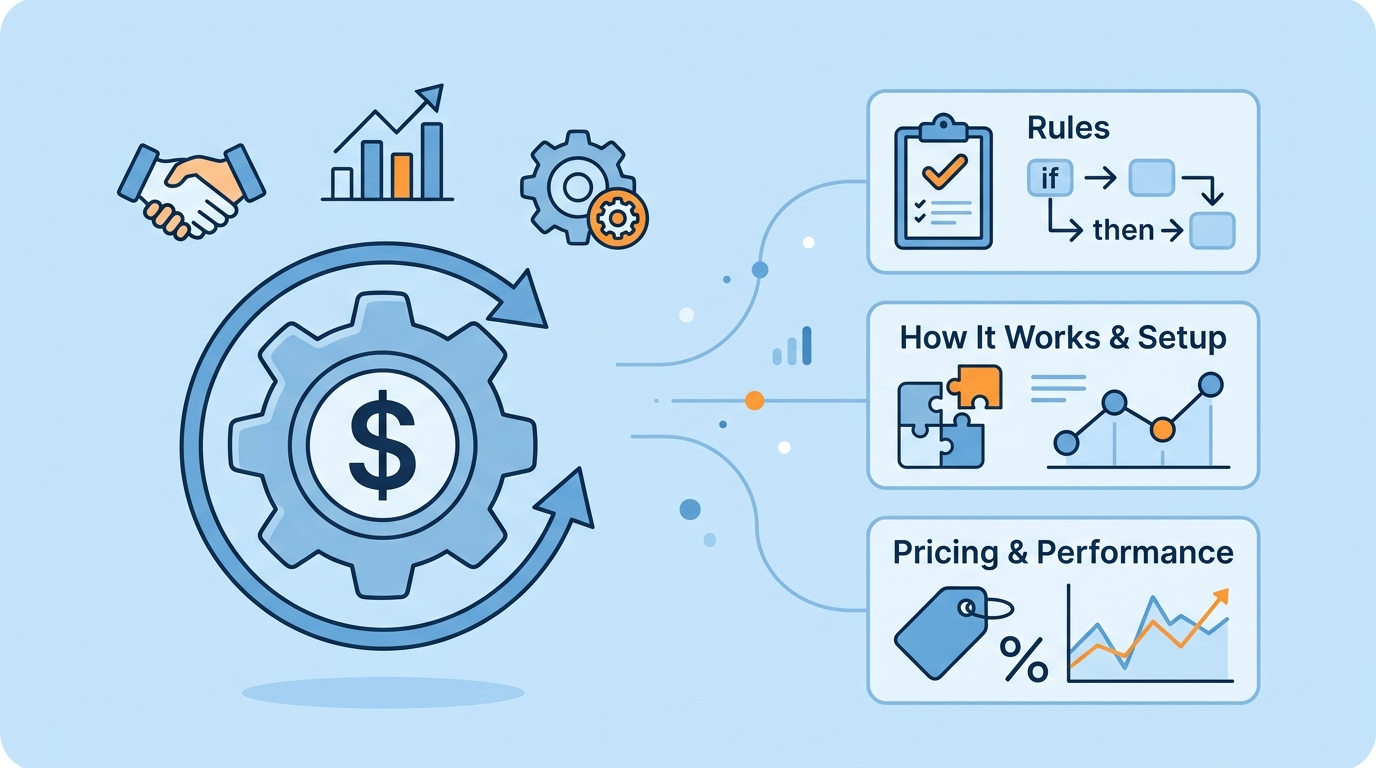
"Amazon Business services" means two different things. To a company buying on Amazon, it means account features, spending controls, and payment terms. To a brand selling on Amazon, it means the B2B tools inside Seller Central. Most pages cover one side. This one lists both, with what each costs and where to find it.
01
What Services Does Amazon Business Offer?
- Free Amazon Business account
with multi-user access and business-only pricing
- Prime Business
subscription tiers adding spend controls and analytics
- Tax exemption
through ATEP
- Business Credit Account
with extended payment terms on eligible plans
- Guided Buying and approval workflows
for purchasing policy
- Request for quote
on large orders
- B2B Central
in Seller Central, the seller-side hub
- Business Price and quantity discounts, plus Business Discount Insights
- Business-only deals, opened to third-party sellers in August 2026
- Seller credentials and product documents
shown to business buyers
Buyer services come first, then seller tools, then a master table of everything.
02
What Is Included in a Free Amazon Business Account?
No subscription is required for any of these:
- Multi-user accounts and roles.
Add colleagues with permission levels in business account settings.
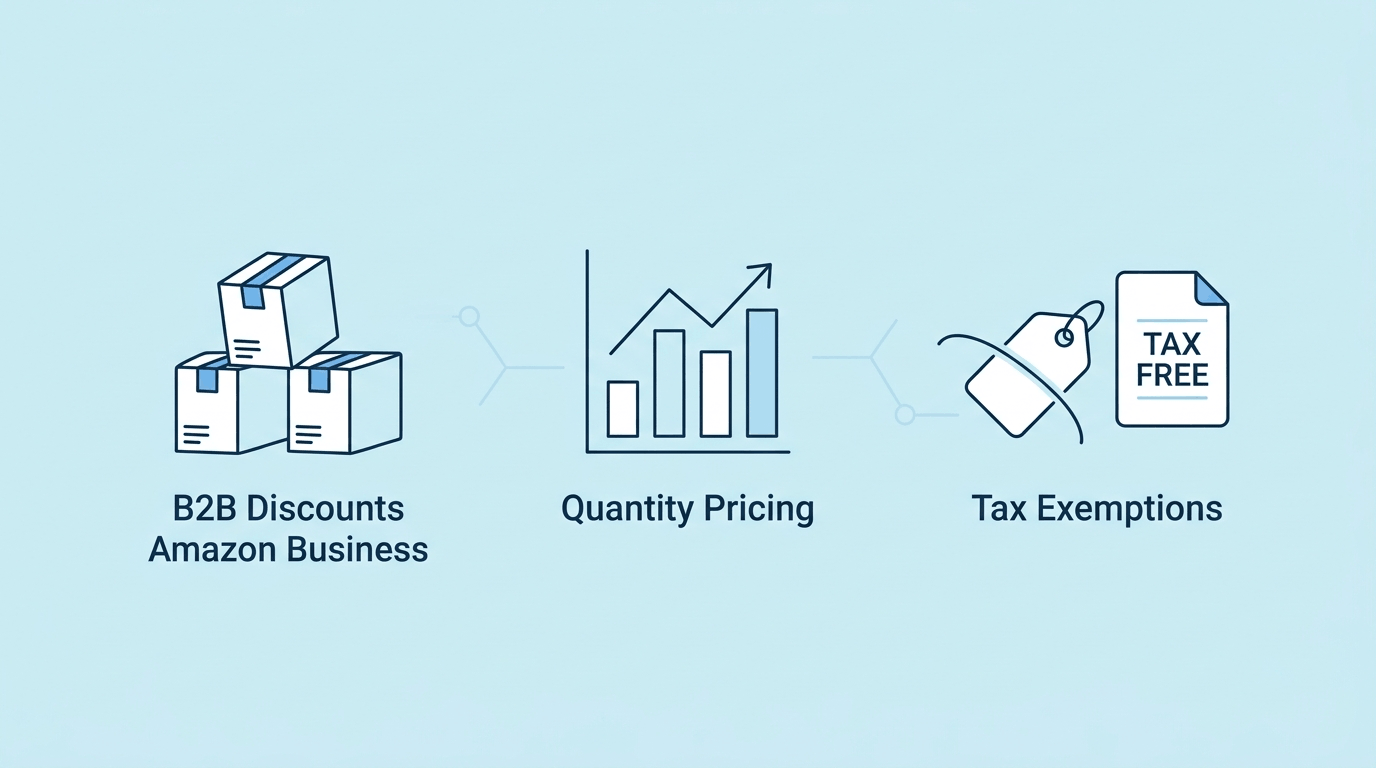
- Business-only pricing and quantity discounts.
Lower prices on eligible items that consumer accounts never see.
- Basic approval workflows.
Route orders above a threshold to an approver.
- Core Guided Buying.
Restrict or flag sellers and categories. Advanced policy types and hard blocks need a paid plan.
- Tax exemption through ATEP,
available to all Amazon Business accounts regardless of tier. Our Amazon Business pricing guide
covers the seller-side implications.
- Order tracking, reporting, and analytics
by user, department, or cost center.
- Invoice and reconciliation tools.
- Procurement integrations.
Punch-out and purchasing-system connections.
- Request a quote
on eligible large orders.
- Credential filtering
for certified, small, or diverse sellers.
03
Prime Business: What the Paid Tiers Add
Amazon now brands the subscription Prime Business. It is separate from personal Prime, and Duo requires a personal Prime membership.
| Plan |
Annual Fee |
Users |
Adds |
| Duo
|
Free with personal Prime |
Sole proprietors |
Fast, free business delivery; Prime Business Rewards |
| Essentials
|
$179 |
Up to 5 |
Spend Visibility and Guided Buying |
| Small
|
$499 |
Up to 20 |
45-day terms with Business Credit Account, on approval |
| Medium
|
$1,299 |
Up to 200 |
Extended approvals up to 14 days |
| Enterprise
|
$10,099 |
Unlimited |
60-day terms, Guided Buying hard blocks, Spend Anomaly Monitoring |
Prices and user limits confirmed on Amazon's Prime Business plans page, September 2026.
Payment and credit.
The Business Credit Account offers invoiced purchasing with terms, subject to credit approval. Extended terms of 45 or 60 days are tied to the Small, Medium, and Enterprise plans. Terms apply to Amazon Business purchases only, not your other supplier relationships.
04
Seller Tools: The Amazon Business Selling Program
Eligibility comes first.
All Professional sellers
can sell B2B. The Professional plan is $39.99 per month plus selling fees. There is no separate application, and older guides describing tools that appear "upon approval" are out of date.
Business Price and quantity discounts.
A per-unit price visible only to business customers, plus tiered discounts by quantity, set as percent off or fixed price. The business price must sit below your standard price, or buyers simply see the standard one. Changes can take up to 15 minutes to appear. Mechanics are in our pricing guide.
Business-only deals.
Amazon opened Amazon Business Deals
to third-party sellers on August 31, 2026. Sellers can create Fixed Price or Percent Off business-only deals lasting from one hour to 30 days. Eligible products must be new, have at least a 3.5-star rating, and meet Amazon's pricing and seller-performance requirements. Amazon currently requires at least a 10% discount for regular Business Deals and 15% for High Velocity Events such as Prime Big Deal Days, Black Friday, and Cyber Monday. Check current eligibility in Seller Central before scheduling.
B2B Central dashboards.
Use B2B Central to separate business performance from non-B2B sales and see which customer segments buy from you. Amazon's business reporting
includes industry-level performance, year-over-year growth, total sales, average order value, and quantity-discount impact. For discount changes, you can compare units sold, orders, and Featured Offer percentage before and after.
[SCREENSHOT PLACEHOLDER] B2B Central performance dashboard. Real, anonymized Seller Central capture, annotated with the metrics a seller should monitor rather than just the navigation.
Business Discount Insights.
Amazon surfaces up to 10 recommended products that may benefit from business pricing or quantity discounts, ranked by their potential to attract business customers. Generate the downloadable report
for catalog-level opportunities: glance views, B2B Featured Offer price, Business Savings Blue Badge price, and popular discount tiers. Use it to find where a pricing change is worth testing rather than discounting everything. Found under B2B, then Business Discount Insights.
Measure B2B pricing changes against a baseline.
Before changing a business price or discount tier, record the previous period's B2B sales, units, orders, average order value, and Featured Offer percentage. Compare the same metrics after the change over a consistent period, accounting for promotions, inventory, and seasonality. Amazon's quantity-discount reporting supports the comparison, but a lift after a pricing change is not proof the discount caused it.
Manage Quotes.
Business buyers request custom pricing on eligible bulk purchases, and sellers respond through Amazon's B2B tools. Treat each request as a margin decision: check requested quantity, available inventory, fulfillment cost, and acceptable per-unit margin before responding.
[SCREENSHOT PLACEHOLDER] Manage Quotes. Real, anonymized capture showing the buyer request, quantity, quote status, and response controls.
B2B and Case Pack Product Opportunities.
Amazon's recommendations of products business buyers are searching for, plus candidates for bulk or case pack offers.
Multi-unit and bulk order discounts.
Offer business discounts of 3% or more, and when business customers order two or more units, you can receive discounts on FBA fulfillment costs. Business orders over $1,000 of a single product can earn lower referral fee rates, reaching as low as 5% on the largest orders, for both FBA and merchant-fulfilled.
Seller credentials and product documents.
Quality credentials such as ISO 9001, and diversity or ownership credentials, are displayed to business buyers. Amazon verifies documentation but does not certify you. Product documents cover manuals, spec sheets, safety data sheets, and compliance certificates.
ATEP and B2B repricing.
Enroll in tax exemption handling, and keep business prices current with the Automate Pricing tool. Note that manual price edits in Manage Inventory remove a product from its automated rule.
05
How Do I Access Amazon Business Services?
Buyers:
Create a free Amazon Business account with your business details, complete verification, add users and roles, then decide whether a Prime Business tier earns its fee.
Sellers:
Confirm a Professional selling plan, then open B2B in the Seller Central main menu for B2B Central, Business Discount Insights, and Product Opportunities. Upgrading from Individual runs through Settings, Account Info, Your Services, Manage.
06
What Amazon Does Not Do for You
Amazon supplies the tooling. The operating work stays with the seller.
B2B pricing strategy.
Amazon recommends prices. It does not decide which SKUs should carry one, how deep the tiers go, or how B2B pricing interacts with your consumer price and distributor agreements.
Quote response.
Manage Quotes delivers the request. Someone has to price it, check margin and inventory, and answer while the buyer is still deciding.
Product documentation.
Spec sheets, manuals, safety data sheets, and compliance certificates have to be produced, kept current, and uploaded by you.
Credentials.
Amazon verifies documents but is not a certifying body and does not assist with obtaining credentials.
Catalogue decisions.
Which SKUs belong in B2B at all, at what case pack, and with what fulfillment model.
In our work with Amazon brands, enabling B2B tools is the easy part. The operating work comes afterward: deciding which SKUs deserve business pricing, responding to quote opportunities, maintaining product documentation, and reviewing B2B performance regularly. That is what full-service account management
covers.
07
The Complete List: Every Amazon Business Service at a Glance
| Service |
Side |
Cost / Access |
Where |
| Multi-user accounts and roles
|
Buyer |
Free |
Business account settings |
| Business-only pricing
|
Buyer |
Free |
Product pages |
| Approval workflows
|
Buyer |
Free (basic), paid plan (extended) |
Business account settings |
| Guided Buying
|
Buyer |
Free (core), Essentials+ (advanced), Enterprise (hard blocks) |
Business account settings |
| ATEP tax exemption
|
Buyer |
Free, all tiers |
Business settings, tax exemption |
| Spend Visibility
|
Buyer |
Essentials and above |
Business analytics |
| Spend Anomaly Monitoring
|
Buyer |
Enterprise |
Business analytics |
| Business Credit Account
|
Buyer |
Credit approval; 45 or 60-day terms on eligible plans |
Payment settings |
| Procurement integrations
|
Buyer |
Free, setup required |
Business account settings |
| Request a quote
|
Buyer |
Free |
Product page, eligible items |
| Business Price and quantity discounts
|
Seller |
Professional plan |
Manage Inventory or bulk upload |
| Business Discount Insights
|
Seller |
Professional plan |
B2B, Business Discount Insights |
| Business-only deals
|
Seller |
Professional plan, Business Price required |
Seller Central deals tools |
| B2B Central dashboards
|
Seller |
Professional plan |
B2B, B2B Central |
| Manage Quotes
|
Seller |
Professional plan |
Seller Central B2B tools |
| B2B and Case Pack Opportunities
|
Seller |
Professional plan |
B2B, Product Opportunities |
| Multi-unit and bulk order discounts
|
Seller |
3%+ business discount, qualifying orders |
Automatic on eligible orders |
| Seller credentials
|
Seller |
Professional plan, documents verified |
B2B credentials |
| Product documents
|
Seller |
Professional plan |
Listing management |
08
Amazon Business Services List: Questions Sellers and Buyers Ask
Is an Amazon Business account free?
Yes. Registration costs nothing, and business-only pricing, ATEP, multi-user access, and basic controls are included. Prime Business is the optional paid layer.
What's the difference between Amazon Business and Prime Business?
Amazon Business is the free account type. Prime Business is a subscription on top of it adding analytics, advanced policies, and extended payment terms. Personal Prime is separate from both and includes entertainment benefits that Prime Business does not.
Do sellers need to apply for B2B tools?
No. A Professional selling plan gives you the B2B menu in Seller Central.
Can I sell to business customers on an Individual plan?
Business buyers can purchase your listings, but the B2B toolset requires a Professional plan.
Does Amazon help sellers get diversity certifications?
No. Amazon verifies credential documents and displays them, but certification comes from third-party organizations.
Getting More From Amazon Business Than a Business Price
Most of these tools are free or already included in what you pay Amazon. The difficulty is the operating work behind them: pricing strategy, quote response, documentation, and deciding which SKUs belong in B2B. That is what we handle. See full-service Amazon account management.