Amazon Business Pricing Explained How B2B Discounts, Quantity Pricing and Tax Exemptions Work
Amazon Business pricing is the set of B2B-only prices a seller can offer verified business buyers: a business price below the standard consumer price, quantity discounts that reward bulk orders, and tax-exempt purchasing through ATEP. Buyers see these prices automatically when logged into a business account; consumers never do. As of August 31, 2026, there is a new reason it matters — Amazon opened a business-only deals type that prices against your Business Price, so any product without one is locked out of the promotion entirely.
Open the same product page logged in as a shopper, then as a verified business buyer, and you can see two different prices. Most sellers have never looked at the second one, which is a problem, because that is the price their highest-volume, lowest-return customers actually pay. This article explains that mechanism from both ends: what business buyers see and how to evaluate it, and how sellers configure it to win B2B revenue. If you are a buyer, the first third is for you. If you sell, the whole thing is, and the deadline in the middle is why now rather than someday.
What Is Amazon Business Pricing?
Amazon Business pricing is a set of per-unit prices, visible only to verified Amazon Business customers, that sit below the standard consumer price. Take a SKU listed at $10 to consumers; a seller can set an $8 business price that only logged-in business buyers see, while everyone else still sees $10. Structurally, the business price is not a separate listing. It is a separate price field on the same listing, so you manage one product with two prices attached. There is no extra fee to participate: B2B runs on the same Professional selling plan at $39.99 per month, with the normal referral and FBA fees you already pay. It does require a Professional account in good standing, since performance problems can affect eligibility, per Amazon's B2B pricing documentation.
Amazon Business vs Business Prime
These get confused constantly, so one clean distinction: Amazon Business is a free buyer account, and Business Prime is a paid membership layered on top of it that adds shipping and purchasing benefits. Sellers do not need Business Prime and never buy it to sell. It is worth understanding only because it shapes what your business buyers value — faster shipping and consolidated purchasing — alongside the price you set.
Is Amazon Business Cheaper Than Regular Amazon?
Sometimes, and not systematically. That is the honest answer, and it is more useful than the blanket "yes" most pages imply. Four things determine whether a business buyer actually pays less:
- Whether the seller set a business price at all. Many have not. A product with no business price shows the same price to everyone, so there is no B2B saving to find.
- How deep the business price goes. When one exists, it is often only a few percent below consumer. As a practitioner rule of thumb, not an Amazon standard, that gap frequently lands around 3 to 5 percent, though it varies entirely by seller and category.
- Order quantity. Quantity discounts kick in at tier thresholds, so a buyer purchasing one unit may save nothing while a buyer purchasing fifty saves meaningfully.
- Tax exemption. For a qualifying organization, removing sales tax can outweigh the price difference entirely, which is why the tax section below matters as much as the price.
Here is the seller-side flip on that buyer question: if your competitors have business prices and you do not, you are invisible on price to this segment even when your consumer price wins. A business buyer comparing offers sees their prices and not yours, and decides accordingly.
How Do Quantity Discounts Work on Amazon Business?
Quantity discounts give business buyers a lower per-unit price as order size grows, applied automatically at checkout based on how many units are in the cart. There are two constructions: percent off (a percentage reduction at a quantity threshold) and fixed price (a specific per-unit price at a threshold). You can set up to five tiers per product. A full tier ladder on a product with an $8 business price might look like this:
| Order quantity | Discount | Per-unit price |
|---|---|---|
| 1 to 4 units | Business price | $8.00 |
| 5 to 9 units | 5% off | $7.60 |
| 10 to 24 units | 10% off | $7.20 |
| 25 to 49 units | 12% off | $7.04 |
| 50+ units | 15% off | $6.80 |
The margin logic underneath is the part most sellers skip. Tier thresholds should map to real pack, case, or pallet economics, not round numbers that look tidy. A "10+" tier on a product that ships six to a case is a fulfillment problem disguised as a pricing decision — you are inviting an order quantity that breaks your packing and shipping math. Set thresholds where your costs actually step down.
Setting Business Prices and Quantity Discounts
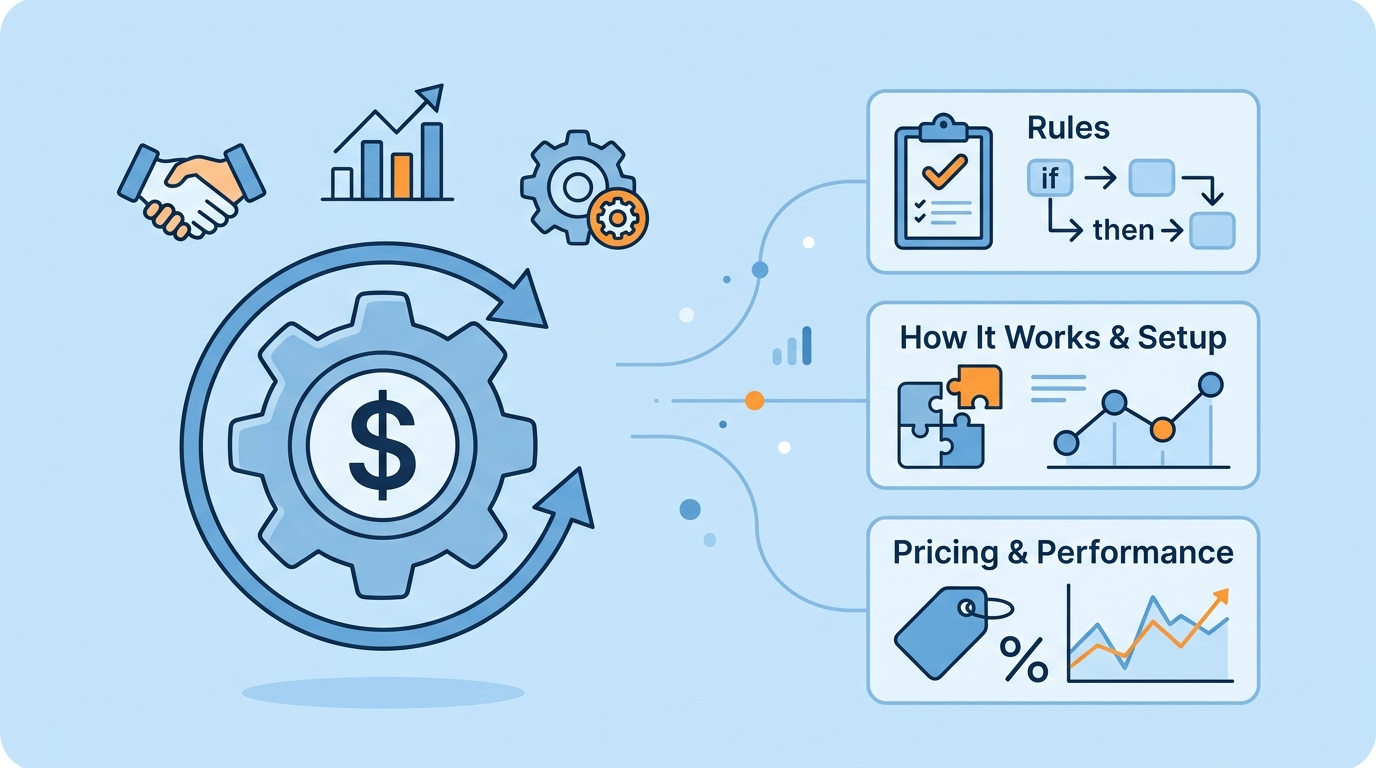
The path, verified against Amazon's current documentation: go to Inventory, then Manage All Inventory, and select the business price shown in the "Price and shipping cost" column. In the Business Price action panel, choose % off or Fixed Price, then Add more thresholds to build your tiers, up to five, and Save changes. If the business price field is not visible, enable it first through your business-price preferences and save.
The Business Price action panel: set the business price, choose percent-off or fixed-price, and build up to five tiers mapped to real pack economics.
One safeguard to know: the same minimum price threshold applies to both your standard and business prices, and if your price falls below that minimum, the pricing rule pauses for that SKU and the listing can be suppressed. Set your floor from real margin before you build tiers on top of it.
Bulk Setup
Past a few dozen SKUs, configuring prices one at a time stops being realistic. Amazon provides the Business Price/Quantity File, a feed template you download, fill, and upload to set business prices and quantity discounts across your catalog at once. This is the practical route for any catalog of real size.
Where to Watch Performance
B2B Central is where you see whether any of this is working: business order volume, top B2B ASINs, quantity discount performance, and buyer-segment data. You reach it through B2B in the Seller Central main menu, then B2B Central.
B2B Central shows business order volume, top B2B ASINs, and quantity-discount impact. Amazon does not surface it prominently, so many sellers never find it.
How Does Tax Exemption Work on Amazon Business?
Tax exemption is often the largest saving in B2B, and it runs on the Amazon Tax Exemption Program (ATEP).
What ATEP Is
On the buyer side, qualifying organizations have their exemption applied automatically at checkout, no per-order paperwork. On the seller side, Amazon collects and stores each buyer's exemption certificate per order in the Tax Document Library, so the documentation burden that would otherwise land on your team is handled by the platform.
Who Actually Qualifies
This is where competing content most often gets it wrong, so plainly: being a registered business does not by itself qualify anyone for tax exemption. Qualification requires a valid legal basis under state law plus acceptable documentation. The organizations that typically qualify are resellers buying for resale (using the RESALE exemption code), recognized nonprofits, federal, state, and local government, educational institutions, and direct payment permit holders. A business without a valid exemption basis pays tax like anyone else.
Enrollment
Buyers enroll through the Tax Exemption Wizard, manual entry is active in roughly 15 minutes, and uploaded documents can take up to 24 hours to process. Sellers enroll through their tax settings in Seller Central, and one detail catches people out: enrollment is often automatic when tax settings are saved unless you actively opt out, so some sellers are enrolled and do not realize it.
The Visibility Cost of Not Enrolling
Here is the part most seller content misses, and it costs more than the paperwork it saves. Business buyers can filter search results to sellers who accept tax exemptions. If you are not enrolled, you do not appear in those filtered searches, which means you are invisible to exactly the institutional buyers — schools, government, nonprofits, resellers — with the largest recurring orders. The real cost of non-enrollment is disappearing from the buyers most worth having.
New: Business-Only Deals (August 2026)
Last verified September 2026. The business-only deals feature launched two weeks before this was written. Details are recent and may shift — confirm in Seller Central's News and Announcements before acting.
On August 31, 2026, Amazon opened a business-only discount type to third-party sellers, reaching its 11 million business accounts across ten marketplaces (US, Canada, UK, Germany, France, Italy, Spain, Japan, Mexico, and Australia). You set it up through the Price Discounts tool in Seller Central, choosing a Fixed Price or Percent Off construction, with durations from one hour to 30 days. Deals require a product rating of 3.5 stars or higher and new condition, alongside standard pricing and performance requirements. The launch was reported across the trade press and announced through Seller Central's News and Announcements channel.
The mechanic that makes this urgent: the deal is calculated from your Business Price, not your public listing price. Any SKU without a Business Price is excluded from the tool entirely. Minimum discounts are 10 percent for standard deals, rising to 15 percent during Prime Big Deal Days, Black Friday, and Cyber Monday.
So the implication lands hard on any seller who skipped B2B pricing. You are not just missing a discount lever — you are locked out of an entire promotion type aimed at millions of business accounts, during the exact Q4 window when it matters most. And there is a real deadline: deals placed into major shopping events get free email and push-notification distribution through December 31, 2026. After that, the free promotional distribution ends. A seller with no business price cannot participate at all; a seller who sets one now can, before the free-distribution window closes.
Automating B2B Prices
You do not have to manage all of this by hand, but automation here has a blind spot worth knowing. Amazon's Automate Pricing includes a Business Price and Quantity Discounts rule type, one of several rule types the tool offers. Rather than rebuild that here, our guide to the Amazon Automate Pricing tool covers the full rule set.
The blind spot is third-party repricers. Most do not manage B2B quantity discount tiers at all, and those that support B2B typically reprice only the single-unit business price, letting Amazon derive the tier prices from it. The practical consequence: a seller running a standard repricer very likely has stale tiers — thresholds set once against costs that have since moved. If you run a repricer, verify what it is actually touching. Tiers built two years ago against today's costs are one of the more common and invisible margin leaks in B2B.
Is B2B Pricing Worth It for Your Catalog?
Not for every seller, and saying so is more useful than pretending otherwise.
Strong fit: office supplies, industrial, janitorial and sanitation, safety, electronics accessories, healthcare, breakroom — anything consumable or bought in multiples. These are the categories where a business genuinely orders five, or fifty.
Weak fit: single-purchase consumer goods, gifting, fashion, anything where a business buyer has no reason to order more than one. A quantity discount on a product nobody buys in bulk is effort with no return.
Then the margin test. A business price only makes sense if the incremental volume covers the per-unit give-up. A quick way to frame it: at a 5 percent business discount, you need enough additional unit volume to hold total contribution flat, which for thin-margin products can be a larger volume lift than the discount will realistically drive. Run that math before you discount, not after. If your catalog does not fit, the honest verdict is do not bother yet. Credibility on that point is worth more than a discount you will never see move.
B2B Pricing Is Now a Gate, Not Just a Discount Field.
B2B pricing is a configuration most sellers in eligible categories have never completed, and as of August 2026 it decides whether you can access an entire promotion type. The audit below is the fastest way to find out where you stand.
Free Amazon Audit: Is Your B2B Pricing Set Up, or Just Switched On?
Most sellers in eligible categories have never completed this configuration, and as of August 2026 it is a gate on promotion access, not just a discount field. We run a specific diagnostic: whether business prices exist across your catalog, whether your tiers match real pack and case economics, whether ATEP is enrolled and you appear in exemption-filtered searches, and whether your catalog qualifies for the new business-deals tool before the free-distribution window closes.
Because B2B buyers also expect different service standards on larger orders, our guide to Amazon Business customer service covers the operational side that keeps them reordering.
Frequently Asked Questions About Amazon Business Pricing
| What is Amazon Business pricing? |
| It is a set of B2B-only prices — a business price below your consumer price plus optional quantity discounts — visible only to verified Amazon Business customers on the same listing. Consumers continue to see your standard price. It runs on the same Professional selling plan at no extra fee, and it is how sellers compete for business buyers without changing their retail price. |
| Is Amazon Business cheaper than regular Amazon? |
| Sometimes, not systematically. It depends on whether the seller set a business price, how deep it goes, the order quantity relative to discount tiers, and whether the buyer qualifies for tax exemption, which can save more than the price difference. There is no blanket B2B discount across Amazon; it is set per SKU at each seller's discretion. |
| How do quantity discounts work on Amazon Business? |
| Sellers set tiered per-unit discounts, percent off or fixed price, that apply automatically at checkout based on order quantity, up to five tiers per product. For example, business price for 1 to 4 units, 5 percent off at 5 to 9, 10 percent off at 10 or more. Tiers should map to real pack or case economics rather than round numbers. |
| How does tax exemption work on Amazon Business? |
| Through ATEP, qualifying organizations have exemption applied automatically at checkout, and Amazon stores their certificates in the Tax Document Library. Qualification requires a valid legal basis under state law — resellers, nonprofits, government, education, and permit holders — not simply being a registered business. Sellers should enroll so they appear in exemption-filtered buyer searches. |
| Does it cost extra to sell on Amazon Business? |
| No. B2B selling runs on the same Professional plan at $39.99 per month, with the normal referral and FBA fees. There is no separate Amazon Business seller subscription; you enable the B2B tools on the account you already have. |
| What is the difference between Amazon Business and Business Prime? |
| Amazon Business is a free buyer account. Business Prime is a paid membership on top of it that adds shipping and purchasing benefits. Sellers never need Business Prime; it only shapes what your business buyers value alongside the price you set. |
| How many quantity discount tiers can I set? |
| Up to five per product, using either percent-off or fixed-price construction. Amazon applies the correct tier automatically based on the buyer's order quantity. |
| Do I need a business price to run B2B deals? |
| Yes. The business-only deals type Amazon opened to third-party sellers on August 31, 2026 calculates the discount from your Business Price, so any SKU without one is excluded from the tool entirely. Setting a business price is the prerequisite for participating. |
| Can business and consumer customers see different prices for the same product? |
| Yes. That is the core mechanism. The business price and quantity discounts are visible only to verified business buyers on the same listing, while regular consumers continue to see your standard price. One product, two prices, shown to two audiences. |

William Fikhman is the founder of Chief Marketplace Officer (CMO), a fractional Amazon executive agency based in Los Angeles, California. He began selling on Amazon in 2009, scaling to $5M in year one and $20M+ within two years. Over 16 years, William has managed Amazon operations for more than 100 consumer brands, overseeing $300M+ in marketplace revenue across Seller Central and Vendor Central. He founded CMO to give consumer brands access to senior-level Amazon leadership on a fractional basis — without the cost of a full-time hire or the limitations of a traditional agency. William specializes in brand protection, distribution control, Amazon PPC strategy, and marketplace operations.
Connect on LinkedIn |
Book a consultation
Recent Posts