The Hidden Costs of Overstocking How to Avoid Amazon FBA Storage Fee Traps
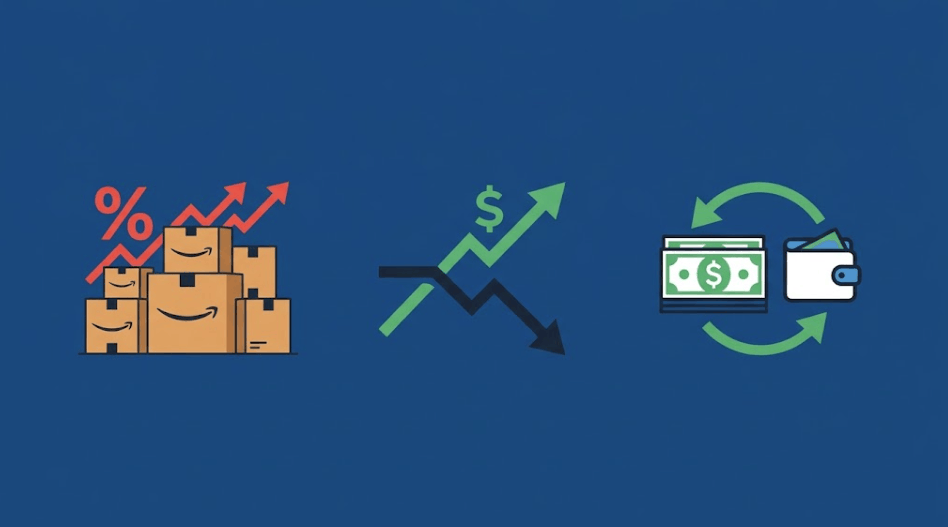
Amazon FBA storage fees are not a flat cost. They escalate based on how long inventory remains in fulfillment centers and increase significantly during Q4. Monthly storage fees apply to all inventory. Aged inventory surcharges apply when products have not sold within defined windows. The Inventory Performance Index ties overall account storage limits to how efficiently a seller manages this cost. Together, these three mechanisms make overstocking one of the fastest ways to erode FBA margins without any single fee appearing large enough to trigger a response.
Most FBA sellers discover they have an overstocking problem the same way: a monthly fee statement that is larger than expected, inventory that has been sitting in a fulfillment center for longer than they realized, and a margin calculation that was built without accounting for storage as a variable cost per unit. By the time the fees become visible, they have typically been accumulating for months.
Amazon's FBA fee schedule is structured to incentivize fast-moving inventory. Every element of it, from monthly storage to aged inventory surcharges to the Inventory Performance Index, functions as a financial signal about whether a product is earning its warehouse space. Brands that read that signal proactively prevent fee accumulation. Brands that read it reactively pay for the months they missed.
How Amazon's FBA Fee Structure Is Actually Designed
Amazon charges for storage through three distinct mechanisms that compound against each other. Understanding the relationship between them is the starting point for managing inventory economics on FBA.
Monthly storage fees are the baseline. Amazon charges per cubic foot of space occupied, assessed on inventory levels at the end of each month. The rate is not flat across the year: October through December carries a significantly higher rate than January through September because Amazon's fulfillment network is operating at peak capacity during Q4. Sending excess inventory to Amazon before Q4 without a plan to sell it before the rate change is one of the most common and most expensive inventory decisions FBA sellers make.
Aged inventory surcharges are the escalating penalty. Inventory that remains in a fulfillment center beyond defined windows incurs additional fees on top of the standard monthly storage rate. Unlike monthly storage fees, which apply to all inventory, aged inventory surcharges specifically penalize units that are not selling at a rate that justifies their fulfillment center occupancy.
The Inventory Performance Index creates the systemic consequence. A low IPI score, driven by excess inventory, low sell-through rates, stranded inventory, or in-stock problems, reduces the seller's FBA storage limits. Reduced storage limits constrain the seller's ability to restock fast-moving products during the periods when they most need inventory availability.
Monthly Storage Fees: The Baseline Cost Every Inventory Decision Should Account For
The storage fee per cubic foot varies by product size tier and by time of year. Standard-size products and oversize products carry different rates, and the Q4 rate increases significantly across both categories.
| Fee Period | Product Size | What Drives the Cost |
|---|---|---|
| January through September | Standard-size | Cubic feet at month-end inventory snapshot, off-peak rate |
| January through September | Oversize | Cubic feet at month-end, lower per-unit rate than standard-size |
| October through December (Q4) | Standard-size | Same cubic-foot calculation at significantly higher Q4 rate |
| October through December (Q4) | Oversize | Same calculation at a meaningfully higher Q4 premium than off-peak |
The rate difference between off-peak and Q4 storage makes the timing of inventory shipments to Amazon one of the highest-leverage inventory decisions in the FBA calendar. A product with a 120-day sell-through rate shipped to Amazon in August will sit through the Q4 rate window at a storage cost meaningfully higher than the same product shipped in January. Amazon publishes its current fee schedule in Seller Central and updates it periodically. Verifying the current rates before building any inventory cost model prevents planning against outdated figures.
Aged Inventory Surcharges: When Slow-Moving Stock Becomes a Separate Cost Layer
Under Amazon's current fee schedule, aged inventory surcharges begin at 181 days, with higher surcharge tiers applying to inventory that remains beyond that window. The surcharge applies on top of, not instead of, the standard monthly storage fee. Amazon has revised aged inventory fee thresholds and rates multiple times, so verifying the current structure against Amazon's published fee documentation before modeling inventory costs is the right practice.
The 181-day threshold is the operationally critical one because it is reachable within a single inventory cycle for products with seasonal demand patterns or slower-than-expected sell-through. A product sent to Amazon in September that has not sold by March has crossed the 181-day mark. A product sent in a larger-than-needed quantity that is still partially in stock at month seven is paying both monthly storage and the aged inventory surcharge simultaneously.
The higher-tier surcharge for inventory remaining beyond 365 days typically indicates a more significant inventory management failure: a product that either stopped selling entirely, was overstocked by a wide enough margin that even normal velocity could not clear it within a year, or was not being monitored in a multi-ASIN catalog where low-velocity products accumulate costs without triggering alerts.
The Inventory Performance Index and What It Controls
The Inventory Performance Index is Amazon's measure of how efficiently a seller is using FBA storage. It is calculated from four components: excess inventory percentage, sell-through rate, stranded inventory rate, and in-stock rate. Under Amazon's current policy, maintaining an IPI score of 400 or higher generally avoids storage limits, though Amazon has adjusted this threshold in the past and may do so again.
The IPI creates a structural link between storage efficiency and growth capacity. A brand with a low IPI score cannot simply increase FBA inventory to drive higher sales volume. They are limited by the storage space Amazon allocates to them until the score improves. This means the fees paid on slow-moving inventory do not just cost margin dollars directly: they cost storage capacity that could have been used for fast-moving products.
Excess Inventory as the Primary IPI Driver
Excess inventory is consistently the largest
single driver of IPI decline. Amazon defines excess inventory as units unlikely to sell within the next 90 days
based on recent sales velocity. When excess inventory as a percentage of total inventory rises, the IPI score
falls and storage limits contract. The inventory audit that prevents this from compounding is the same audit
that prevents fee accumulation in the first place.
Stranded Inventory Creates Storage Fees Without Sales
Stranded inventory occurs when FBA
units remain in fulfillment centers but are not connected to an active, purchasable listing: the ASIN has been
suppressed, a pricing error prevented the listing from going live, or a compliance issue removed it from search.
The units continue accumulating monthly storage fees while generating zero sales and no sell-through rate
contribution.
In the IPI calculation, stranded inventory is treated as a distinct inefficiency that reduces the score independently of sell-through performance on active listings. A product stranded at 200 units for three months generates storage fees, reduces the IPI score, and constrains storage capacity for active products simultaneously. The Stranded Inventory report in Seller Central identifies these cases, and resolving the underlying listing issue is the only path to clearing the fee and IPI impact.
The Inventory Audit That Prevents Fee Accumulation
Preventing Amazon FBA storage fee accumulation requires a consistent audit cadence rather than a reactive response to the monthly fee statement.
The Inventory Age report in Seller Central shows units grouped by days in the fulfillment center. Units approaching 150 days, with 30 days before the aged surcharge triggers, require an immediate decision: accelerate sell-through, create a removal or liquidation order, or accept the surcharge and factor it into the unit's updated profitability calculation.
The decision to remove aged inventory is frequently deferred because removal orders have an associated cost. The correct calculation compares the removal fee per unit against the ongoing monthly storage cost plus any imminent aged surcharge per unit. In most cases where a product is not expected to sell within 30 to 60 days, removal is often less expensive than continued storage for two to three months.
Increasing advertising spend on products approaching aged inventory thresholds is one of the fastest levers for improving sell-through rate on slow-moving stock. The cost of the additional spend should be weighed against the cost of the surcharge to determine which lever is more efficient. This is one of the inventory management functions that structured Amazon PPC management applies with precision rather than as a blanket campaign increase.
Sending 90 days of supply to Amazon rather than 180 requires more frequent replenishment but eliminates the risk of paying Q4 storage rates on inventory intended for standard-period sales. The trade-off between shipment frequency cost and storage fee reduction favors shorter replenishment cycles for most products, particularly during the months leading into Q4.
When Amazon Warehousing and Distribution Makes More Sense
Amazon Warehousing and
Distribution (AWD) is a bulk storage and replenishment service that allows sellers to hold inventory outside the
FBA network at lower per-unit storage costs, automatically replenishing FBA stock as needed. For products with
high sales velocity but unpredictable demand spikes, AWD reduces the risk of holding excess units in FBA
fulfillment centers while maintaining the ability to restock quickly. Brands managing large volumes of pre-Q4
inventory often use AWD to hold bulk stock until FBA replenishment is needed, avoiding the Q4 storage premium on
inventory that is not yet ready to be sold.
What We Consistently See in Overstocked FBA Accounts
Across the account audits we conduct, the overstocking pattern follows a predictable sequence. A product had a strong launch period. The seller increased the reorder quantity to avoid stockouts. Velocity was normalized, but the reorder quantity was not. Six months later, the Inventory Age report shows a significant portion of that ASIN's units in the 150- to 270-day range; the aged surcharge has started applying; and the IPI score has fallen enough to restrict storage limits on the same seller's fastest-moving products.
The true storage cost is almost always larger than the seller estimates until they calculate it at the unit level. A product with 400 units in the 180-day-plus window accumulates aged surcharges that frequently exceed the total margin contribution of those units at their current sell-through pace. The product is no longer profitable when the storage cost is included in the per-unit calculation. It is creating a net loss while the seller waits for it to eventually clear.
Structured Amazon account management at the catalog level runs the Inventory Age report as a standing weekly review rather than a monthly reactive check, catches the 150-day mark before it becomes a 181-day surcharge, and maintains a replenishment model that accounts for storage cost as a variable that changes with time in fulfillment.
Storage Fees Appearing on Your Monthly Statement That Were Not in Your Margin Model?
By the time the fee appears, the cost has already been accruing for weeks. The correction happens in the inventory audit cadence, not the accounting review.
What Sellers Ask About Amazon FBA Storage Fees
| What are Amazon FBA storage fees? |
| Monthly fees Amazon charges per cubic foot of space occupied in its fulfillment centers. The rate depends on product size tier and time of year, with a significantly higher rate applied from October through December. They apply to all inventory regardless of sales velocity and are assessed based on month-end inventory levels. |
| What are Amazon aged inventory surcharges? |
| Under Amazon's current fee schedule, additional fees are applied to inventory that remains in fulfillment centers beyond defined windows, beginning at 181 days. They apply on top of, not instead of, standard monthly storage fees. Amazon has revised these thresholds over time, so verifying the current structure in Seller Central before modeling inventory costs is recommended. |
| What is the Inventory Performance Index and why does it matter? |
| A score Amazon calculates from excess inventory rate, sell-through rate, stranded inventory rate, and in-stock rate. Under Amazon's current policy, maintaining a score of 400 or higher generally avoids storage limits. Sellers below the threshold have FBA storage capacity restricted, limiting their ability to restock fast-moving products while the score recovers. |
| When is it better to remove FBA inventory than to keep paying storage fees? |
| When the removal fee per unit is less than the ongoing monthly storage cost plus any imminent aged surcharge per unit, calculated over the expected remaining weeks until the product sells. In most cases where a product is not expected to sell within 30 to 60 days, removal is often less expensive than continued storage for two to three months. |
| What is Amazon AWD and how does it reduce storage fees? |
| Amazon Warehousing and Distribution is a bulk storage service outside the FBA network with lower per-unit storage costs that automatically replenishes FBA inventory as needed. Brands use AWD to hold pre-season or bulk inventory at lower cost until FBA restocking is required, reducing exposure to Q4 storage premiums on inventory not yet ready to be sold. |

William Fikhman is the founder of Chief Marketplace Officer (CMO), a fractional Amazon executive agency based in Los Angeles, California. He began selling on Amazon in 2009, scaling to $5M in year one and $20M+ within two years. Over 16 years, William has managed Amazon operations for more than 100 consumer brands, overseeing $300M+ in marketplace revenue across Seller Central and Vendor Central. He founded CMO to give consumer brands access to senior-level Amazon leadership on a fractional basis — without the cost of a full-time hire or the limitations of a traditional agency. William specializes in brand protection, distribution control, Amazon PPC strategy, and marketplace operations.
Connect on LinkedIn |
Book a consultation
Recent Posts