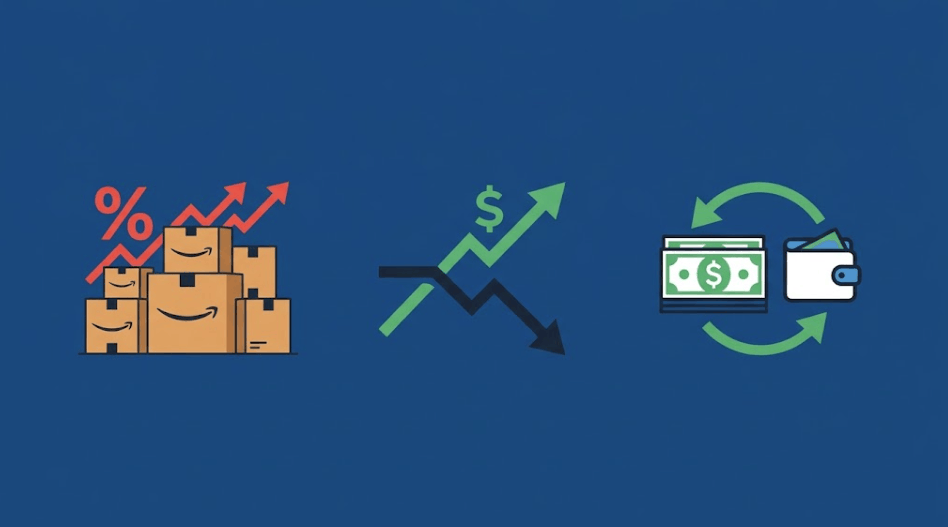
ACoS (Advertising Cost of Sale) = ad spend divided by ad revenue. A $500 spend generating $2,000 in ad revenue = 25% ACoS. A lower ACoS means better profitability. A rising ACoS without organic rank growth means your budget is working against you.
Most brands discover this the hard way. Ad spend climbs. Revenue does not keep pace. The instinct is to cut budget or increase bids. Both responses frequently make the problem worse. What rising ACoS actually requires is structural diagnosis, and that is where professional PPC management produces results that reactive bid adjustments never will.
ACoS vs. TACoS: Why Both Numbers Matter
Reading ACoS Correctly
ACoS is ad spend divided by ad-attributed revenue. At a 35% gross margin, any ACoS above 35% means advertising is losing money on a contribution basis. Industry benchmarks range from 15% to 30% across most categories, with meaningful variation by margin, competitive intensity, and campaign objective. New product launches may run above 40% intentionally to build organic rank. The number that matters is not the category average. It is your specific break-even threshold, which is your gross margin percentage and nothing else.
Most brands running self-managed campaigns have never calculated that number explicitly. Which means they cannot tell whether their advertising is profitable at all.
Why TACoS Tells the Structural Story
TACoS measures ad spend as a percentage of total revenue including organic sales. A brand with 40% ACoS and 12% TACoS is spending aggressively on paid but generating strong organic lift alongside it. A brand with 25% ACoS and 22% TACoS has efficient-looking ads producing almost no organic growth. Improving Amazon advertising ROI requires managing both numbers because TACoS is where the compounding returns of a well-structured account actually appear. ACoS tells you about today. TACoS tells you about the trajectory.
The 5-Step ACoS Reduction Framework
Effective ACoS reduction follows a consistent structural sequence. Each step addresses a specific failure mode that is costing money every day campaigns run without it.
Eliminate waste through negative keyword sculpting
Segment match types into discovery and performance layers
Harvest converting queries biweekly into exact match
Adjust bids by placement type and time-of-day patterns
Audit and restructure campaign architecture to reflect current performance data
Five Tactics That Reduce ACoS and Improve Amazon Advertising ROI
1. Negative Keyword Sculpting
The fastest path to reducing ACoS on Amazon in most accounts is not better bidding. It is stopping spend on searches that cannot convert. The Search Term Report reviewed every two weeks reveals which queries are consuming budget without generating purchases. Those queries are added to the negative keyword list at the campaign or ad group level.
A typical account audit reveals that 20% to 40% of total ad spend flows to queries that have never converted. Redirecting that spend to validated keywords produces immediate ACoS improvement without requiring any increase in total budget. Eliminate the drain before adjusting anything else.
2. Match Type Segmentation
Running all keywords on broad match is the single most common structural cause of high ACoS in self-managed accounts. Broad match expands semantic reach and is valuable for discovery. It is destructive for Amazon ad spend efficiency when it represents the majority of campaign spend.
The correct architecture separates match types by function. Broad match and automatic campaigns serve as the discovery layer, running at controlled daily budgets to surface new converting queries. Exact match campaigns serve as the performance layer, populated only by queries proven to convert at acceptable ACoS. Phrase match bridges the two. This separation is what makes PPC bid optimization precise rather than approximate, because each match type has a defined purpose rather than competing for the same budget.
3. Search Term Harvesting
Search term harvesting is the recurring process that connects the discovery layer to the performance layer, and it is the process most self-managed accounts skip. Every two to four weeks, converting queries from broad and automatic campaigns move to exact match campaigns with optimized bids. Non-converting queries are negated.
After six months of consistent harvesting, the exact match portfolio reflects only queries that have earned their place through conversion data. Amazon ad spend efficiency compounds over time because budget concentrates progressively on validated, high-intent traffic. This is the mechanism through which an agency-managed account becomes more efficient month over month while self-managed accounts stay flat or drift.
4. Bid Adjustments by Placement and Daypart
Amazon allows bid adjustments by placement type: top of search, rest of search, and product pages. Agencies audit placement performance data and apply specific bid multipliers to shift sponsored products spend toward placements delivering acceptable ACoS and away from those that are not. A brand running standard bids across all placements is almost certainly overpaying for some and underpaying for others simultaneously.
Dayparting adds a further efficiency layer. Categories with strong weekday morning purchase intent warrant higher bids during those windows and reduced bids during overnight hours where impression costs are similar but conversion probability is lower. This level of granular management is difficult to sustain manually and essentially never happens in self-managed accounts.
5. Campaign Structure Audits
Legacy campaigns accumulate structural debt: ad groups mixing high and low performers, budgets allocated by historical convention rather than current data, duplicate keyword targeting causing a brand to compete against itself. A campaign structure audit identifies these problems and restructures the account so budget allocation reflects actual performance.
This step produces the largest single-period ACoS reduction because it eliminates structural waste that was present all along, not because it changes what the campaigns are targeting. Our team runs this as a standard onboarding step through Amazon PPC management at CMO, and it is where most accounts show their first meaningful improvement within the first 30 days.
6. Keyword and Listing Alignment
A keyword absent from the listing title, bullets, or backend search terms underperforms in paid campaigns because Amazon uses listing content as a relevance signal for ad placement quality. Low relevance produces lower impression share at the same bid and a higher effective CPC, which directly raises ACoS.
Before scaling spend on any keyword, confirm it is present in the listing. This is a recurring audit that runs alongside the harvesting cycle. Treating keyword strategy and listing optimization as a single integrated workstream rather than two separate functions is one of the structural disciplines that separates agency-managed PPC at CMO from accounts where each function runs independently.
Before and After: What Structural ACoS Improvement Looks Like
A supplement brand came to our team with a 58% blended ACoS across their Sponsored Products campaigns. Monthly ad spend was $18,000 with $31,000 in attributed ad revenue. Gross margin was 42%, meaning every advertising-generated sale was losing money on a contribution basis.
The audit identified three structural problems. Sixty-two percent of spend was on broad match with no exact match separation. The Search Term Report showed 34 high-spend queries with zero conversions over 90 days. Two campaigns had overlapping keyword targeting causing self-competition.
Over 90 days: negative keyword sculpting, match type segmentation, a biweekly harvesting cycle, and placement bid adjustments. ACoS fell from 58% to 29% on the same monthly budget. Attributed ad revenue increased from $31,000 to $52,000 because spend concentrated on validated, high-intent exact match keywords.
The budget did not change. The structure changed.
The Agency as an ROI Lever, Not a Cost
The most common objection to professional PPC management is the agency fee. The accurate frame is opportunity cost. A brand running 55% ACoS on $20,000 per month is spending $11,000 above a 35% break-even target. Bringing that account to 30% ACoS on the same budget recovers $5,000 per month in contribution margin. The agency fee is not an additional cost. It is a fraction of the recovered margin, and it compounds as organic rank improves and TACoS declines.
The brands that achieve durable Amazon advertising ROI do so because structural improvement is running as a continuous operational discipline, not a quarterly project. The harvesting cycle runs every two weeks. The negative keyword list grows every review period. The campaign structure reflects current performance, not launch-day assumptions. That continuous process is what self-managed accounts cannot consistently sustain, and it is where the performance gap between professionally managed and self-managed PPC compounds over time.
Final Thoughts
Reducing ACoS on Amazon is not a bidding problem in most accounts. It is a structural problem. Negative keyword sculpting, match type segmentation, search term harvesting, placement bid adjustments, campaign structure audits, and listing alignment each address a specific structural failure that is generating waste every day campaigns run without them.
The difference between a 55% ACoS and a 28% ACoS on the same product and the same budget is almost always the process running between those two numbers, not the keywords that started the campaigns.
If your ACoS is above your break-even margin or your ad spend is growing without a corresponding improvement in organic rank, the structure of your campaigns is where to start. Book a consultation with our team to find out what your current setup is costing you beyond the ad spend itself.
What Brands Ask Before Fixing Their Amazon ACoS
What is a good ACoS on Amazon?
Typically 15% to 30% depending on category, but your break-even ACoS (your gross margin percentage) is the only number that determines whether your advertising is actually profitable.
How does an Amazon PPC agency lower ACoS?
Through structural fixes: eliminating non-converting spend via negative keywords, separating match types into discovery and performance campaigns, and running a biweekly harvesting cycle that concentrates budget on validated exact match keywords.
How long does ACoS improvement take?
Meaningful reduction is visible within 30 to 60 days from structural fixes. The compounding gains from a consistent harvesting cycle build over 90 to 180 days as the exact match portfolio accumulates validated, profitable keywords.
What is the difference between ACoS and TACoS?
ACoS measures ad efficiency within the paid channel only. TACoS measures ad spend against total revenue including organic, making it the more meaningful metric for assessing whether advertising is building compounding growth or simply sustaining paid revenue.