Amazon Brand Protection That Defends Your Marketplace Presence
Your brand is one of your most valuable assets, but without active protection, unauthorized sellers and counterfeit listings can reduce profits, weaken customer trust, and take control of your Buy Box.
We combine Amazon Brand Registry management with continuous monitoring and enforcement to identify violations, remove infringing sellers, and protect your listings using Project Zero, Transparency, and Amazon's brand protection tools.
What we run
Enrollment is the door. Enforcement is the work.
Brand Registry is one of Amazon's most powerful programs and one of the most consistently underused. Plenty of brands enroll once and stop there, which leaves them barely better off than the brands that never enrolled at all.
The value sits in what Registry unlocks: Report a Violation, Project Zero, Transparency, A+ Content, Brand Analytics, Vine, and Brand Stores. None of them work on autopilot. We handle the enrollment and then run the tools it opens up as a repeating cycle, watching the listings, gathering the evidence a takedown needs, and filing the enforcement action.
Amazon Brand Registry
Enrollment, trademark coordination, and active management of everything Registry unlocks. If your trademark is pending or not yet filed, we can connect you with Amazon's IP Accelerator program.
- Enrollment and trademark coordination
- Project Zero setup and Transparency for high-risk SKUs
- Report a Violation management
- Brand Analytics, Vine, and Brand Store
Amazon Brand Protection
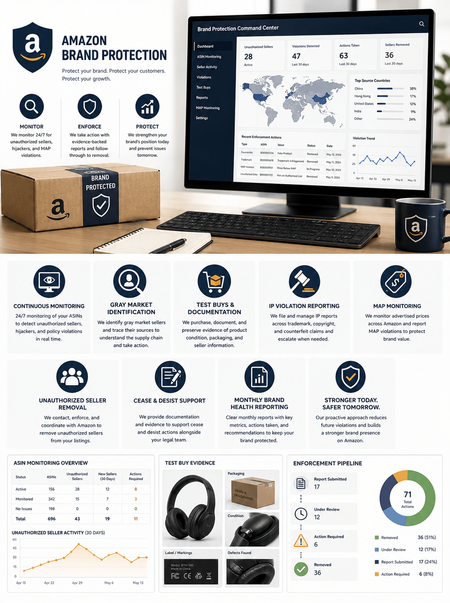
Continuous monitoring, source identification through test buys, and enforcement against unauthorized sellers, hijackers, and MAP violators. Proactive rather than reactive.
- Unauthorized seller monitoring and removal
- Test buys and gray market source tracing
- IP violation reporting and escalation
- MAP enforcement and cease and desist support
Brands whose Amazon presence we protect:
 Anna Griffin
 Toki
Toki
 Jatai
Jatai
 Korres
 Abbott
 Bianco DiNapoli
 Christina USA
 The Pause Group
The cost
What unauthorized sellers are actually costing you
Most brands discover brand protection problems late, and by then the damage is already done. Here is what happens on your listing while you are focused on running the business.
Margin erosion
A seller sourcing your product through diverted inventory or gray market channels will undercut your price to move volume. When they win the Buy Box, your authorized retailers lose it. Customers buy from someone you did not choose, at a price you did not set, with service standards you cannot control. The revenue shows up in someone else's account and the brand damage shows up in yours.
Listing damage
Hijackers attach themselves to your ASIN and sell counterfeit or non-compliant versions of your product. The reviews they generate hit your listing and the returns they cause hurt your metrics. Customers blame your brand for a product you never made, and by the time the hijacker is gone, the listing still carries the record of everything they did.
The reactive trap
By the time a hijacker is identified and removed, they have already collected reviews, received returns, and potentially triggered compliance flags on your listing. Early monitoring is the only way to prevent that damage rather than clean it up afterward. Brands waiting for a customer complaint to surface the problem are always operating behind it.
Know what you are dealing with
Not every unauthorized seller comes off the same way
The enforcement path depends on the type of seller and the evidence available. Choosing the wrong one produces delays that cost real revenue.
| Seller type | What they are doing | How it gets resolved |
|---|---|---|
| Counterfeit seller | Selling a fake version of your product against your ASIN, generating reviews and returns that land on your listing. | Fastest path. Project Zero self-removal or an IP violation report through Brand Registry, backed by test buy evidence. Typically moves in days to weeks. |
| Listing hijacker | Attaching to your ASIN with non-compliant or misrepresented product, often winning the Buy Box on price. | Brand Registry reporting supported by documentation of the condition and source. Speed depends on the evidence available at the time of filing. |
| Gray market reseller | Selling genuine product sourced through diverted wholesale or international channels, outside your distribution agreements. | Hardest to remove, because the product is real and counterfeit tools do not apply. Requires source tracing, distribution policy, and direct outreach. |
| MAP violator | Advertising below your minimum advertised price, pulling the whole category down with them. | Amazon does not enforce MAP. Resolution runs through seller agreements, monitoring, selective distribution, and outreach to the violator. |
The detail
What each service covers
Open only what you need. Every engagement covers the full operation rather than individual enforcement actions on request.
Amazon Brand Registry
Enrollment, and everything it unlocks afterward
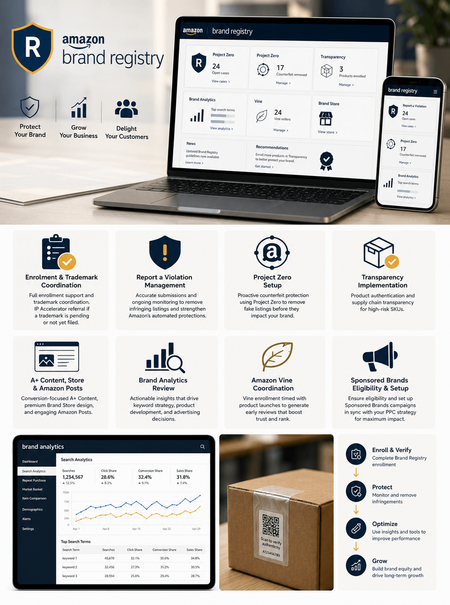
Enrollment requires either a registered trademark or a pending application. We manage the application, resolve errors, and can refer you to Amazon's IP Accelerator program. After enrollment, we actively manage Report a Violation, Project Zero, Transparency, A+ Content, Brand Analytics, Vine, and Brand Stores as a repeating cycle.
- Enrollment and trademark coordination, with IP Accelerator referral if needed
- Report a Violation management and IP infringement monitoring
- Project Zero setup and counterfeit removal
- Transparency implementation for high-risk SKUs
- A+ Content creation, Brand Store build, and Amazon Posts
- Brand Analytics review and Amazon Vine coordination
- Sponsored Brands eligibility and setup, coordinated with PPC
Amazon Brand Protection
Monitoring, evidence, and enforcement
Proactive rather than reactive. We monitor your ASINs continuously for new third-party sellers, identify who they are and where they are sourcing from, and work out how to remove them. Test purchases give us evidence of source and product condition. Without that documentation, many enforcement paths are unavailable or significantly slower.
- Continuous ASIN monitoring for unauthorized seller activity
- Gray market seller identification and source tracing
- Test buy documentation for enforcement actions
- IP violation reporting across trademark, copyright, and counterfeit claims
- MAP pricing monitoring and violation reporting
- Unauthorized seller outreach and removal coordination
- Cease and desist documentation support alongside your legal team
- Monthly brand health reporting
Real accounts
What the enforcement work has produced
Two engagements, with the numbers as they were reported.
A personal care brand selling on Amazon for four years
Nine unauthorized third-party sellers were active across the primary ASINs. Several were undercutting MAP by 15 to 25%, winning the Buy Box on the two top-selling ASINs consistently, and generating negative reviews tied to packaging and product condition issues that did not reflect the brand's own fulfillment. Buy Box ownership had dropped to 52% on the primary ASIN and 38% on the second.
A full seller audit across all active ASINs identified source channels for the highest-volume violators through test purchases. IP violation reports were filed through Brand Registry for two sellers showing counterfeit indicators, direct outreach was coordinated for the remaining gray market resellers operating outside the distribution agreement, and Project Zero self-removal was activated for the confirmed counterfeit listings.
A consumer home goods brand, two years on Amazon
The brand had been selling for two years without enrolling in Brand Registry. Multiple unauthorized third-party sellers were listing against their products, and in one case using the brand name incorrectly on a counterfeit version. There was no A+ Content, no Storefront, and no visibility into how customers were searching for the products.
Managed the full enrollment process and coordinated trademark verification, then implemented an immediate IP monitoring and violation reporting strategy. A+ Content was built across the top eight SKUs, a Brand Store was launched to support organic and paid traffic, and two hero products were enrolled in Amazon Vine to accelerate review generation after the content update.
Included as standard
What every brand protection engagement covers
These run as part of the managed operation rather than as enforcement actions billed on request.
Running all the time rather than on a weekly review cycle, so new sellers get caught in days rather than months.
Evidence of source and product condition, which many enforcement paths require before they will move at all.
Trademark, copyright, and counterfeit claims filed and then tracked, with escalation when the first response falls short.
Set up and run as working tools, with Transparency reserved for the SKUs where counterfeit risk actually justifies it.
Violations identified and reported, with advice on the enforcement approach that fits your distribution model.
Seller counts, Buy Box ownership, enforcement status, and what changed since the last report.
Why brands choose CMO
Catching it on day one instead of day thirty
Most brands find out about a hijacking from a customer complaint. We find it before the reviews start, and that gap is the difference between a quick removal and a listing carrying months of review damage.
Brand Registry, Project Zero, Transparency, and IP violation reporting each have specific workflows, documentation requirements, and escalation paths. We have run these processes for brands across dozens of categories. Filing the wrong type of report, or filing without the right documentation, produces delays that cost real revenue.
"We began our collaboration with CMO nearly a year ago and it has been a game-changer for our business. Our store's traffic has significantly increased, and sales continue to grow steadily."
Elena Davidson Christina USAWorks with
A suppressed listing and an unauthorized seller are often the same problem
Brand protection is one of four service categories here. Because we manage the full Amazon operation, we see connections a standalone enforcement firm would miss.
Who runs this
Enforcement judgment, built over sixteen years
Brand protection is one of William Fikhman's named specialties, alongside distribution control. That matters here because the hardest cases are rarely the counterfeit ones. Gray market sellers hold genuine product, which puts them outside counterfeit enforcement entirely and makes the distribution policy behind the enforcement more important than the takedown itself.
CMO is an Amazon Service Provider Network certified agency. The credential reflects accountability to Amazon's own standards for partner conduct and expertise, and it is a verified status rather than a self-reported claim.
Chief Marketplace Officer is not affiliated with or endorsed by Amazon.

William Fikhman
FAQ
Amazon brand protection and Brand Registry questions
Amazon brand protection is the set of strategies and tools used to prevent unauthorized sellers, counterfeit products, listing hijacks, and pricing violations from damaging a brand's Amazon presence and revenue. It includes active monitoring, enforcement actions, and ongoing management of Brand Registry tools. It is an operational discipline, not a one-time setup.
The most effective approach combines Brand Registry enforcement tools, documented test buys to establish source and identity, IP violation reports, seller outreach, and where appropriate, legal cease and desist action. CMO manages this process end to end. The right enforcement path depends on the type of seller and the evidence available, because there is no single action that works for every situation.
A gray market seller sells genuine branded products acquired through unauthorized channels, such as diverted wholesale inventory or international sourcing, without the brand's consent. They typically undercut MAP pricing and operate outside the brand's distribution agreements. Because the product is genuine, counterfeit enforcement tools do not apply, which makes gray market sellers among the more difficult to remove without a clear distribution policy and documentation.
No. Brand Registry provides tools to report violations, but removal requires active monitoring, documentation, and enforcement through Amazon's reporting systems. Unauthorized sellers who are not selling counterfeit product are particularly difficult to remove without a clear policy framework and distribution agreement structure. Brand Registry is a set of tools, not an automated enforcement system.
Minimum Advertised Price is a brand-set floor price. Amazon does not enforce MAP directly. Brands enforce it through seller agreements, monitoring, selective distribution, and direct outreach to violators. CMO supports MAP enforcement as part of a broader brand protection strategy. MAP enforcement without the right distribution structure behind it produces inconsistent results.
Timeline depends on the type of violation and the seller's response. Counterfeit and IP violation cases handled through Brand Registry typically move within days to weeks. Gray market and unauthorized reseller cases that require seller outreach or legal escalation take longer. CMO prioritizes the fastest enforceable path for each situation rather than defaulting to a single method.
You need either a registered trademark or a pending trademark application issued by a designated government trademark office in a country with a corresponding Amazon store. CMO can help determine whether your current trademark status qualifies, and can connect you with Amazon's IP Accelerator program if you need to start or accelerate the trademark process.
Brand Registry is the gateway to a suite of Amazon tools that are otherwise unavailable, including A+ Content, Sponsored Brands advertising, Brand Analytics, Amazon Vine, Brand Stores, Project Zero, and Transparency. Enrollment itself does not produce results. Actively using what it unlocks does.
Project Zero is a Brand Registry feature that gives enrolled brands the ability to remove counterfeit listings immediately, without submitting a case and waiting for Amazon to act. It also includes Amazon's automated protections, which scan for counterfeits proactively. Brands in categories with high counterfeiting risk, including beauty, supplements, electronics accessories, and apparel, should be using it.
Yes, when used properly. Report a Violation allows brands to submit IP infringement reports that feed Amazon's automated protection systems. Project Zero allows enrolled brands to remove infringing listings directly without waiting on Amazon review. Transparency assigns unique serial codes to products so that only authenticated units reach customers. None of these tools work on autopilot, and they require active monitoring and consistent use to be effective.
Amazon does allow enrollment with a pending trademark in many cases. CMO reviews each brand's situation individually. Where a trademark is not yet filed, we can refer brands to Amazon's IP Accelerator program, which connects sellers with vetted legal providers offering competitive rates for trademark filing.
Brand Registry unlocks Sponsored Brands and Sponsored Display advertising, as well as Posts and Amazon Live. These formats are not available to sellers who have not enrolled. CMO manages Brand Registry and PPC together so the advertising strategy and brand protection tools operate from a single coordinated approach.
Stop losing revenue to sellers you did not authorize
Every day an unauthorized seller is on your listing is a day you are funding someone else's business with your brand equity. We monitor, enforce, and remove, so your Amazon presence stays yours.
Book a free consultation Or call 818-351-6065 · Support hotline