

Top 10 Amazon Compliance Mistakes Brands Make (and How to Fix Them)

William Fikhman • September 2, 2025

Share this article

Success on Amazon isn’t just about keyword rankings, PPC campaigns, or high-quality images. The foundation of long-term growth is compliance. One policy violation can tank a listing, trigger account suspensions, or even cause permanent brand damage. Unfortunately, many brands learn this the hard way.


Below, we’ll break down the top 10 compliance mistakes brands make on Amazon — and, more importantly, how to fix them before they cost you sales.


1. Using Prohibited Keywords in Listings

The Mistake: Brands often add restricted words like “FDA-approved,” “cure,” “guaranteed,” or competitor brand names. These trigger policy violations and suppress listings.

The Fix: Build keyword lists from approved sources only. Use tools like Helium 10 or Amazon’s own Search Term Report, but cross-check every keyword against Amazon’s restricted terms list. Avoid medical, drug, or competitor references entirely.


2. Ignoring Character Count and Formatting Rules

The Mistake: Titles over 200 characters, bullet points crammed with keywords, or emojis in product descriptions all risk suppression.

The Fix: Follow Amazon’s style guides by category. Stick to 200 characters for titles, 350–400 characters for bullets, and 1,000–1,200 characters for descriptions. Prioritize readability — not stuffing.


3. Misclassifying Products in the Wrong Category

The Mistake: Some sellers intentionally put items in less competitive categories or accidentally misclassify them, leading to suppressed search visibility or even removal.

The Fix: Use the correct browse node and ensure category alignment with GS1 barcodes, packaging, and product intent. If unsure, open a case with Seller Support to confirm.


4. Incomplete or Inaccurate Product Identifiers

The Mistake: Using incorrect UPC/EAN codes, non-GS1 barcodes, or duplicating identifiers across products. Amazon is cracking down on this, and mismatches can cause listing removal.

The Fix: Purchase GS1-certified UPCs only. Verify UPCs against Amazon’s database, and keep a core data sheet of your catalog with each product’s identifier, dimensions, and brand owner details.


5. Neglecting Image Compliance

The Mistake: Lifestyle images with text overlays, logos, or props that mislead buyers can be flagged. So can missing white-background hero images.

The Fix: Follow strict image requirements:

  • Hero Image: Pure white background (RGB 255, 255, 255), no text or props.

  • Secondary Images: Lifestyle, infographic, or comparison shots are fine but must reflect the actual product.

  • Minimum Resolution: 1,000 x 1,000 pixels to enable zoom.


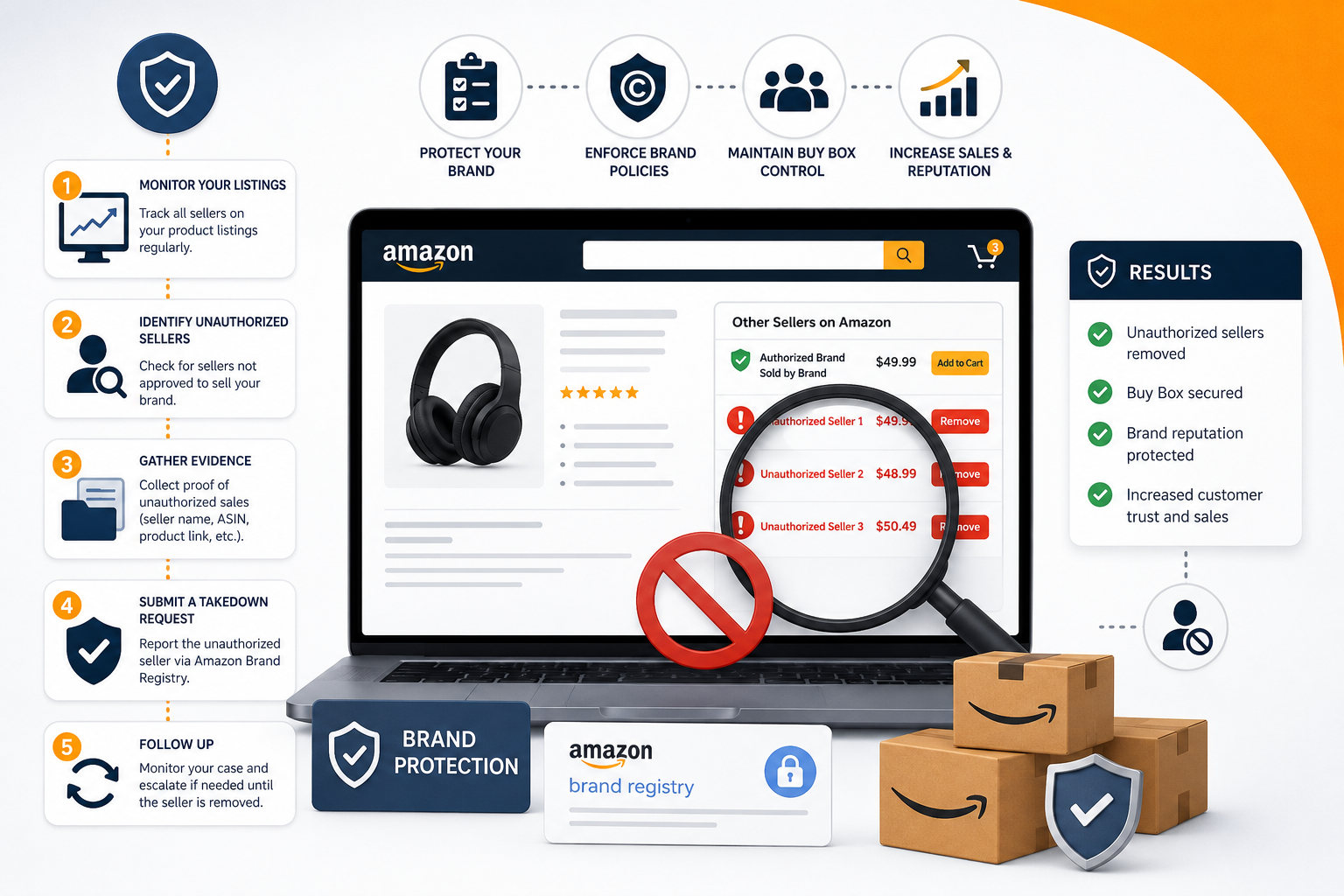
6. Failing to Control Unauthorized Resellers

The Mistake: Even if your listings are compliant, unauthorized resellers can hijack them with lower-quality images or incorrect information. This damages your brand and leads to poor customer experiences.

The Fix: Enroll in Amazon Brand Registry. Use programs like Transparency to serialize products and leverage Report a Violation tools to remove unauthorized sellers.


7. Overlooking Country-Specific Regulations

The Mistake: What’s compliant in the U.S. may not be in Europe or Canada. For example, chemical labeling requirements (CLP) differ in the EU.

The Fix: Before expanding internationally, review Amazon’s compliance guidelines for each marketplace. Ensure your packaging, labeling, and descriptions match local laws.


8. Ignoring Packaging and Prep Requirements

The Mistake: Brands send inventory into FBA without following prep standards — such as polybagging, suffocation warnings, or expiration date labels. This leads to stranded inventory and chargebacks.

The Fix: Always review Amazon’s FBA Prep and Packaging Requirements. Train warehouse teams or work with a 3PL that specializes in Amazon compliance.


9. Failing to Manage Customer Claims Properly

The Mistake: Negative reviews mentioning “expired,” “fake,” or “unsafe” products can escalate into compliance investigations. Ignoring them risks listing suspension.

The Fix: Monitor reviews and feedback daily. If a claim arises, open a proactive case with Seller Support to provide documentation proving compliance (COAs, invoices, GS1 certificates). Show Amazon you take safety seriously.


10. Not Keeping Documentation on File

The Mistake: Many brands assume Amazon won’t ask for compliance documents until there’s a problem. When requested, they scramble — and often fail to provide proof in time.


The Fix:
Maintain a compliance binder with digital copies of:

• Certificates of Analysis (COAs)
• Safety Data Sheets (SDS)
• GS1 certificates
• Trademark and brand registry documentation
• Lab test results (where applicable)

Being able to submit these within 24 hours can mean the difference between a listing reinstated or permanently removed.


Final Thoughts

Compliance isn’t optional on Amazon — it’s the baseline for survival. The marketplace is only getting stricter as it grows, and enforcement is faster than ever. Brands that treat compliance as an afterthought often find themselves locked out of their own revenue streams.

The good news? Every mistake above is fixable with a proactive system. By maintaining clean data, following style guides, monitoring resellers, and keeping documentation ready, you can avoid the most common pitfalls.

In a world where Amazon’s algorithms and compliance policies evolve constantly, the safest brands are those that treat compliance as part of their daily operations — not a one-time checklist.


�55357;�56393; Want to safeguard your brand’s Amazon growth?
We’ll audit your listings for hidden compliance risks, streamline your backend data, and build a system that protects your revenue while keeping you competitive.

�55357;�56393;
Book Your Free Strategy Call with CMO Now

Smiling bearded man in a light gray shirt against a plain gray background


William Fikhman is the founder of Chief Marketplace Officer (CMO), a fractional Amazon executive agency based in Los Angeles, California. He began selling on Amazon in 2009, scaling to $5M in year one and $20M+ within two years. Over 16 years, William has managed Amazon operations for more than 100 consumer brands, overseeing $300M+ in marketplace revenue across Seller Central and Vendor Central. He founded CMO to give consumer brands access to senior-level Amazon leadership on a fractional basis — without the cost of a full-time hire or the limitations of a traditional agency. William specializes in brand protection, distribution control, Amazon PPC strategy, and marketplace operations.
Connect on LinkedIn | Book a consultation


Recent Posts

By William Fikhman June 10, 2026
Amazon's ranking systems evolved beyond keyword matching. Here is what changed, what behavioral signals now drive visibility, and how modern Amazon SEO works.
th:first-child, td:first-child
By William Fikhman June 2, 2026
Amazon backend keywords are the hidden search terms that expand your indexation. Here is the 250-byte limit, what to include, what to exclude, and how to fill it correctly.
Stylized Amazon logo with rockets, charts, and glowing arrows on a blue tech background
By William Fikhman May 25, 2026
Learn the Amazon product launch strategy that works in 2026. Improve conversion, reviews, PPC performance, and scale profitably.
E-commerce workflow illustration with product screens, shopping cart, and package delivery icons on a blue background
By William Fikhman May 25, 2026
Learn why Amazon image stacks drive higher conversions than keywords and how optimized product images improve clicks, trust, rankings, and sales.
Global logistics scene with drones, trucks, workers, and a rising blue arrow around a globe
By William Fikhman May 20, 2026
Discover how Amazon Supply Chain Services (ASCS) helps businesses scale faster with advanced logistics, fulfillment, and delivery solutions.
Upward growth chart with people climbing a rising arrow toward a rocket launch, symbolizing success
By William Fikhman May 18, 2026
Here’s a **160-character SEO meta description**: Data-driven Amazon listing optimization in 2026 helps sellers improve rankings, boost conversions, and outperform competitors using advanced tools and strategy.
Image Showing  pu
By William Fikhman May 6, 2026
Unlock Amazon Subscribe & Save in 2026: turn one-time buyers into recurring revenue, boost retention, and grow predictable sales for CPG and consumable brands.
Boxes Showing Amazon Vine vs. Early Reviewer Program
By William Fikhman May 6, 2026
Amazon Vine vs Early Reviewer Program: see which builds social proof faster in 2026 and how Vine drives reviews, rankings, and conversions.
Amazon Advertising logo on dark gray background with orange curved arrows around the text
By William Fikhman April 7, 2026
An Amazon growth agency manages the operational, advertising, and compliance systems that break when founders try to scale alone. Here is what that actually means.
Amazon Rufus logo with a smiling yellow dog on a blue background
By William Fikhman April 7, 2026
In the 2026 Amazon marketplace, product discovery has shifted from traditional keyword search to AI-powered conversations and visual inputs. As the CEO of an Amazon services agency, I’ve seen brand owners struggle as shoppers increasingly rely on Rufus to ask natural questions, upload photos, or get instant recommendations. We are no longer only competing against other listings; we are competing against Amazon’s multimodal AI that “sees” your images, understands context, and decides whether your product deserves to surface.  This is the Rufus-Ready Image Blueprint: Your visuals must now serve dual purposes — instantly convincing human shoppers while providing clear, machine-readable signals that help Rufus confidently match your product to buyer intent. If your images fail to deliver both, even strong keywords and PPC won’t save the listing. The New Discovery Reality: AI That Sees and Understands By 2026, Rufus has become a dominant force in how shoppers explore Amazon. It handles conversational queries, processes uploaded photos via visual search, identifies materials, styles, proportions, and real-world use cases, then surfaces relevant products or alternatives. When a shopper interacts with Rufus — whether typing “show me a blender that crushes ice easily” or uploading a kitchen photo — the AI scans your product images using computer vision and OCR. Your visuals are no longer just decorative; they are data sources that either strengthen or weaken Rufus’s confidence in recommending your item. To succeed in this environment, brand owners must ensure their image stack meets these core requirements: High-Resolution Clarity: Minimum 1000 pixels on the longest side (ideally 2000x2000+), with sharp focus that enables zoom and detailed inspection. Rufus extracts features like texture, dimensions, and functionality from clear images. Contextual Storytelling: Show the product in authentic lifestyle scenarios tied to buyer needs rather than sterile white-background shots alone. This helps Rufus map your item to specific use cases and emotional triggers. Fast and Mobile-Optimized: Compress images properly for quick loading on mobile devices while preserving quality, since most Rufus interactions happen on phones. Many brand owners we work with discover that weak visuals cause Rufus to overlook their products even when text matches the query. Building Trust Through AI-Friendly Visual Storytelling In an era flooded with AI-generated content, authenticity combined with strategic visuals creates your strongest competitive moat. Shoppers and Rufus alike make rapid judgments. Generic or low-effort images signal unreliability, causing quick bounces and poor algorithmic signals. To multiply trust and feed Rufus meaningful data, we recommend structuring your full image stack (up to seven main images plus A+ modules) with intention: Detail-Oriented Shots: Include multiple angles, close-ups of key features (e.g., materials, mechanisms, size comparisons), and infographics that visually call out specifications. Add descriptive alt text in A+ Content such as “Woman using high-speed blender with tamper to crush ice for green smoothie” to give Rufus extra context. Lifestyle Integration: Demonstrate real-world application across different scenarios relevant to your audience. For example, show the product solving specific problems or fitting into daily routines. This builds emotional connection for humans and contextual understanding for AI. Consistent Brand Identity: Maintain uniform lighting, color palette, composition, and style across all images. Inconsistency confuses both shoppers and Rufus when it tries to build a coherent product narrative. Our agency audits and redesigns image stacks for clients, often resulting in higher click-through rates, longer dwell time, and improved Rufus-driven visibility. Optimizing Visuals to Strengthen Algorithm Signals Amazon’s underlying A9/A10 system, enhanced by multimodal AI like Rufus and COSMO, now weighs image quality and relevance alongside text. Strong visuals reinforce claims, improve conversion rates, and send positive performance signals back to the algorithm. Here are actionable steps we implement for brand owners: Leverage A+ Content Fully: Use rich modules with comparison charts, infographics, short videos, and interactive elements (where available via Brand Registry). Well-executed A+ Content can lift conversions by 10-20% or more while giving Rufus additional data points about benefits and differentiators. Feature Visualization: Overlay clear, benefit-focused text on images (e.g., “Fits most 15-inch laptops” or “Waterproof up to 1 meter”) instead of generic labels. This helps both human scanning and AI parsing. Friction Reduction: Answer common objections visually before shoppers ask — size references, usage outcomes, material close-ups. This lowers cart abandonment and improves overall listing performance metrics that influence ranking. Avoiding the 2026 Visual Optimization Pitfalls Even solid PPC or keyword strategies can be undermined by visual mistakes that hurt both human conversion and AI understanding. In today’s environment, these issues are especially expensive: Overly Busy or Cluttered Images: Too much text, logos, or competing elements overwhelm mobile viewers and confuse computer vision systems. Keep compositions clean and focused on one primary message per image. Edge and Cropping Problems: Important details placed near frame borders often get cut off on different device ratios. Design with generous safe zones. Lack of Differentiation: If images blend in with category competitors, Rufus and shoppers treat your product as a commodity. Use unique lifestyle contexts and clear USPs to stand out without exaggeration. Ignoring Alt Text and Metadata: Failing to add descriptive, context-rich alt text in A+ modules misses an easy opportunity to feed Rufus better signals. We run regular competitive visual audits to help brands sidestep these traps and turn average listings into high-performing assets. Conclusion: Visuals Are Now Core to Discovery and Conversion As we advance through 2026, the boundary between search optimization, visual content, and AI-driven discovery has largely disappeared. Your images function as critical inputs for Rufus, the broader algorithm, and human buyers alike. A well-crafted visual blueprint ensures your brand isn’t merely discovered — it’s confidently recommended and chosen. Mastering Rufus-ready visuals delivers compounding benefits: higher organic visibility, better ad performance, stronger conversions, and reduced reliance on paid traffic over time.
Show More