Amazon Project Zero: The Brand Protection Tool Most Sellers Miss
Amazon Project Zero brand protection
exists because Report a Violation was too slow. File a complaint, wait 24 to 72 hours, and hope Amazon's review team agrees with you. Meanwhile, the counterfeit listing is live, buyers are purchasing fake products, and one-star reviews are landing on your ASIN. For brands dealing with organized counterfeiting operations, that timeline is not a minor inconvenience. It is a week of compound damage per incident, multiplied across every listing the counterfeiter targets simultaneously.
Project Zero hands the removal decision to the brand owner. File correctly, and the listing comes down immediately. File incorrectly too many times, and Amazon pulls your access. That accountability structure is the whole reason the program works. Without it, every brand owner on Amazon would use self-service removal to target competitors. With it, only brands that are confident in their complaints actually use the tool aggressively.
How Project Zero's Three Components Actually Work
The Automated Scanning Layer
Amazon's machine learning system runs continuously across the catalog without any input from your team. It is looking for specific patterns: trademark misuse in listing content, imagery that resembles your authenticated brand assets, pricing behavior that fits counterfeit economics, seller account profiles associated with previous enforcement actions.
When it finds a match, the listing comes down before a buyer purchases anything. No action required from you.
Where it falls short: novel threats. A counterfeit operation that has not been flagged before, using slightly modified product names and new seller accounts, looks clean to a model trained on previous violations. The ML scanning catches the high-volume, low-sophistication operations that run the same playbook repeatedly. Sophisticated counterfeiters who change their approach get through.
Important:
Amazon Project Zero brand protection does not detect new counterfeits automatically when tactics change. It removes what has already been identified as a pattern. Active monitoring from your team is what catches the rest.
The Self-Service Counterfeit Removal Tool
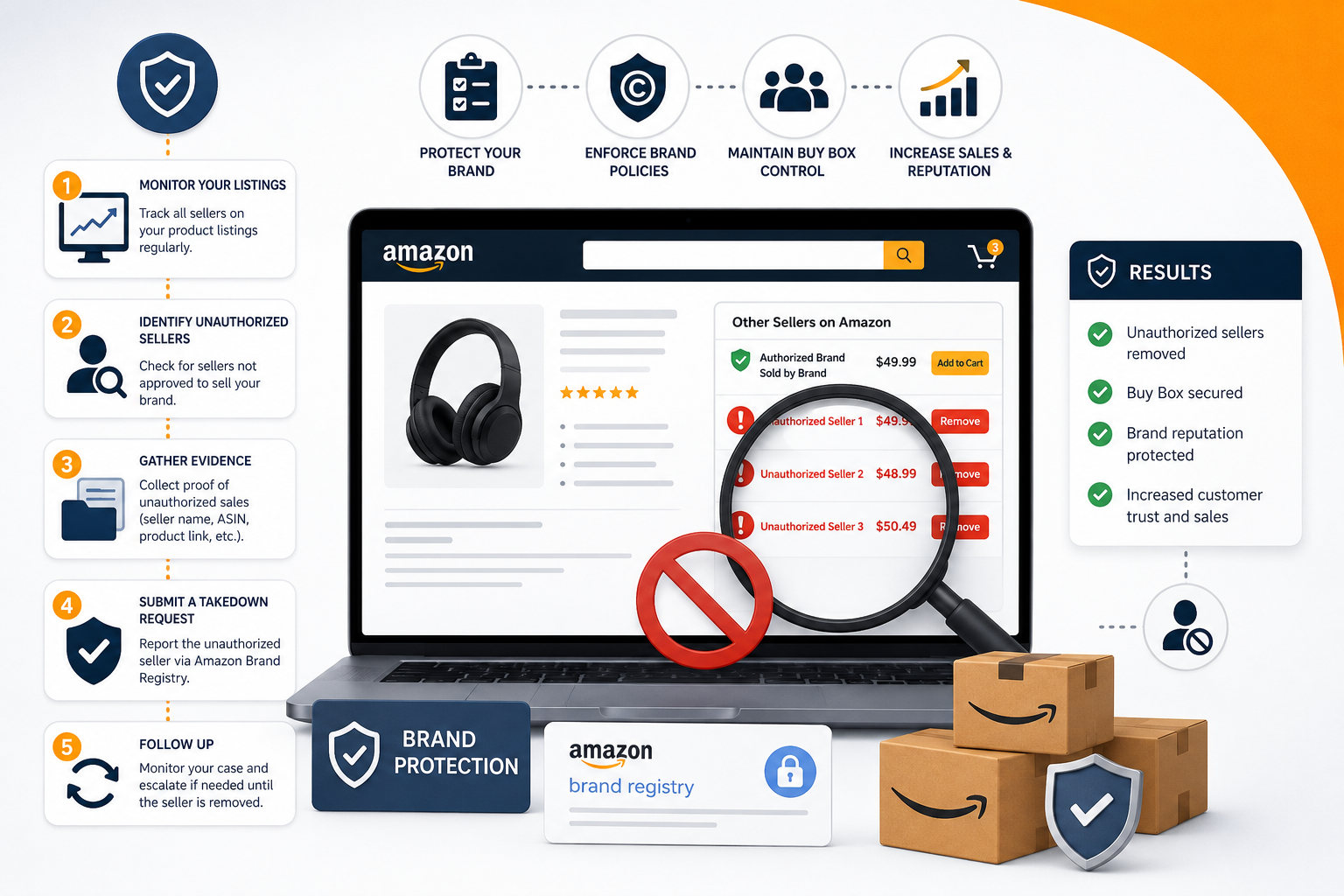
This is what most brands actually enroll for. Through the Project Zero dashboard, you search for a counterfeit listing, select the offer, and remove it. No complaint form. No waiting. The listing is gone.
You do not submit documentation at the time of removal. Amazon checks your accuracy retroactively. Every removal gets scored against what Amazon determines the listing actually was. A brand that removes real counterfeit listings consistently keeps full access. A brand that starts removing legitimate resellers or authorized distributors loses the privilege and faces further consequences.
Real scenario:
A skincare brand enrolled in Amazon Project Zero brand protection identified a counterfeit offer on their bestselling ASIN on a Monday morning. The listing had been live since the previous Friday. It had generated six sales and three one-star reviews before the brand's monitoring flagged it. Using the self-service removal tool, the listing came down in under ten minutes. A Report a Violation complaint filed on a comparable listing two months earlier had taken 61 hours to resolve. The three reviews stayed on the listing regardless of which tool was used. The speed difference did not undo the review damage already done, but it stopped it from compounding further.
Product Serialization
This is where Amazon Project Zero brand protection goes beyond removal and into prevention.
Enrolled brands generate batches of unique codes through Amazon's system. Each code gets applied to an individual product unit before it enters Amazon's supply chain. At the fulfillment center, Amazon scans the code during inbound. Units with valid codes are accepted. Units without them cannot be picked, packed, or shipped.
A counterfeit product that looks identical to yours down to the packaging cannot fulfill through FBA without one of your brand's codes.
The cost is around $0.05 per unit for code generation, on top of normal FBA fees. A brand moving 10,000 units monthly is looking at $500. For brands that have dealt with counterfeit reviews destroying their rating on a flagship ASIN, $500 is not a difficult number. For a brand that has never seen a counterfeit listing, it requires more thought.
The operational adjustment is real. Your prep workflow needs to incorporate code application before every inbound shipment. If you forget to apply codes to your own units, they get flagged alongside the counterfeits. Plan for the first month to require closer supervision than the ongoing steady state.
Real scenario:
A supplement brand enabled serialization after discovering that a counterfeit version of their flagship protein product had been reaching buyers through FBA for at least three months. The counterfeit units had been commingled with their own inventory during inbound and were indistinguishable at the listing level.
After enabling serialization and applying codes to every unit before shipment, the next inbound audit flagged 47 units from an unauthorized source. Those 47 units were rejected at the fulfillment center and never shipped. Without serialization, some of those units would have reached buyers.
That discovery also prompted an internal audit of their prep facility that uncovered how the unauthorized inventory was entering the chain in the first place.
Project Zero vs. Transparency vs. Standard Brand Registry: What Each One Actually Does
| Feature
|
Brand Registry
|
Project Zero
|
Transparency
|
| Who can access it
|
All brand-registered sellers
|
Application and approval required
|
Enrollment required
|
| Report a Violation
|
Yes
|
Yes
|
Yes
|
| Automated counterfeit scanning
|
Basic
|
Enhanced ML
|
Not applicable
|
| Self-service listing removal
|
No
|
Yes
|
No
|
| Product serialization
|
No
|
Optional
|
Mandatory
|
| FBA block on uncoded units
|
No
|
Only if serialization is enabled
|
Yes
|
| Buyer-facing authenticity scan
|
No
|
No
|
Yes, via the Amazon app
|
| Per-unit cost
|
No
|
Serialization only, optional
|
Yes per unit
|
Brand Registry is the foundation every brand-registered seller has.
Project Zero adds faster removal and optional physical blocking for brands dealing with active counterfeit listings.
Transparency goes further. Mandatory serialization, consumer-facing code scanning so buyers can verify authenticity themselves, and fulfillment-level blocking as a standard feature rather than an option. It costs more, requires more operational integration, and is designed for brands where the counterfeit problem has reached the point where buyers are actually receiving fake products and noticing.
Most brands dealing with occasional counterfeit listings should evaluate Amazon Project Zero brand protection first. Brands in high-counterfeit categories where buyers have received fake products and complained about it should evaluate Transparency.
Who Qualifies for Amazon Project Zero and What Gets Applications Rejected
Not every Brand Registry seller gets approved automatically.
Amazon reviews your IP complaint accuracy history before granting self-service removal access. Brands that have previously filed complaints that were retracted, disputed, or determined to be inaccurate demonstrate exactly the judgment problem Amazon needs to screen out. If your complaint history is clean, approval is straightforward.
Trademark coverage matters for the serialization component. Enabling serialization in a specific marketplace requires an active trademark registration in that territory.
Brands that are relatively new to Amazon and have not yet built an IP complaint history may lack enough data for Amazon to evaluate. Filing legitimate complaints through the standard Report a Violation process first, building a clean accuracy record, then applying for Amazon Project Zero brand protection is the right sequence.
How to Enroll in Amazon Project Zero: Step by Step
Step 1:
Log into Seller Central and open Brand Registry. Navigate to the brand protection section and look for the Project Zero application option. If you do not see it, your account may not yet meet the eligibility threshold Amazon requires.
Step 2:
Review your IP complaint history before applying. Amazon evaluates accuracy before granting self-service removal access. If you have complaints that were retracted or disputed, address those gaps first.
Step 3:
Submit the application. Amazon reviews it and typically responds within a few business days. If declined, the response will cite a specific reason. Fix that issue and reapply.
Step 4
:
Once approved, access the Project Zero dashboard inside Brand Registry. Set up your brand profile, connect your trademark registrations, and configure alert preferences.
Step 5
:
If enabling serialization, generate your first code batch, integrate code application into your inbound prep workflow, and run a test shipment before scaling to your full catalog.
How to Remove a Counterfeit Listing Through Project Zero
Step 1
:
Open the Project Zero dashboard and use the search tool to find the infringing listing by ASIN, brand name, or keyword.
Step 2:
Identify the specific seller offer that is counterfeit. Check the seller name, storefront history, and pricing against your known authorized seller list.
Step 3:
Select the offer and initiate removal. Amazon processes it immediately without a review queue.
Step 4:
Document every removal you file. Keep a log of the ASIN, the seller's name, the date, and your reason for classifying it as counterfeit. If Amazon ever audits your removal accuracy, this log is your evidence of good-faith enforcement.
Step 5
:
Monitor the ASIN over the following week. Sophisticated counterfeiters often return under a new storefront. A single removal rarely ends the problem permanently.
Is Amazon Project Zero Brand Protection Right for Your Business?
Enroll if:
counterfeit listings have appeared on your ASINs in the past 12 months, reviews or account health flags have been generated by buyers receiving non-authentic product, or you operate in a category where counterfeiting is documented and common.
Enable serialization if:
a counterfeit product is physically entering Amazon's fulfillment network and reaching buyers. Serialization solves the physical supply chain problem. It does not add much value if the counterfeit listings you face are never actually selling product before you remove them.
Hold off if:
your brand is new, you have never experienced a counterfeit listing, and your category does not have a documented counterfeiting pattern. The standard Brand Registry Report a Violation tool handles your current risk level, and Amazon Project Zero brand protection is something to revisit as you scale.
One thing that does not change regardless of where you land: Project Zero is a removal tool, not a detection tool. It does not alert you when a new counterfeit offer appears. Someone has to find it first. That detection requires active monitoring: Buy Box win rate checks, listing alerts through Brand Registry or third-party tools, review pattern tracking that flags suspicious activity before it compounds.
Our Amazon brand protection services
run that detection layer alongside Project Zero for brands that need both. Finding the counterfeit is one problem. Removing it quickly is another. The two require different processes running simultaneously.
The Serialization Workflow in Practice
Amazon generates a batch of unique codes tied to your brand account. You download the batch, then apply the codes to individual product units before they enter the supply chain. Application typically happens through printed labels applied at the manufacturing level, warehouse level, or during FBA prep.
When a shipment arrives at an Amazon fulfillment center, the inbound scanning process reads each unit's code against your brand's code database. Valid codes pass through to storage. Units without a valid code are flagged as ineligible for fulfillment and cannot be picked or shipped.
Your own units get flagged if they arrive without codes. Build code application into your inbound prep checklist as a non-negotiable step before every shipment. The first few weeks typically surface at least one shipment where codes were applied inconsistently. After the workflow adjustment period, it runs cleanly.
Final Thoughts
Amazon Project Zero brand protection does what its name implies: it pushes counterfeit activity toward zero through automated scanning, brand-owned removal, and physical serialization barriers. None of those three components does the job alone. The automated scanning catches volume attacks but misses sophisticated operations. The self-service removal tool resolves listings quickly but requires human detection first. Serialization blocks fulfillment but requires operational integration on your end.
Used together and combined with active monitoring that surfaces counterfeit activity before it damages reviews and account health, Project Zero is the closest thing to a complete counterfeit defense available to Amazon brand owners today.
Counterfeit listings that keep returning after removal, account health flags from IP complaints you did not generate, or a category where you know counterfeiting is active are all situations where the current process is not working.
Book a consultation with our team
to find out where your brand protection setup needs work.
What Brand Owners Ask Before Enrolling in Amazon Project Zero
What is Amazon Project Zero?
It is a brand protection program giving enrolled sellers automated ML counterfeit scanning, a self-service removal interface for instant counterfeit takedowns, and optional product serialization that blocks uncoded units at Amazon's fulfillment centers.
How do I enroll in Amazon Project Zero?
Apply through Brand Registry under brand protection. Amazon reviews your IP complaint accuracy history and Brand Registry standing. A clean complaint record is the key approval factor. Brands with limited complaint history should build that record through standard Report a Violation filings before applying.
What is the difference between Project Zero and Amazon Transparency?
Project Zero adds faster removal and optional serialization to your Brand Registry toolkit. Transparency makes serialization mandatory and adds a consumer-facing authenticity scan so buyers can verify their product is genuine at the point of receipt. Project Zero is the right starting point for most brands. Transparency is the more comprehensive option for high-counterfeit-risk categories.
Does Project Zero require product serialization?
No. Serialization is optional. You can enroll in the automated scanning and self-service removal tool without it. Add serialization when counterfeit products are physically reaching buyers through FBA, not just when counterfeit listings are appearing that you can remove before a sale.