Your Amazon Listing Just Got an IP Complaint — Here Is What to Do About It
Amazon's IP complaint system
has one serious design flaw: anyone with a trademark registration number can file a complaint against your listing, your listing comes down immediately, and you have to prove innocence rather than Amazon proving guilt. The system is built to protect brand owners, which is correct. The side effect is that it gets abused, filed in error, and weaponized by competitors more often than most sellers realize until it happens to them.
When a complaint lands, sellers make one of two mistakes. They panic and do nothing, hoping it disappears. Or they fire off a vague counter-notice with no supporting documentation and wonder why Amazon rejected it. Both responses let the complaint age into account history, and aged, unresolved IP complaints are one of the cleaner predictors of an account suspension review showing up.
Here is what actually works.
The Four Complaint Types and Why Each One Needs a Different Response
Not every Amazon IP violation works the same way. Filing the wrong response to the wrong complaint type wastes time and can actively weaken your position.
Trademark complaints
are the most common and the most frequently wrong. A brand owner sees their product name on your listing, clicks file, and Amazon pulls the ASIN. The complainant does not have to prove you did anything wrong. If you are an authorized reseller with a legitimate distributor invoice, a direct retraction from the brand owner is faster than Amazon's internal process and cleaner for your account history.
Copyright complaints
usually involve listing images. Someone finds their product photography on your detail page, files a copyright claim, and your listing goes dark. The fix is either confirming you have a license for the images, swapping them out for images you own, or providing evidence that the content is not actually protectable.
Patent complaints
are the ones that require a lawyer before you touch the response process. The complaint has to reference a specific patent number, and defending against it means someone has to read the patent claims and technically evaluate whether your product actually embodies them. Filing a counter-notice without that analysis can constitute an admission that creates liability downstream.
Counterfeit complaints
move the fastest and do the most damage. Amazon treats a counterfeit flag as a trust signal, not just a performance metric. A single well-documented counterfeit complaint from a legitimate brand can pull your listing and trigger an account review simultaneously. If the product is authentic and you have the invoices to prove it, those invoices need to be in your counter-notice within 24 hours, not 48.
What Shows Up in Account Health and What It Means for Your Risk Level
Every IP complaint sits in Seller Central under Account Health, in the section labeled "Received Intellectual Property Complaints." The complaint shows the type, the affected ASIN, the complainant's name, and the current status.
One complaint that gets resolved promptly does not move the needle much. Three complaints from three different complainants in a 60-day window, regardless of whether any of them has individual merit, create a pattern signal that Amazon reads as an account problem. Amazon does not evaluate each complaint as a standalone event. It evaluates the density and resolution rate together. Sellers who treat each complaint as a 48-hour action item almost never get to the point where the pattern becomes dangerous.
Defending Against a Complaint: The Process That Actually Gets Results
Step 1: Read the complaint before doing anything else
Check whether the complainant included a valid trademark registration number, copyright registration, or patent number. A complaint without a valid IP registration number is significantly weaker. It may have been filed by an automated brand protection tool that swept your listing without a human reviewing whether you are actually an authorized seller.
Step 2: Identify your documentation
If you are an authorized reseller, your distributor invoice is the most important document you have. If you are the brand owner and someone filed a false complaint against your own listing, your trademark registration certificate handles it. If neither applies, you are in a more complicated position that requires a harder look at what you are actually selling and where it came from.
Step 3: Contact the complainant directly
Amazon shows you the complainant's contact information inside the IP complaint notification. A direct email or call to the brand owner, explaining who you are and providing your invoice or authorization letter, results in a retraction more often than sellers expect. Brand protection tools that file automatically often have a review team that processes retraction requests within 24 to 48 hours when the documentation is clean. A retraction removes the complaint from your account record. An Amazon-internal resolution leaves a residue in your account history even after the complaint closes.
Step 4: File the counter-notice
Whether or not you contact the complainant, file your counter-notice through Seller Central with your supporting documentation attached. For trademark complaints, attach the distributor invoice and any authorization letter. For copyright complaints, attach your license or evidence of original creation. For counterfeit complaints, attach the supplier invoice with the brand name, product name, quantity, and supplier contact visible. Do not submit a counter-notice that says you believe the complaint is wrong without showing Amazon why. Assertions without documentation get rejected.
Step 5: Follow up at 72 hours
If the complaint has not been resolved or retracted within 72 hours of your counter-notice, follow up both with Amazon and with the complainant. An IP complaint that sits unresponded to after a week is already building account risk regardless of its merits.
One example from our practice: a pet supplement seller received an automated trademark complaint from a large brand's brand protection software. The seller was an authorized distributor with a current dealer agreement. They emailed the brand's IP team directly with the dealer agreement attached and received a retraction within 36 hours. Amazon's internal counter-notice review, running in parallel, had not yet produced a response.
When to Get a Lawyer Involved
Patent complaints: always. Before filing any response, before contacting the complainant, before doing anything other than reading the complaint carefully. Patent claims require technical evaluation of the patent specification against your specific product. Getting that wrong in a counter-notice creates problems that extend beyond Amazon.
Trademark complaints where the complainant is a large brand with an IP litigation history: legal review before the counter-notice is worth the cost. A poorly worded response to a sophisticated complainant can be used against you in proceedings that go beyond Seller Central.
Copyright complaints involving high-value creative assets: legal review if the alleged infringement involves substantial content or if the complainant is escalating outside Amazon's platform.
The cost of a brief legal consultation is almost always less than the cost of an extended listing suspension and far less than the cost of a botched response that creates downstream legal exposure.
Filing Against Sellers Infringing Your Brand
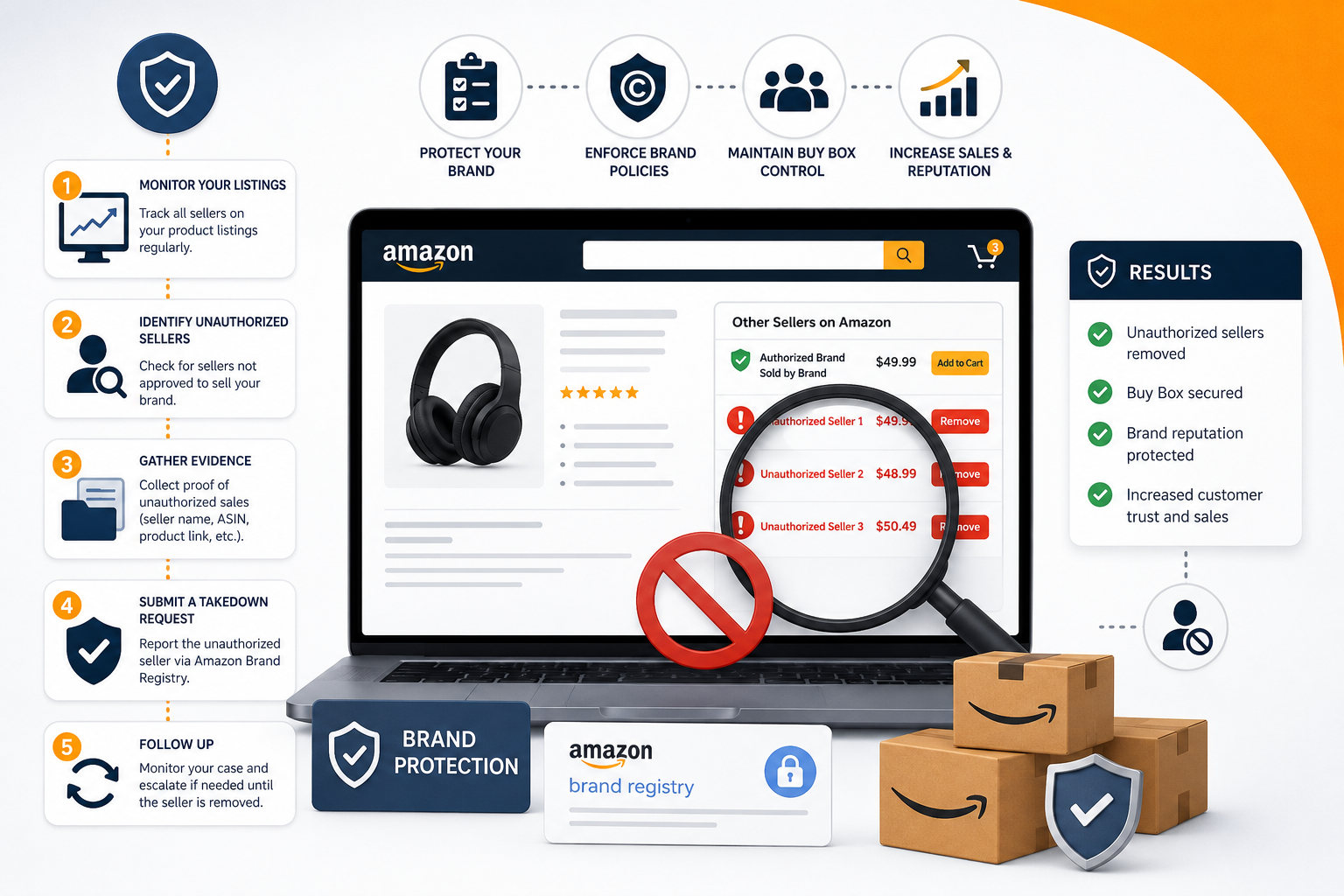
The same system that creates headaches when someone files against you is the tool you use when someone is counterfeiting your product or misusing your trademark. The difference is that when you file, you need to be right. Amazon takes filing accuracy seriously, and brands that file complaints that get retracted or found invalid lose credibility in the system that determines how their future complaints are handled.
Step 1:
Log in to Brand Registry and navigate to Protect, then Report a Violation.
Step 2:
Search for the infringing ASIN or listing by keyword or ASIN lookup.
Step 3:
Select the specific offer you are targeting.
Step 4:
Choose the correct violation type: trademark, copyright, or counterfeit.
Step 5:
Enter your trademark registration number, copyright registration, or patent number. Step 6:
Describe specifically how the listing infringes your registered rights. "This seller is selling counterfeit versions of our product" is not specific enough. "This seller's ASIN B0XXXXXXXX displays our registered trademark [trademark name, Reg. No. XXXXXXXX] on a product we did not manufacture or authorize for sale" is specific enough.
Step 7:
Submit and track status in your Brand Registry dashboard.
A complaint with a valid registration number and a specific infringement description typically receives a response within 24 to 72 hours. Vague complaints without registration numbers take longer and fail more often.
Project Zero Changes the Speed Calculation for Enrolled Brands
If your brand is enrolled in Amazon Project Zero, counterfeit removal works differently. Project Zero gives enrolled brands a self-service removal tool that bypasses Amazon's standard review queue. You identify the counterfeit offer, submit it through the Project Zero interface, and the listing comes down directly rather than waiting for Amazon's review team.
A home goods brand we work with had three counterfeit storefronts surface simultaneously during a peak sales week. Through Project Zero, they removed all three within two hours. The Report a Violation complaints they filed in parallel took four days to produce a response. In a category where counterfeits actively damage your review velocity and BSR, the speed difference matters directly to revenue.
Project Zero also includes a product serialization component that, combined with the Transparency program, blocks counterfeit units at Amazon's fulfillment centers before they reach buyers. That combination, Transparency serialization plus Project Zero enforcement, is the most complete counterfeit prevention stack available on the platform today.
Building that stack and running it as an ongoing operational process rather than a reactive fire-fighting exercise is exactly what Amazon brand protection
requires.
Escalating When the Dashboard Tools Are Not Enough
Some infringers are sophisticated. They operate multiple storefronts so that removing one offer does not stop the supply. They use slightly varied product names to avoid keyword-based detection. They source products through channels that make authorization documentation ambiguous.
For systematic infringement at scale, the platform tools are a starting point, not a solution. Test buys that produce physical counterfeit evidence give complaints significantly more weight than complaints based on listing review alone. Amazon's legal enforcement team handles cases where there is documented evidence of a coordinated counterfeiting operation. External legal action, including injunctions and damages, becomes the appropriate tool when a counterfeit operation survives repeated platform complaints.
The documentation trail built through consistent Report a Violation filings, test buy records, and complaint histories is what makes legal escalation viable when it becomes necessary. Brands that have been filing inconsistently have a much harder time presenting a compelling case to either Amazon's legal team or an external attorney than brands that have maintained clean, documented enforcement records.
Our Amazon brand protection
process builds that documentation trail as a standard operational discipline, not as an emergency response when the situation has already deteriorated.
Final Thoughts
The Amazon IP complaint system is fast, asymmetric, and does not require complainants to be right. That is a problem when a complaint is made against you. It is an advantage when you are the one filing. Understanding which side of the transaction you are on and what each side requires in terms of documentation, speed, and follow-through is what determines whether an IP complaint is a temporary inconvenience or a compounding account health problem.
If you have an active complaint on your listing, multiple unresolved flags in Account Health, or counterfeit listings that keep reappearing after removal, the next step is a conversation, not another solo attempt at the counter-notice.
Book a consultation with our team
to find out what your current brand protection process is missing.
The IP Violation Questions Amazon Sellers Ask When the Listing Goes Down
What happens if I get an IP complaint on Amazon?
Your listing comes down immediately, and the complaint appears in Account Health under Received Intellectual Property Complaints. One resolved complaint rarely causes lasting damage. Multiple unresolved complaints from different parties in a 60 to 90-day window create a pattern signal that Amazon treats as an account-level risk indicator independent of the individual complaint merits.
How do I dispute a false Amazon IP violation?
Contact the complainant directly with your distributor invoice or authorization documentation and request a retraction. File a counter-notice through Seller Central with the same documentation attached. A direct retraction from the complainant is faster than Amazon's internal review and removes the complaint from your account record more cleanly.
How long does Amazon take to resolve IP complaints?
Complaints with a valid registration number and specific infringement description typically receive a response within 24 to 72 hours. Complaints that go to Amazon's internal review process without a complainant retraction can take longer and leave a record in your account history even after resolution.
Will an IP violation suspend my account?
One promptly addressed complaint with clean documentation rarely triggers a suspension review. The suspension risk comes from a pattern: multiple complaints from different complainants within a short period, or complaints that sit unresolved for weeks, create the account health signal that Amazon treats as grounds for a suspension review regardless of whether any individual complaint has merit.
Add your custom HTML here